The Story
One of the oldest written accounts of this day is a short passage in the Agni Purana (chapter 192, verses 7 to 11). It says that on the fourteenth day of the bright fortnight one should worship Hari as Ananta, the endless one, using a figure made of darbha grass; offer cakes made from rice flour, giving half to a brahmin and eating half; hear stories of Hari near a river; and then tie a consecrated thread on one's own hand or neck with the prayer given above. The fuller story families read today, of Sushila and Kaundinya, is the Anant Vrat katha of the Bhavishya Purana (Uttara Parva, chapter 94), told there by Krishna to Yudhishthira.
Krishna Tells the Pandavas
In the Bhavishya Purana's telling, the Pandavas have lost their kingdom at dice and are living in the forest. Yudhishthira asks Krishna how they can be free of this suffering and get back what they lost. Krishna tells him to keep the vow of Ananta on the fourteenth day of the bright half of Bhadrapada.
Yudhishthira asks who Ananta is. Krishna answers that Ananta is not someone else. It is a name of the one Lord, endless in time and in form, the same one people call Vishnu, Hari and by many other names. Then he tells the story of a woman named Sushila, and families still read that story aloud at the puja every year. In the popular retelling, the Pandavas kept the vow and in time won back their kingdom.
Sushila and the Thread
A brahmin named Sumantu had a daughter, Sushila, from his first wife Diksha, a daughter of the sage Bhrigu. Diksha died young, and Sumantu married again. His second wife, Karkasha, was harsh and never warmed to Sushila. When Sushila grew up, Sumantu married her to the sage Kaundinya, but there was so little goodwill at home that the couple left with almost nothing.
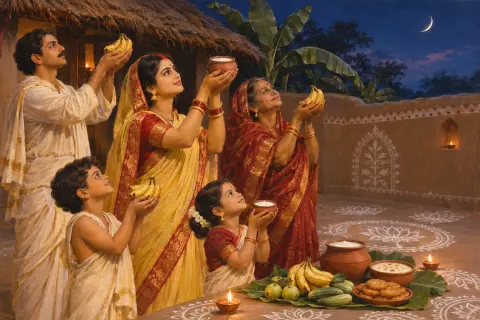
On the way to Kaundinya's home they stopped near a river. Sushila saw a group of women worshipping and asked what they were doing. They told her it was the vow of Ananta: a figure of Ananta made from darbha grass, worshipped with flowers, lamp and incense, an offering of food shared half with a brahmin, and a thread with fourteen knots, dyed with turmeric, tied on the arm. Sushila joined them, kept the vow with what little she had and tied the thread.
After that, life began to go well for the couple. Their home filled with plenty and people respected them. Retellings of what happened next differ in the details, but in the version most families tell, Kaundinya noticed the thread on his wife's arm one day and asked about it. When she told him it was the thread of Ananta, he grew angry. He said their good fortune came from his own effort, not from any thread, pulled it off and threw it into the fire. Sushila ran and saved what was left of it.
Kaundinya Searches for Ananta
From that day everything turned. Their wealth was lost, friends drifted away and the household fell into hardship. Kaundinya understood that he had insulted Ananta, and he left home to find him and ask forgiveness. He wandered through forests, half mad with regret, asking everything he met if it had seen Ananta: a tree, a cow, lakes, a donkey and others. None of them could answer.
At last he fell to the ground, ready to give up his life. Then an old brahmin came, lifted him up and led him to a shining home, where he showed himself in his true form: Vishnu, the Lord, with Ananta. The Lord explained that each thing Kaundinya had met on the road was a soul paying for some past fault, such as a learned man who had never shared what he knew.
Kaundinya bowed and asked to be forgiven. The Lord forgave him and asked him to keep the vow of Ananta for fourteen years. Kaundinya went home, kept the vow with Sushila, and their life was made whole again. This is why the anant thread is tied with care and never thrown away carelessly.
The Anant Puja in Bihar and Uttar Pradesh
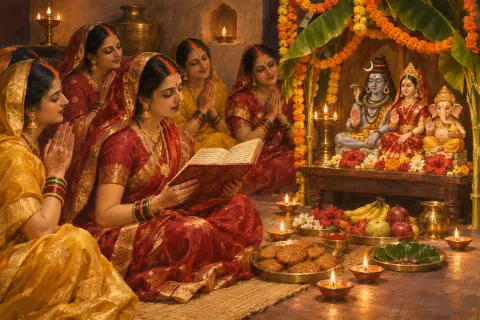
In Bihar, Jharkhand and eastern Uttar Pradesh, Anant Puja is one of the big vrats of the year, kept by men and women alike. Many families do the puja together at home, or gather at a temple or on a riverbank. Fourteen small marks of sindoor or kumkum are drawn on a wooden plank, often with fourteen puris and fourteen puas placed on them. A bowl of panchamrita (milk, curd, ghee, honey and sugar) stands for the ocean of milk.
The new anant, a cotton or silk thread with fourteen knots, dyed yellow and red, is wrapped on a cucumber and stirred through the panchamrita, as if churning the ocean of milk. In many homes the one stirring is asked aloud, "What are you looking for?" and answers, "Anant Bhagwan." "Did you find him?" "Yes, I found him." This little dialogue is a folk custom, not scripture, and children love it.
Then the katha of Sushila and Kaundinya is read, and the thread is tied: men usually on the right upper arm, women on the left. Many keep a fast, eat once in the day, and in many homes the food is cooked without salt. The thread is worn for some days, often fourteen, and then put into a river or pond with respect.
Ganesh Visarjan and the Jain Anant Chaudas
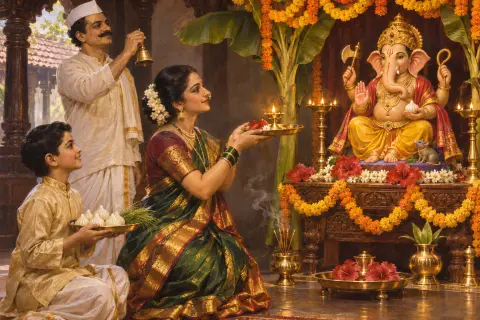
In Maharashtra the same day is best known as the last day of the Ganesh festival. The Ganesh idols brought home and into public pandals on Ganesh Chaturthi are carried in procession to the sea, rivers and lakes and immersed, with drums, dancing and the cry "Ganpati Bappa Morya, pudhchya varshi lavkar ya" (come back soon next year). Mumbai and Pune hold processions that go on through the night.
For Digambar Jains, Anant Chaudas is the last day of the ten-day Das Lakshan Parva, a festival of fasting and reflection on ten virtues such as forgiveness and humility. The day after it, Jains observe Kshamavani, when they ask one another for forgiveness for any hurt they have caused.
In Gita 11.37 Arjuna, having seen the Lord's endless form, asks why anyone would not bow to him: "O Ananta, Lord of the gods, home of the universe." Kaundinya learned that the hard way. His good fortune was not only his own doing, and pride cost him everything until he bowed. The thread on the arm is a small daily reminder: we are held by something without end, and gratitude is the right answer to it.