The Story
Bathukamma has no story in the Sanskrit Puranas. Its oldest and truest source is the body of Telugu folk songs that women of Telangana have sung and passed down to their daughters for generations, songs that name the goddess Gauri, tell how Bathukamma got her name, and carry news of village life. The festival honours Gauri, also called Maha Gauri or Gauramma, as the mother who gives life. Its name is usually explained as "come alive, mother" (bathuku means to live, amma means mother). After Telangana became a state, its government declared Bathukamma the state festival in 2014. People keep it to thank the goddess for the monsoon's flowers and harvest, and to pray for the health and long life of their families.
The flower tower
Everything starts with flowers. In the days before the festival, men and boys go out to the fields, ponds and roadsides to gather what grows wild after the rains. The most loved are tangedu, the golden yellow flowers of the tanner's cassia (Telangana's state flower), and gunugu, the feathery celosia whose white plumes are often dyed pink, green or purple. Marigolds, chrysanthemums, lotus, pumpkin flowers and many others join them.
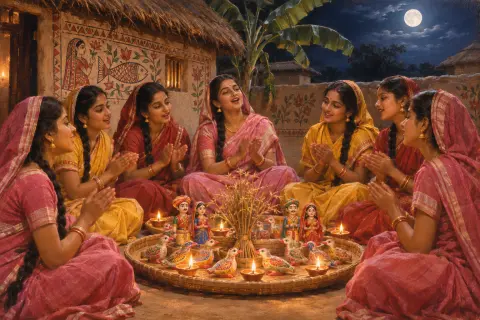
Women and girls then build the Bathukamma. On a round brass plate (a tambalam) they lay a base of leaves and arrange the flowers in neat circles, one ring on top of the next, each a little smaller, until it rises into a cone. Colours are planned ring by ring. Some are small enough for a child to carry; family and community Bathukammas can be taller than a person.
On top sits Gauramma, the goddess herself, shaped by hand from turmeric paste into a small cone. A Bathukamma is not just decoration. It is a temple made of flowers, with the goddess at its peak.
How Bathukamma got her name
The songs give more than one story, and families tell different ones. They are folk tradition, not scripture, and none of them is the single correct account.
The best known says a Chola king named Dharmangada and his queen Satyavati lost their many sons in war. In grief they prayed to the goddess Lakshmi, and she was born to them as a daughter. Sages came to bless the child and said "Bathuku, amma", live long, mother, and so she was called Bathukamma. Other songs say that after the goddess Gauri killed the demon Mahishasura she fell into a deep sleep of exhaustion, and the women gathered around her singing to wake her, calling "Bathuku, amma". Still others remember a girl from a village family who died young, and whom the women brought back to life in song as the goddess.
The stories differ, but they share one wish: that life should go on. Mothers sing it for daughters, daughters for their own families, and the whole village for its fields and water.
Nine evenings, nine offerings
Each of the nine days has its own name, usually after the simple food offered to the goddess that evening. It begins with Engili Pula Bathukamma on Mahalaya Amavasya. Engili means something already touched or tasted; a common explanation is that the flowers for this first day are gathered the day before. The days that follow are named after offerings such as atukulu (flattened rice), muddapappu (soft cooked lentils), nanabiyyam (soaked rice) and atlu (pancakes).
The sixth day, Aligina (or Alaka) Bathukamma, is different: no Bathukamma is played and no food is offered. Folk tradition says the goddess is upset that day, and people let her rest. Then come Vepakayala Bathukamma, named for small fried sweets shaped like neem fruits, and Vennamuddala Bathukamma, with offerings of butter, sesame and jaggery.
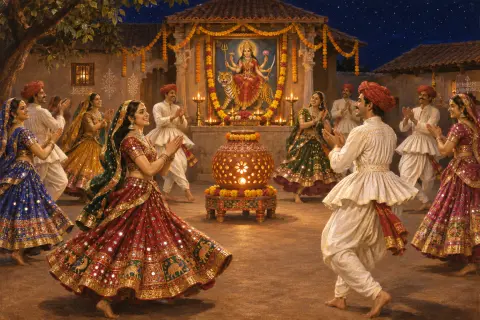
Every evening the women dress in their best silk saris (Pochampally ikat and Gadwal silks are favourites), carry their Bathukammas to an open place in the village or colony, set them in the middle, and walk around them in a circle, clapping in rhythm and singing. One woman sings a line and the others answer, often with the refrain "Bathukamma Bathukamma uyyalo". The songs move from the goddess to family stories, local history, sorrow and teasing. Many married women return to their parents' homes to play Bathukamma with the friends they grew up with.
Saddula Bathukamma: giving the flowers back
The ninth day, Saddula Bathukamma, is the grandest. Families build their tallest towers, and women cook five or more kinds of saddulu, flavoured rice dishes such as tamarind, lemon, coconut, sesame and curd rice. It is a public holiday in Telangana.
In the evening the songs and circles go on for hours, and then everyone walks in procession to a lake, tank or river. With the farewell song, "Poyi raa Bathukamma", go and come again, Bathukamma, the women lower their flower towers gently onto the water and watch them float away. Afterwards they share malida, a sweet of crumbled roti, jaggery and ghee, along with the saddulu, and exchange turmeric and kumkum.
In Hyderabad the immersion draws huge crowds to Tank Bund on Hussain Sagar, where the state holds its main celebration, and in Warangal and Hanamkonda the festival is equally loved. After Saddula Bathukamma, Telangana moves straight on to Dasara, with its own customs of worshipping the jammi (shami) tree and hoping to see the palapitta, the Indian roller bird.
Why the festival matters
Bathukamma comes when the monsoon has filled the village tanks and the fields are green, just before the harvest. It turns the flowers of that season, many of them wild plants of field edges and ponds, into an offering, and then returns them to the water that grew them.
It is also, more than most festivals, a festival led by women. Women build the towers, lead the songs and keep the stories. During the Telangana statehood movement, Bathukamma songs and gatherings became a way to celebrate the region's own culture, which is part of why it was chosen as the state festival.
Nothing in a Bathukamma is grand or rare. It is wild flowers, turmeric, rice cooked at home, and songs everyone knows. In the Gita (5.10) Krishna says that one who acts while offering the work to Brahman, the divine, and lets go of attachment, is untouched by wrong, as water does not cling to a lotus leaf. Bathukamma shows what that looks like in ordinary life: the work of gathering, arranging and cooking becomes worship, the songs of daily joys and sorrows become prayer, and at the end the whole offering is let go into the water without holding on.