The Story
Sama Chakeva has no single old text that families read from. Mithila writers often say its story comes from the Puranas, and both the Skanda Purana and the Padma Purana are named, but no one has pointed to the passage in a standard edition of either, so it is best called what it plainly is: a Mithila tradition, kept for generations in Maithili songs and in the telling of mothers and grandmothers. The story is that Sama, a daughter of Krishna, was slandered by a tale-bearer named Chugla, turned into a bird by her angry father, and brought back by the love of her brother Samba. Sisters keep the festival to pray for their brothers, and to say something about gossip that everyone understands.
Sama, Krishna's Daughter
In the Mithila story, Sama (also called Shyama) is a daughter of Krishna in Dwaraka. She loved the forest. With her companions she would go to Vrindavan, to the quiet ashrams of the rishis, to sit with them, walk among the trees and watch the birds.
Her husband, in many tellings, is Charuvakya, whom the songs call Chakeva. In other tellings Chakeva is her brother. The tradition is not bothered by the difference. What matters in every version is that Sama was innocent, that someone spoke falsely about her, and that a brother refused to give up on her.
Chugla's Slander
Chugla was a man at court who could not keep a story to himself, and when he had no true story, he made one up. He saw Sama's visits to the forest and went to Krishna with a whisper: your daughter is meeting men in Vrindavan.
Krishna, the story says, believed it in his anger and cursed Sama to become a bird. She flew off to live in the forests of Vrindavan. In the tellings where Chakeva is her husband, he could not bear to be without her and took the form of a bird too, so that the two lived on as a pair, Sama and Chakeva.
This is why Chugla is the one figure in the festival that nobody pities. His name in Maithili simply means a tale-bearer, and for nine evenings girls sing songs that mock him, scold him and wish his mouth burned for the trouble it caused.
Samba Brings His Sister Home
Sama's brother Samba, Krishna's son by Jambavati, was away when this happened. When he came back and heard, he did not argue with his father's anger. He went away to pray. The story says his tapasya was long and hard, and that it moved Krishna to see the truth and soften the curse.
So Sama came back. In the way the festival tells it, she returns each Kartika for a few days, as a guest from far away, and then has to leave again. That is why the clay figures are made each year after Chhath and sent off at the full moon.
Many people in Mithila also notice that this is the season when migratory birds come down from the north to the ponds and wetlands of the plains, and they see Sama and Chakeva in the clay birds of every basket.
Clay Figures and Evening Songs
The festival begins with clay. Brothers often dig it, and sisters shape it: Sama and Chakeva as birds, Chugla with a moustache made of jute, Satbhaiya (a row of seven brothers), a little Vrindavan made of straw or grass stuck in clay, a drummer and a cymbal player, a flower seller, and more birds and animals. They are painted in white, red, yellow and black, often with dots, in the same colours as Mithila painting. In towns many families now buy them from potters' stalls.
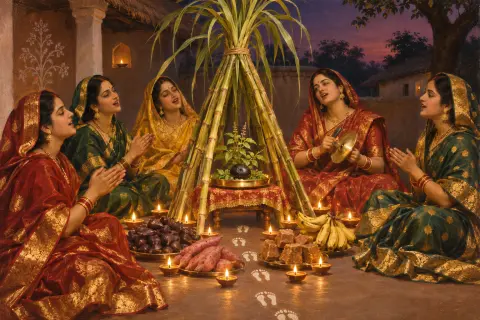
Every evening the girls carry the figures in a bamboo dala with a small lamp, to the courtyard, a village square, a field or the pond. They sit in a circle and sing. The songs have names like Sama khele chalali (Sama has gone out to play) and Tohe badka bhaiya ho (You, my elder brother), and they praise brothers, bless them and scold Chugla.
Two things are burned, in play, almost every night. The girls set the straw Vrindavan alight and sing that Vrindavan is on fire, then put it out. And they singe Chugla's jute moustache, to the loud satisfaction of everyone watching.
Kartik Purnima: Saying Goodbye to Sama
On the full moon night the mood changes. Married daughters often come back to their parents' homes for the festival, and on this last day sisters serve their brothers dahi and chura (beaten rice). The farewell songs sound like those sung when a daughter leaves home after her wedding.
Then the figures are taken out for the last time. Chugla is burned properly now. Sama, Chakeva and the others are set in a pond or a river, or left in the fields, and the girls sing that they hope Sama will come back next year.
In Nepal's Madhesh, from Janakpur to Siraha, Saptari and Sarlahi, the festival is just as strong. Women carry their baskets to crossroads, temples and the same ghats where Chhath was kept a few days earlier, and Tharu families in the Terai keep it too.
Sama loses her human form because of one man's loose talk, and gets it back because of one brother's faith in her. In Gita 16.2 Krishna lists apaiśunam, not carrying tales against others, among the qualities of a good nature, beside truth, compassion and gentleness. Sama Chakeva teaches that lesson to children with clay and songs: words can turn a person into something they are not, and loyalty can bring them back. Be slow to repeat a story, and quick to stand by your own.