
Parvati
Daughter of the mountain, Shiva's wife
Parvati is the Hindu goddess who is Shiva's wife and the mother of Ganesha and Kartikeya. Her name means daughter of the mountain: she is the child of Himavan, king of the Himalaya, and his queen Mena. In her earlier life she was Sati, Daksha's daughter, and she is also called Uma and Gauri. The Kena Upanishad has the oldest mention of Uma Haimavati, and the Puranas and Kalidasa's Kumarasambhava tell how she won Shiva through penance. Women worship her for a happy marriage and a long life for their husbands on Teej, Gangaur, Karva Chauth and Madhushravani, and Bengal welcomes her home each autumn as Uma during Durga Puja.
Also called: Uma, Gauri (the fair one), Girija and Shailaja (born of the mountain), Haimavati (daughter of the Himalaya), Aparna (who gave up even leaves), Ambika (mother), Bhavani, Shiva or Shivaa (Shiva's consort), Maheshvari, Annapurna (giver of food), Kaushiki, Gaura and Chauth Mata in Rajasthan, Gauramma in Telangana, Sati in her earlier birth
Parents: Himavan, king of the Himalaya, and Mena (Menaka)
Sister: Ganga, the elder daughter of Himavan and Mena in the Ramayana (Bala Kanda)
Brother: Mainaka, the mountain who hid in the sea
Earlier birth: Sati, daughter of Daksha
Husband: Shiva
Sons: Ganesha, whom she made herself, and Kartikeya (Skanda, Murugan)
Mount: a lion in many images; she shares Shiva's bull Nandi when she rides with him
Home: Mount Kailash; Bengal and Rajasthan sing of her coming home to her parents each year
स तस्मिन्नेवाकाशे स्त्रियमाजगाम बहुशोभमानामुमां हैमवतीं तां होवाच किमेतद्यक्षमिति ॥
sa tasminn evākāśe striyam ājagāma bahuśobhamānām umāṃ haimavatīṃ, tāṃ hovāca kim etad yakṣam iti.
In that very sky Indra came upon a woman of great radiance, Uma, daughter of the Himalaya. He asked her: "What is this wondrous being?"
Stories
The goddess appears first as Uma Haimavati in the Kena Upanishad, where she teaches the gods about Brahman. The Ramayana (Bala Kanda) names Uma as the younger daughter of Himavan and Mena, given in marriage to Rudra. The great telling of her life is in the Puranas, above all the Shiva Purana (Rudra Samhita, Sati Khanda and Parvati Khanda), and in Kalidasa's poem Kumarasambhava, which describes her birth, her penance and her wedding. Later texts such as the Devi Mahatmya and the Devi Bhagavata Purana see her as a form of the one great Goddess, the same Shakti who is Durga and Kali. Folk songs and women's vrata stories, from Rajasthan to Mithila and Telangana, add the daughter who comes home and the wife whose own vow won her husband.
Uma Teaches the Gods
The Kena Upanishad (parts 3 and 4) tells a short and striking story. After a victory over the asuras, the gods grew proud and thought the win was theirs. Brahman, the one reality, appeared before them as a mysterious being, a yaksha, and they did not know what it was.
Agni went to find out. The being placed a blade of grass before him and said, "Burn this." Agni, who boasts he can burn everything on earth, could not burn it. Vayu, the wind, could not move it. When Indra came, the being vanished.
In that same place Indra found a woman of great radiance, Uma, daughter of the Himalaya. He asked her what the being was. "It is Brahman," she said. "Through Brahman's victory you have grown great." So in the oldest text that names her, Uma is the one who knows and who teaches the king of the gods what he could not see.
Sati Born Again
In the Shiva Purana, Parvati's story begins with her earlier life as Sati, Daksha's daughter, who married Shiva against her father's wishes and gave up her body when Daksha insulted him at his sacrifice. The Shiva page on this site tells that story.
Sati was born again to Himavan, king of the mountains, and his wife Mena (Shiva Purana, Rudra Samhita, Parvati Khanda). Kalidasa's Kumarasambhava (canto 1) describes the mountain filling with joy at her birth, and the child growing like the crescent moon. Her parents named her Parvati, daughter of the mountain, and Uma.
When the sage Narada saw her, he told her parents that she would marry Shiva. Himavan took her to serve Shiva, who was lost in meditation on the mountain after Sati's death. She brought flowers and water each day, but he hardly noticed her. Then came the day when the gods sent Kama, and Shiva burned him to ash with the fire of his third eye.
Aparna, Who Gave Up Even Leaves
Parvati saw that beauty would not win Shiva. She decided to win him by tapas, as he himself was a yogi. Her mother tried to stop her with the words u ma, "oh, don't," and Kalidasa says this is how she got the name Uma (Kumarasambhava 1.26). She went into the forest anyway.
She lived through summer heat between fires, winter cold in icy water and rain in the open. At first she ate fruit, then only fallen leaves, and at last not even those. That is why people call her Aparna, she who lives without even leaves (Kumarasambhava 5.28). The great sages came to see the young woman whose penance was harder than their own.
One day a young brahmachari came by. He praised her, then asked why she wanted a husband who wore snakes and ashes, rode an old bull and lived in cremation grounds. Parvati answered him sharply and turned to leave rather than hear more. Then the visitor showed his true form. It was Shiva. "From today I am your servant, bought by your penance," he says in Kalidasa's poem (5.86). The Shiva Purana tells the same test, and their wedding, in the Parvati Khanda.
Mother of Ganesha and Skanda
Both of Shiva's sons come into the world in unusual ways. In the Shiva Purana (Rudra Samhita, Kumara Khanda, chapter 13), Parvati wants a guard who will obey her and not Shiva. From the paste she rubs off her body before bathing she shapes a boy and sets him at her door. When Shiva, not knowing him, cuts off his head, Parvati's grief and anger shake the world, and the gods give the boy an elephant's head and first place in every worship. This is Ganesha.
Skanda, also called Kartikeya and Murugan, is born from Shiva's fiery seed, which no one could hold. Agni and the river Ganga carry it, and the six Krittikas nurse the child. In the Tamil telling, six babies lie on six lotuses in the Saravana pool until Parvati gathers them in her arms and they become one child with six faces. In Tamil tradition she later gives him her Vel, the spear with which he defeats the asura Surapadman.
Gauri and Kali, Half of Shiva
Several texts link Parvati's fair and dark forms. In the Devi Mahatmya (chapter 5), Parvati comes to bathe in the Ganga, and from the sheath of her body steps out a radiant goddess, Ambika, called Kaushiki because she came from the kosha, the sheath. Once Kaushiki has come out, the text says, Parvati herself turns dark and is called Kalika. Later Puranas tell a gentler family version, in which Shiva teases her dark skin, she does penance and comes back golden as Gauri.
The Arunachala Mahatmya of the Skanda Purana says Parvati did penance at Arunachala, and Shiva gave her the left half of his body. This is Ardhanarishvara, half Shiva and half Parvati, an image already carved in the Kushan and Gupta periods. On Karthigai Deepam at Tiruvannamalai, the festival image of Ardhanarishvara is brought out just before the flame on the hill is lit.
The Daughter Who Comes Home
In women's songs and festivals, Parvati is less a distant goddess than a daughter, a bride and a sister. In Bengal, the Agamani songs sung before Durga Puja speak in the voice of Mena, longing for her daughter Uma married far away on Kailash. During the puja Uma comes home with her children, and on Vijaya Dashami she leaves again, and women see her off with tears and vermilion.
In Rajasthan, Gangaur is kept for her as Gauri, with clay images of Gauri and Isar, Shiva, worshipped for sixteen days and taken in procession to the water. Hariyali Teej and Hartalika Teej remember her penance and her faithfulness, and Madhushravani in Mithila, Bathukamma in Telangana and the evening puja of Karva Chauth all honour her as the goddess of a happy married life. These customs come from folk and vrata tradition more than from the Puranas, and that is exactly why they feel so close to the women who keep them.
How to recognise
- •Fair or golden skin, which is the meaning of her name Gauri. Painters dress her in a red or deep coloured silk sari with gold jewellery, a crown, sindoor in her hair parting and a red bindi, the signs of a married woman.
- •Two arms when she sits beside Shiva, often holding a blue lotus, with her other hand round him or resting on her knee. On her own she may have four arms, holding lotuses and showing the gestures of blessing and of giving.
- •With her family she is shown on Kailash beside Shiva, with the child Ganesha on her lap or nearby and Kartikeya with his peacock. This family group is one of the most loved images in Indian painting.
- •A lion sometimes rests near her, as in many paintings and in her fierce forms. When she rides with Shiva, she sits behind him on the bull Nandi.
- •In her ascetic form, as in the story of her penance, she wears bark cloth or plain saffron, her hair loose, sitting before a small Shiva linga in the forest.
- •Ardhanarishvara, the lord who is half woman, shows her as the left half of Shiva's body, with one breast, a sari, jewellery and a lotus, joined to Shiva's half with matted hair and a trident.
- •As Annapurna, a form kept above all in Kashi, she holds a ladle and a bowl of food.
Festivals
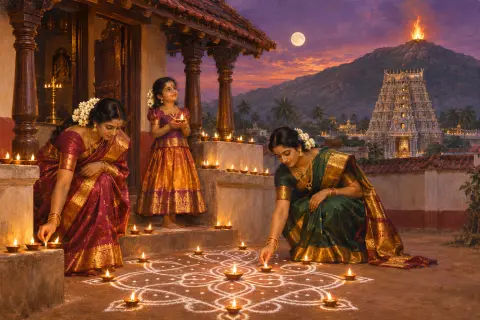 Karthigai DeepamNov 24, 2026She did penance at Arunachala and became the left half of Shiva, whose Ardhanarishvara image comes out at the lighting.
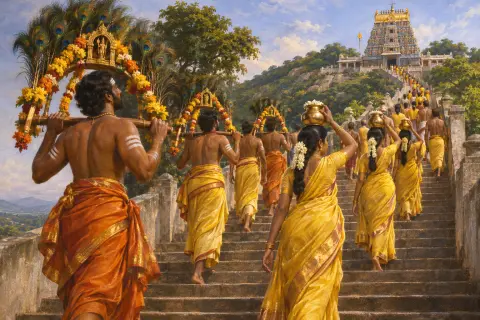 ThaipusamJan 22, 2027She is Murugan's mother, who gathers the six babies into one child and, in Tamil tradition, gives him her Vel on this day.
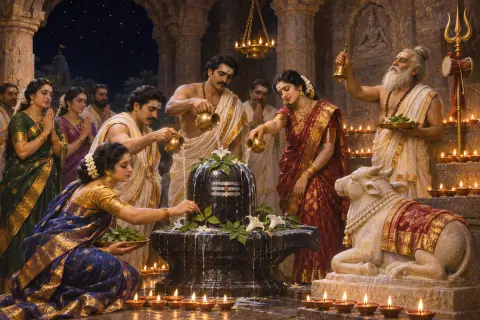 Maha ShivaratriMar 6, 2027Popular tradition celebrates her wedding to Shiva on this night, above all at Deoghar.
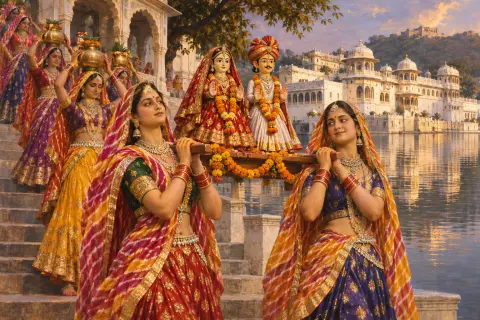 GangaurApr 9, 2027The festival is hers: as Gauri she is worshipped for sixteen days and carried to the water with Isar.
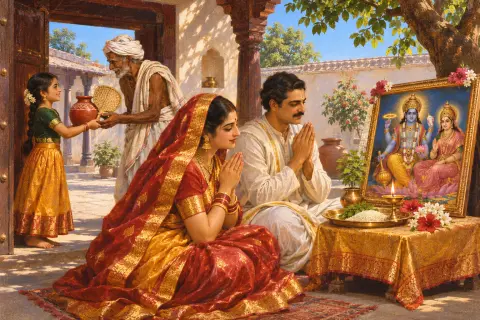 Akshaya TritiyaMay 9, 2027Many homes pray to her form Annapurna, giver of food, who popular belief says appeared on this day.
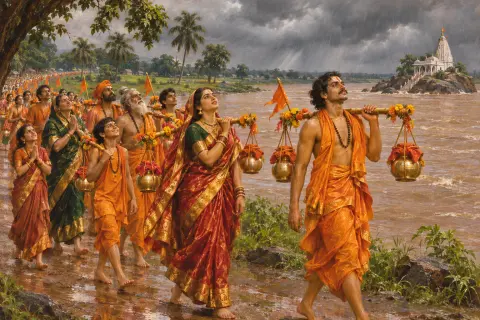 Shravani MelaJul 19 - Aug 17, 2027She is worshipped with Shiva at Deoghar, and in the Bhagavata she agrees when he drinks the poison to save the world.
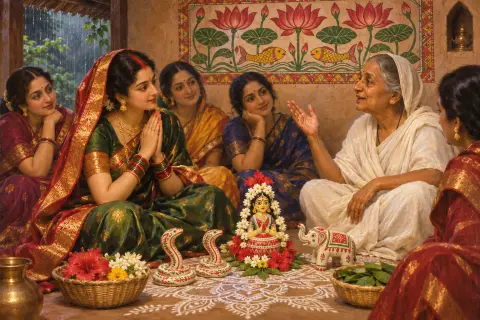 MadhushravaniJul 24 - Aug 4, 2027Mithila believes she kept this vrata first, and new brides worship her as Gauri every day of it.
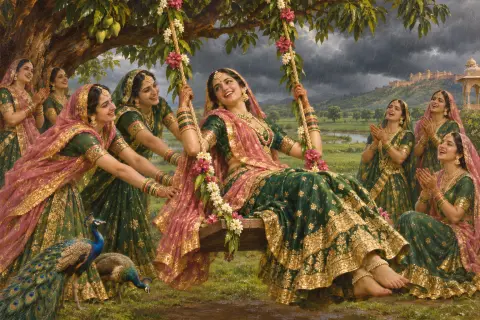 Hariyali TeejAug 4, 2027Her penance and her reunion with Shiva are remembered, and she is worshipped as Teej Mata.
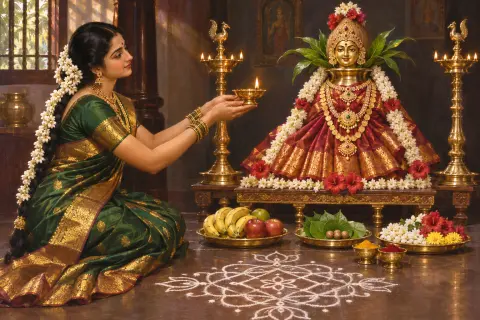 Varalakshmi VratamAug 13, 2027She asks Shiva for a vow that will bring good to women and their families, and he tells her of this one.
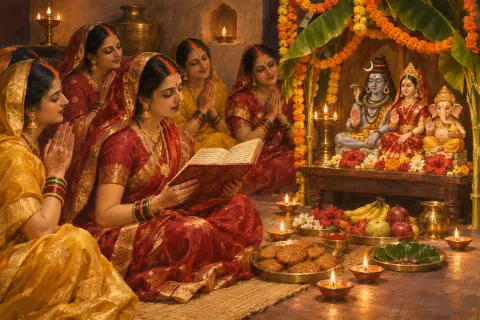 Hartalika TeejSep 3, 2027Her friends carry her into the forest, where she keeps the first Hartalika vrata before a sand linga.
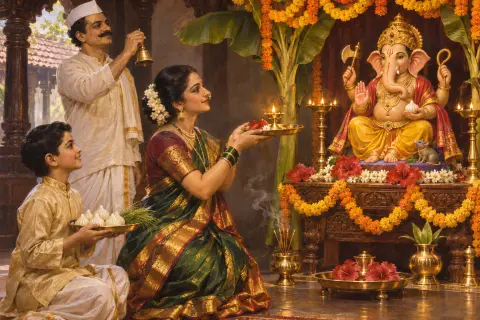 Ganesh ChaturthiSep 4 - Sep 14, 2027She makes Ganesha from the paste of her own body, and her grief at his death makes the gods bring him back.
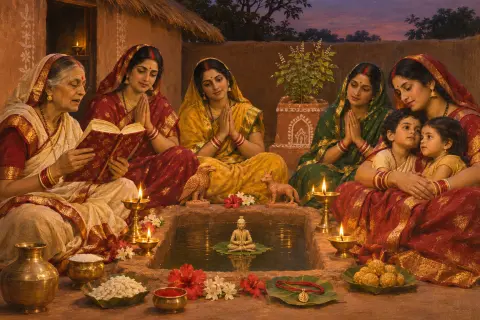 JitiyaSep 22 - Sep 24, 2027In some tellings she and Shiva promise that mothers who keep this fast will not lose their children.
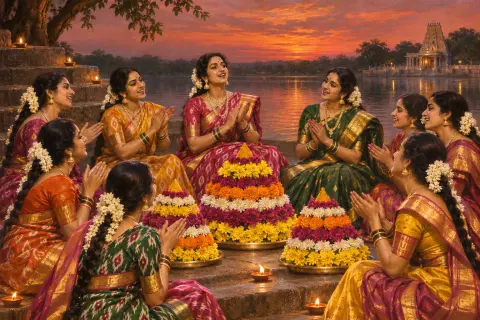 BathukammaSep 30 - Oct 7, 2027As Gauri, or Gauramma, she is the small turmeric cone placed on top of every flower stack.
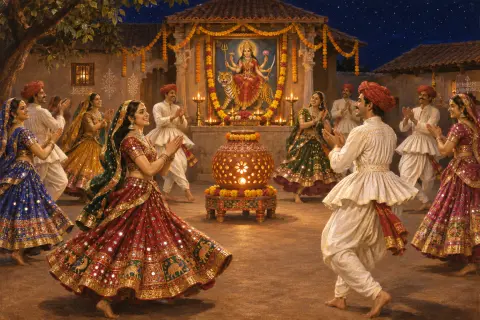 NavaratriSep 30 - Oct 9, 2027In the Devi Mahatmya the goddess Ambika steps out of her body when she comes to bathe in the Ganga.
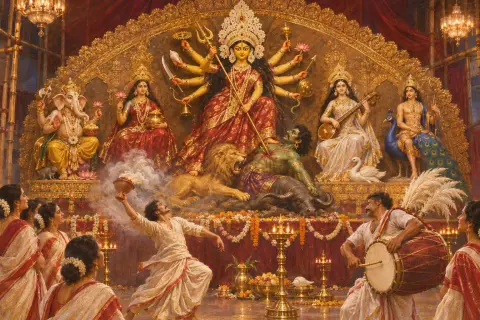 Durga PujaOct 5 - Oct 10, 2027Bengal welcomes her as Uma, the daughter who comes home from Kailash with her children for a few days.
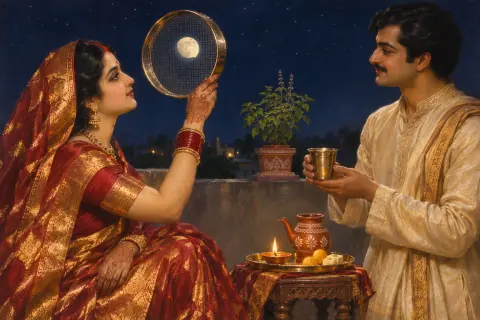 Karva ChauthOct 18, 2027As Gaura and Chauth Mata she is worshipped first at the evening puja, before Shiva, Ganesha and Kartikeya.
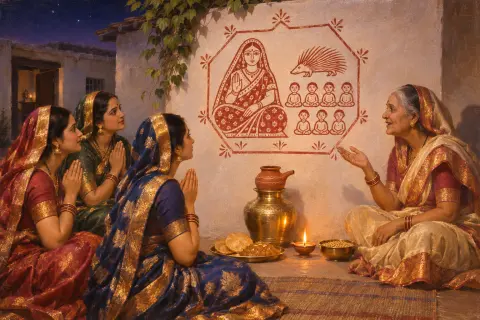 Ahoi AshtamiOct 22, 2027Many families see Ahoi Mata, drawn on the wall and worshipped in the evening, as a form of Parvati.
Paintings
9 paintingsAsk about Parvati
Ask Gita Chat about Parvati and what their story can teach you.