The Story
Baisakhi has no single founding scripture. As Mesha Sankranti, the day the sun enters Aries, it comes from the Indian solar calendar, which starts the year at this point, and in Punjab it is also when the winter wheat is ready to cut. For Sikhs the day carries a second meaning. The earliest account of the founding of the Khalsa is Sri Gur Sobha, a poem by Guru Gobind Singh's court poet Sainapati, written in the early 1700s. The well-known story of the five who offered their heads is told in full in later Sikh histories, especially Koer Singh's Gurbilas Patshahi 10 (1751). People keep the day to give thanks for the harvest, to welcome the new year and, for Sikhs, to remember the birth of the Khalsa.
The sun enters Mesha
In the Indian solar calendar, the year begins when the sun moves into Mesha, the sign of the ram. This moment is called Mesha Sankranti, and in Punjab it opens the month of Vaisakh, which gives the festival its name.
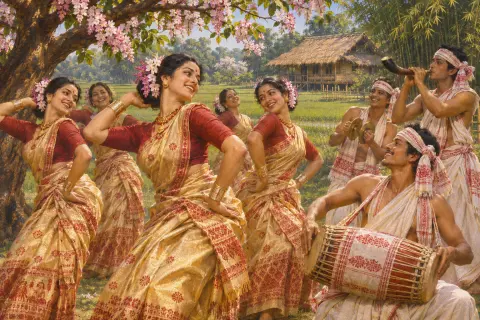
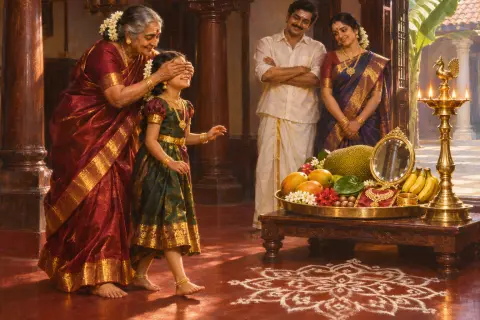
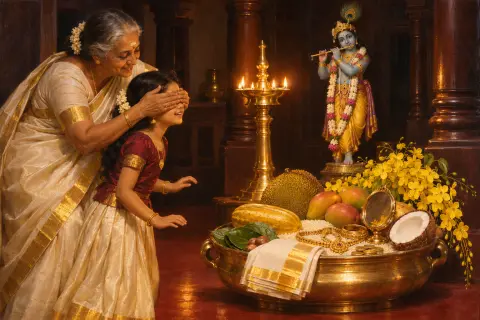
The same turning of the year is a festival in many other places, under other names. Assam celebrates Bohag Bihu, Odisha Pana Sankranti, Tamil Nadu Puthandu, Kerala Vishu, and Bengal Pohela Boishakh, though some of these fall a day apart. Many Hindus mark the day with a dip in a holy river. At Haridwar crowds bathe in the Ganga at Har ki Pauri, and in Punjab people go to rivers and temple tanks before visiting temples.
A harvest festival
For farmers, Baisakhi is about the rabi crop, mainly wheat, sown in the winter and harvested in spring. The days are getting hot, the grain is heavy, and the long wait is almost over. Families give thanks for the crop and begin the harvest soon after.
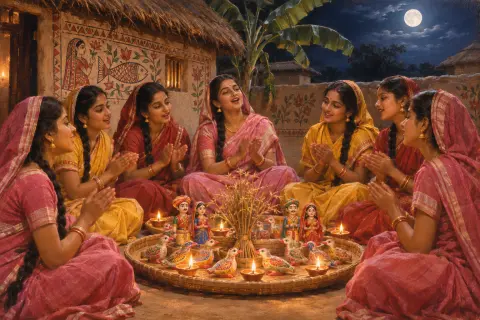
Villages and towns hold melas, fairs with food stalls, wrestling, music and rides. Men dance bhangra to the beat of the dhol, a dance that grew out of Punjab's harvest celebrations, and women dance gidda, clapping and singing boliyan, short teasing folk verses. New clothes, sweet rice and fresh food are part of the day.
A Sikh gathering day
Sikh tradition remembers that Guru Amar Das, the third Sikh Guru, asked Sikhs to gather at Goindwal on Vaisakhi, along with Diwali, so that the community could meet the Guru and each other. Over time Vaisakhi became one of the main days in the Sikh year.
That is why, on Vaisakhi of 1699, Sikhs from far and wide had come to Anandpur Sahib in the Shivalik hills, where the tenth Guru, Guru Gobind Singh, was living. They did not know that this gathering would change their history.
The founding of the Khalsa
As later Sikh histories tell it, Guru Gobind Singh came before the crowd with a drawn sword and asked: who is ready to give his head for the faith? The crowd went silent. Then Daya Ram stood up. The Guru led him into a tent and came out alone, his sword dripping. He asked again. One by one, four more men came forward: Dharam Das, Himmat Rai, Mohkam Chand and Sahib Chand. They came from different castes and different parts of India.
Then the Guru brought all five out of the tent, alive and dressed in new clothes. He called them the Panj Pyare, the Five Beloved Ones. He prepared amrit, sweetened water stirred in an iron bowl with a double-edged sword while sacred hymns were recited. Sikh tradition remembers that his wife, Mata Sahib Kaur, added sugar puffs to the water; some accounts name Mata Jito instead. He gave the amrit to the five, and they took the name Singh.
Then the Guru did something that Sikhs still find moving. He knelt before the five and asked them to give him the amrit in the same way. Born Gobind Rai, from then on he was Gobind Singh. Members of the Khalsa were asked to keep the five Ks, including uncut hair, the kara (a steel bracelet) and the kirpan, and to live with courage, equality and service. Sikh women who join the Khalsa take the name Kaur.
How the day is kept today
Gurdwaras hold kirtan and the reading of the Guru Granth Sahib, and serve langar, a free shared meal for everyone who comes. Nagar kirtans, street processions led by five Sikhs in the role of the Panj Pyare, move through towns with hymns and martial arts displays. Many gurdwaras replace the cloth on the Nishan Sahib, the tall Sikh flag pole, and hold amrit ceremonies for those ready to join the Khalsa. The biggest gatherings are at the Golden Temple in Amritsar, Takht Sri Keshgarh Sahib in Anandpur Sahib and Takht Sri Damdama Sahib in Talwandi Sabo.
The day also carries a painful memory. In 1919 a large crowd had gathered at Jallianwala Bagh in Amritsar on Baisakhi when British troops opened fire on them without warning, killing hundreds. Many people visit the memorial there on this day.
Baisakhi begins with a field of grain and ends with a shared plate. Sikhs serve langar because their Gurus taught that everyone eats together, as equals. Hindus reading the Gita hear a close echo in 5.18: the wise look with an equal eye on a learned priest, a cow, an elephant, a dog and a person society shuts out. A good harvest is not only ours. It comes from the sun, the rain and the work of many hands, and it is meant to be shared with everyone at the same table.