Hanuman is the vanara (monkey) devotee and messenger of Rama, the son of Anjana and the vanara chief Kesari, born by the blessing of Vayu, the wind god. He is known for his strength, learning and humility: he leapt across the sea to find Sita in Lanka, burned the city, and carried a mountain of healing herbs to save Rama's army. His story is told in the Valmiki Ramayana, especially the Sundara Kanda, and he meets Bhima in the Mahabharata. Today he is one of the most widely worshipped gods in India, with the Hanuman Chalisa read daily, temples crowded on Tuesdays and Saturdays, and his birth kept on Hanuman Jayanti.
Also called: Anjaneya (son of Anjana), Maruti and Pavanputra (son of the wind), Kesari Nandan (son of Kesari), Bajrangbali (strong one with a body like a thunderbolt), Mahavir (great hero), Sankat Mochan (remover of trouble), Ramaduta (Rama's messenger)
Mother: Anjana, once the apsara Punjikasthala, born as a vanara because of a curse
Father: Kesari, a vanara chief; divine father: Vayu, the wind god
Brother in the Mahabharata: Bhima, also a son of Vayu
Master: Rama; earlier a minister of Sugriva, king of the vanaras
Marriage: most traditions say he never married; a Telugu tradition based on the Parashara Samhita pairs him with Suvarchala
Son in later tellings: Makardhwaja, born to a fish from a drop of Hanuman's sweat (not in Valmiki)
Birthplace: accounts differ; Anjaneri near Nashik, Anjanadri near Hampi and Anjanadri at Tirumala are all claimed
I am the servant of Rama, king of Kosala, whose deeds never tire. I am Hanuman, son of the wind, destroyer of enemy armies.
Stories
The oldest full account of Hanuman is the Valmiki Ramayana. The Kishkindha Kanda tells of his birth and his first meeting with Rama, the Sundara Kanda follows his journey to Lanka, the Yuddha Kanda shows him in the war, and the Uttara Kanda adds his childhood. The Mahabharata brings him back in the Vana Parva, where he meets Bhima, and links him with the monkey on Arjuna's banner. Later works made him bigger still: the Shiva Purana calls him a form of Shiva, Tulsidas's Ramcharitmanas in Awadhi gave north India the Hanuman most people know, and the Hanuman Chalisa, traditionally said to be by Tulsidas in the sixteenth century, is now read every day in millions of homes.
Son of Anjana, Kesari and the wind
On the southern shore of the sea, the bear king Jambavan tells Hanuman his own story (Valmiki Ramayana, Kishkindha Kanda, sarga 66). His mother Anjana had once been Punjikasthala, the foremost of the apsaras. Because of a curse she was born on earth as a vanara who could take any form she wished, and she became the wife of the vanara chief Kesari.
One day Anjana, in human form, was walking on a mountain top. Vayu, the wind god, saw her and loved her. He told her not to be afraid: he had touched her only in his mind, and she would have a son who was strong and wise and who would equal the wind itself in leaping and flying. So Hanuman is called both the son of Kesari and the son of the wind.
Much later, the Shiva Purana adds that Hanuman is a form of Shiva, born to serve Vishnu as Rama. Valmiki does not say this, but many devotees hold it dear.
The leap at the sun and how he got his name
Jambavan goes on (Kishkindha Kanda 66). As a small child, Hanuman saw the sun rising over the forest and thought it was a ripe fruit. He jumped into the sky to grab it. Indra, king of the gods, was angry and threw his thunderbolt at him. The child fell onto a mountain peak and broke his left jaw. Hanu means jaw, and that, says Jambavan, is why he is called Hanuman.
Seeing his son hurt, Vayu stopped blowing in all three worlds, and every living being began to suffer. The gods hurried to calm him. Brahma gave the child a boon that no weapon in battle could kill him. Indra, seeing that the thunderbolt had not destroyed him, gave him the boon that he would die only when he himself chose.
The Uttara Kanda (sarga 36), where the sage Agastya tells the story to Rama, adds more boons from the other gods and what came next. Full of his new strength, the young Hanuman kept wrecking the sages' ashrams, breaking their ladles and scattering their bark clothes. At last sages of the Bhrigu and Angiras families, not very angry, put a curse on him: for a long time he would not know his own strength. That is why, years later, Jambavan has to tell him who he is before he can leap to Lanka.
Meeting Rama and Lakshmana
Hanuman grew up as a minister of Sugriva, the vanara prince who had been driven out by his brother Vali and was hiding on Rishyamuka hill. When two armed strangers came walking by Lake Pampa, Sugriva was afraid Vali had sent them. He sent Hanuman to find out (Kishkindha Kanda, sarga 3).
Hanuman went dressed as a wandering monk. He greeted the brothers kindly, praised them and asked who they were. Rama turned to Lakshmana, struck by how he spoke. No one could talk like this, he said, without knowing the Rigveda, the Yajurveda and the Samaveda. There was not a single mistake in his words, and his voice was pleasant to hear.
When Hanuman learned that this was Rama, searching for his wife Sita, he took his own form again, lifted both brothers onto his shoulders and carried them to Sugriva (sarga 4). Rama and Sugriva then made a pact of friendship with fire as their witness. From that day Hanuman's life belonged to Rama.
The leap to Lanka and finding Sita
The Sundara Kanda, the fifth book of the Ramayana, is almost all Hanuman's. After Jambavan reminds him of his strength, he grows huge, climbs Mount Mahendra and leaps across the sea (sarga 1). On the way the mountain Mainaka rises from the water to offer him rest, Surasa, mother of the nagas, blocks his way to test him, and the demoness Simhika tries to catch him by his shadow. He gets past each one, by politeness, by cleverness or by force.
He reaches Lanka in the evening, makes himself small and searches the city through the night. At last he finds Sita in the Ashoka grove, sitting under a shimshupa tree, thin with grief and surrounded by guards. Hiding in the branches, he softly tells Rama's story so as not to frighten her. Then he comes down and gives her Rama's ring (sarga 36). Sita gives him her hair jewel, the chudamani, to take back to Rama as a sign (sarga 38).
Before leaving, Hanuman wrecks the grove so that Ravana will notice him. He kills the guards sent against him, and in Lanka he shouts the verse given at the top of this page: I am the servant of Rama. Indrajit finally binds him with Brahma's weapon and brings him before Ravana. Hanuman calmly advises Ravana to return Sita. Ravana orders him killed, but his brother Vibhishana reminds him that an envoy must not be put to death, so they set Hanuman's tail on fire instead.
With his tail burning, Hanuman breaks free, leaps from roof to roof and sets Lanka ablaze (sargas 53 and 54). Then a fear grips him: what if Sita has burned too? He hurries back and finds her safe; the fire, the Ramayana says, did not touch her. He bows to her and leaps home across the sea with the news that she is alive.
The mountain of healing herbs
Hanuman carries the mountain of herbs across the sea to Lanka.
In the war, Ravana's son Indrajit struck down Rama, Lakshmana and much of the vanara army with Brahma's weapon. In the Valmiki Ramayana (Yuddha Kanda, sarga 74), Jambavan sends Hanuman to the Himalayas for four healing herbs, among them mritasanjivani, the herb that brings back the dying. Hanuman flies there, but the herbs hide from him. So he tears off the whole mountain peak and carries it to Lanka. The fragrance of the herbs alone is enough: Rama, Lakshmana and the fallen vanaras rise up healed.
Later in the Yuddha Kanda, when Ravana's spear strikes Lakshmana down, the vanara physician Sushena sends Hanuman again, and again he brings back a mountain peak with the herb.
The version most people in north India know comes from Tulsidas's Ramcharitmanas (Lanka Kanda). There Lakshmana is struck by Meghnad's spear, Sushena names the sanjivani herb, the demon Kalanemi tries to trap Hanuman on the way, and as he flies back over Ayodhya at night, Bharata mistakes him for a demon and brings him down with an arrow before they learn who each other is. Through all the versions, the picture of Hanuman flying with a mountain in his hand has become his best known image.
Meeting Bhima on the forest path
Bhima cannot lift the old monkey's tail.
The Mahabharata brings Hanuman back in the Vana Parva (sections 146 to 150 in Ganguli's translation). The Pandavas are living in the forest near Mount Gandhamadana, and Bhima has gone to find the fragrant saugandhika flowers that Draupadi asked for. In a grove of banana trees he finds an old monkey lying across the narrow path.
Bhima roars at him to move. The monkey says he is old and sick and asks Bhima to move his tail aside himself. Bhima, proud of his strength, takes hold of the tail with one hand, then with both, and strains until he sweats, but he cannot lift it even a little. Ashamed, he folds his hands and asks who the monkey really is.
It is Hanuman, his elder brother, since both are sons of Vayu. Hanuman embraces him, tells him the story of Rama, and at Bhima's request shows him the huge form he took to cross the sea. Then he gives Bhima a promise: when Bhima roars on the battlefield, Hanuman will add his voice, and sitting on the flagstaff of Arjuna's chariot he will let out shouts that weaken the enemy. This is the Mahabharata's link between Hanuman and the monkey on Arjuna's banner.
How to recognise
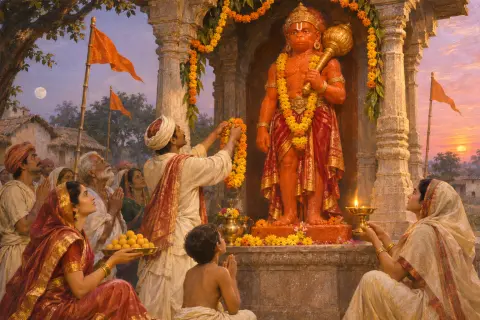
•A monkey face with a human body and a long tail, usually two arms. In north India most temple images are coated with sindoor mixed with oil (chola), which is why they look orange. The popular story that he covered himself in sindoor for Rama's long life is folk tradition, not Valmiki.
•A mace (gada) in one hand or resting on his shoulder. The mace comes from later art and temple images; in the Valmiki Ramayana he fights with trees, rocks and, in Lanka, an iron bar torn from a gateway (Sundara Kanda 42).
•Flying with a mountain held up in one hand: the mountain of herbs he carried from the Himalayas to heal Rama's army (Yuddha Kanda).
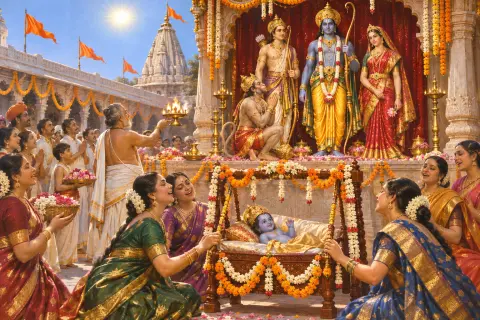
•Kneeling with folded hands at the feet of Rama, Sita and Lakshmana, as in the Ram Darbar picture found in many homes. This is Hanuman as dasa, the servant, the way he describes himself in the Ramayana.
•Tearing open his chest to show Rama and Sita in his heart. This image comes from later devotional stories and calendar art, not from Valmiki, and stands for a devotee whose heart holds nothing but his god.
•Panchamukha Hanuman, with five faces (Hanuman, Narasimha, Garuda, Varaha and Hayagriva) and many arms, is a later form worshipped for protection, often linked with the story of Ahiravana from regional Ramayanas.
•In Tamil Nadu and Karnataka he is often called Anjaneya and shown standing with folded hands. Tamil temples decorate him with butter (vennai kaappu) or with long garlands of vadai.
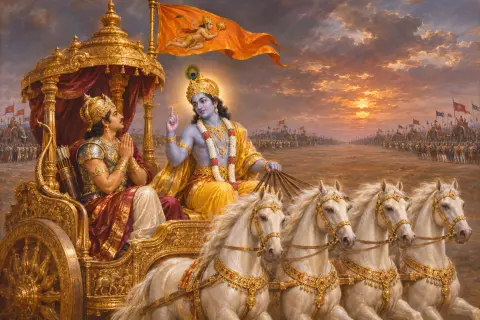
Then, seeing the people of Dhritarashtra’s party standing arrayed and the discharge of weapons about to begin, Arjuna, the son of Pandu, whose ensign was a monkey, took up his bow and said the following to Krishna, O Lord of the earth.
Sanjaya calls Arjuna kapi-dhvaja, the one whose banner bears the monkey. The Gita itself does not name the monkey. The identification with Hanuman comes from the Mahabharata, where Hanuman promises Bhima in the Vana Parva that he will sit on Arjuna's flagstaff, and from the tradition that grew from it.