The Story
The Puranas tell two different stories of a devoted wife who becomes the tulsi plant. The Shiva Purana (Rudra Samhita, Yuddha Khanda, chapter 23) tells of Vrinda, wife of the asura Jalandhara. The Devi Bhagavata Purana (Book 9, chapter 24) tells of Tulasi, wife of the asura Shankhachuda, who curses Vishnu to become a stone and is promised that she will become the tulsi plant and he the Shaligram stone beside her. The next chapter (9.25) says Tulasi's worship was set by Vishnu himself on Kartika Purnima. The wedding ceremony itself, as families do it today, is a household and regional custom handed down through generations; the Puranas give it its meaning. Families often merge the two stories, so here they are one by one.
Vrinda and Jalandhara
In the Shiva Purana, Jalandhara was a powerful asura born of the ocean, who married Vrinda, a woman of deep virtue. Her faithfulness was his shield. As long as her vow stood, no one could defeat him, and he went to war against the gods and finally against Shiva himself.
To end the war, Vishnu went to Vrinda using his power of illusion. She first saw a bad dream about her husband, then, wandering in a forest, met Vishnu disguised as a sage, and finally lived with a man she took to be Jalandhara. When she realised it was Vishnu, her vow was already broken, and on the battlefield Jalandhara could now be killed.
Vrinda cursed Vishnu: just as he had parted her from her husband, he would one day lose his own wife to demons and would have to seek the help of monkeys in the forest. The Purana links this curse to Rama, Sita and Hanuman. Then, though Vishnu tried to stop her, she entered the fire. In this chapter of the Shiva Purana there is no tulsi plant yet. It is a hard story, and the text does not soften what Vishnu did.
Tulasi, the Gandaki and the Shaligram
The Devi Bhagavata Purana tells the second story. Tulasi was a devoted woman who married the asura king Shankhachuda, and again her faithfulness protected him. To end his rule, Vishnu came to her in her husband's form. When Tulasi understood, she said to him: you have no pity, your heart is like a stone, so become a stone.
Vishnu accepted the curse and gave her a promise in return. Her body would become the holy river Gandaki. Her hair would become a sacred plant, known as tulasi after her. And he himself would live as a stone on the Gandaki's banks, the Shaligram, so that they would always be together. The Purana then praises the Shaligram stone and says that Vishnu is present wherever it is kept.
This is why in every home that keeps a Shaligram, tulsi leaves are placed on it, and why a Vishnu puja without tulsi is felt to be incomplete. The tulsi plant and the black stone from the Gandaki are treated as a couple who belong together.
Why the Plant Is Married
Tulsi Vivah turns that promise into a wedding. It comes right after Dev Uthani Ekadashi, when Vishnu is said to wake from his four-month sleep. The first thing the waking Lord does, in the family telling, is marry Tulsi. After that, the wedding season for people opens too.
In many homes the family that hosts the wedding plays the bride's side. They decorate the tulsi, give her away in kanyadaan and feed the guests. Couples who have no daughter often take this role with special feeling, and many people believe the merit of giving Tulsi in marriage is as great as giving away a daughter.
The Devi Bhagavata gives the eight names of Tulasi quoted above and says that whoever worships her with them gains great merit. Many families recite these names while doing the puja.
Sugarcane Mandap and Wedding Songs in Bihar and Uttar Pradesh
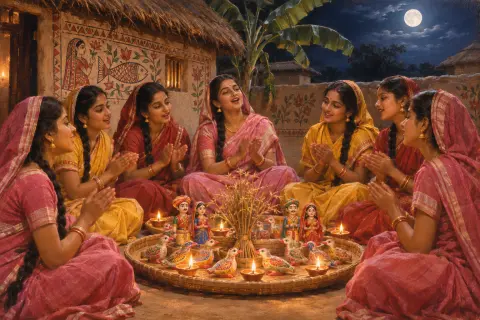
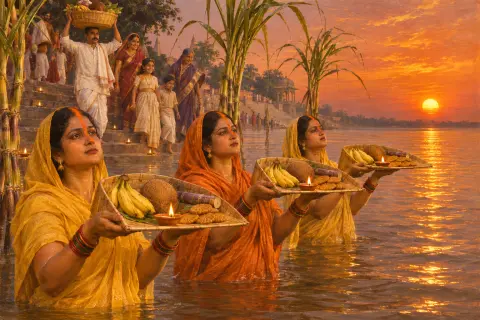
In Bihar, across Bhojpur, Magadh, Mithila and Anga, and in Uttar Pradesh, almost every courtyard has a tulsi chaura, a raised platform of clay or brick for the plant. In the month of Kartika women light a lamp there every evening. For Tulsi Vivah the chaura is freshly plastered and painted, and four or more sugarcane stalks are tied together over the plant to make the wedding mandap.
The tulsi is dressed as a bride with a red chunri, sindoor, bangles and a bindi. The Shaligram, or a small image of Krishna, is brought to her on a plate as the groom. Water chestnuts, sweet potatoes, ber, amla and pieces of sugarcane, the produce of the season, are laid out as offerings. Women sing the same wedding songs they sing when a daughter of the house is married, then the songs that wake the Lord after his long sleep.
In many Bihari and Purvanchali homes the evening of Dev Uthani Ekadashi and the Tulsi Vivah run together: Vishnu's footprints are drawn on the floor, plates are tapped to wake him, and the wedding follows under the same sugarcane canopy. After this day families begin fixing wedding dates.
Tulshi Lagna, Tulasi Habba and Other Regional Ways
In Maharashtra and Goa the plant grows in a tulshi vrindavan, a tall decorated planter in front of the house. On Tulshi Lagna an antarpat, a cloth screen, is held between the tulsi and the image of Krishna, mangalashtak wedding verses are sung, and when the cloth is lowered everyone showers rice on the couple, just as at a Maharashtrian wedding. The ceremony can be held on any evening from Dwadashi to Kartika Purnima.
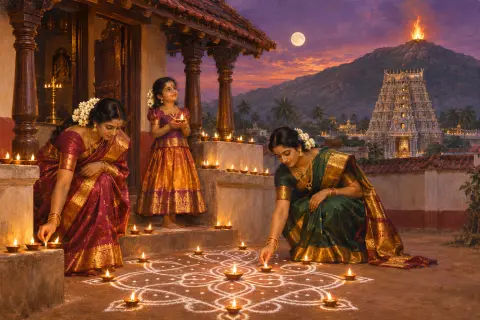
In Karnataka, Tulasi Habba is kept on Utthana Dwadashi. Families place a branch of the amla tree beside the tulsi in its tulasi katte, worship the two together, and light rows of lamps around it. In Gujarat many temples and homes hold a full wedding with a procession for the groom and a feast.
The forms change from place to place, but the heart is the same everywhere: the small plant that lives in the courtyard, watered every morning, is honoured once a year as a bride.
Both Puranic stories begin with a wrong done to a faithful woman, and both end with Vishnu binding himself to her for ever: no worship of him is complete without her. In Gita 7.17 Krishna says that the best of his devotees is the one who is ever steadfast and devoted to him alone: 'I am exceedingly dear to such a one, and they are dear to me.' Tulsi Vivah is that verse acted out in a courtyard. The Lord keeps close the one whose devotion never wavered, and families, by marrying a plant they water every day, remember that devotion is kept in small, daily acts.