Kamadeva, or Kama, is the god of love and desire. He is a handsome young man with a bow of sugarcane strung with bees and five arrows tipped with flowers, who rides a parrot with his wife Rati and his friend Vasanta, the spring. In the Rigveda, desire is the first seed of mind at the creation of the world; in the Puranas and Kalidasa's poetry he is the god the other gods send to stir Shiva, who burns him to ash with his third eye. He lives on without a body as Ananga and is born again as Krishna's son Pradyumna. The Gita names him as Kandarpa, and South India remembers his burning at Holi.
Also called: Kama (desire), Kandarpa, Manmatha (who churns the mind), Madana (who intoxicates), Ananga (the bodiless), Smara (memory), Pradyumna (in his rebirth), Pushpadhanva and Pushpabana (whose bow and arrows are flowers), Makaradhvaja and Minaketana (whose banner bears a makara or a fish), Ratipati (Rati's husband), Manasija (born in the mind), Mara
Origin: accounts differ; born from Brahma's mind in the Shiva Purana, son of Dharma and Shraddha in the Vishnu Purana (1.7), and in Vaishnava tradition reborn as the son of Krishna and Rukmini
Wife: Rati, goddess of delight, daughter of Daksha in the Shiva Purana; reborn as Mayavati to find him again
"Lord, hold back your anger, hold it back!" While the gods' cry was still moving through the sky, the fire born from Shiva's eye had already left of Madana nothing but ash.
Stories
Kama begins not as a person but as an idea. The Rigveda's hymn of creation (10.129) says that in the beginning desire arose, the first seed of mind, and the Atharvaveda praises Kama as a power greater than the gods. In the Puranas he becomes a person: a beautiful young archer born from Brahma's mind or as the son of Dharma, whose arrows no one, not even Brahma, can escape. His great story is his burning by Shiva, told in the Shiva Purana and, most beautifully, in Kalidasa's Kumarasambhava. After that he lives without a body, and the Bhagavata Purana tells how he is born again as Pradyumna, Krishna's son. Kama is also one of the four aims of life, and the Kamasutra is named after him.
Desire, the First Seed of Mind
The Nasadiya hymn of the Rigveda (10.129) wonders how the world began, out of a darkness where there was neither being nor non being. Then, says verse 4, desire came upon it in the beginning, the first seed of mind. The sages, searching their hearts, found in desire the bond between what is and what is not.
The Atharvaveda (9.2) goes further. Its hymn to Kama calls him the first born, greater than the gods, the ancestors and men, and asks him to drive away the singer's enemies. In these old texts Kama is not yet a boy with a flower bow. He is the force that makes anything begin at all.
Born from Brahma's Mind
The Shiva Purana (Rudra Samhita, Sati Khanda, chapters 2 to 4) gives him a birth. As Brahma was creating, a beautiful young man appeared from his mind, holding a bow of flowers and five arrows. Brahma told him that his arrows would strike the hearts of all beings and that creation would go on through him. The young man asked his name, and the sages named him Manmatha, the one who churns the mind, and Kama and Madana.
His first targets were Brahma himself and the sages, who were stirred by the sight of Brahma's daughter Sandhya. Shiva, passing by, laughed at them. Ashamed and angry, Brahma cursed Kama: one day Shiva's fire would burn him to ash. Kama pleaded that he had only done what Brahma asked, and Brahma softened the curse: he would live again.
Daksha gave him his daughter Rati, born of his own body, as his wife, and Kama was overjoyed at her beauty. The Vishnu Purana (1.7) gives a different parentage, calling Kama the son of Dharma and Shraddha; the texts do not agree.
Burned by Shiva
After Sati's death Shiva sat in meditation on the Himalaya and would not look at anyone. The demon Taraka could be killed only by a son of Shiva, so the gods asked Kama to help. He went with Rati and with Vasanta, the spring, and the whole forest bloomed out of season. When Parvati came near with her offering of flowers, Kama aimed his arrow. Shiva felt his mind stir, looked round, saw Kama with his bow and opened his third eye. Fire leapt out and burned Kama to ash (Shiva Purana, Rudra Samhita, Parvati Khanda, chapter 19; Kalidasa, Kumarasambhava, canto 3). The verse at the top of this page is Kalidasa's: the gods had not even finished crying out for mercy before it was over.
Kalidasa gives the whole of canto 4 to Rati's grief. She wakes from her faint, sees the ash in the shape of a man and mourns her husband, her friend Vasanta beside her. She is about to follow him into the fire when a voice from the sky tells her to wait, because she will have him again.
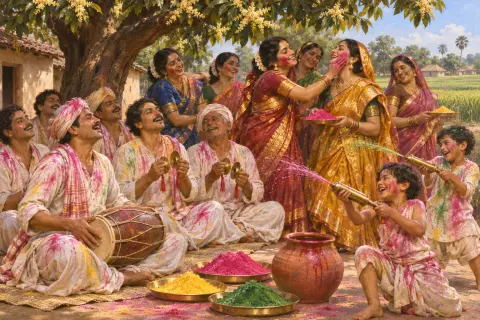
Shiva promised that Kama would live on without a body, as Ananga, the bodiless one, felt everywhere and seen nowhere (the Shiva page tells this). In Tamil Nadu, Karnataka, Andhra Pradesh and Telangana the Phalguna full moon remembers this burning: a figure of Kama goes into the bonfire, and songs of Rati's lament are sung.
Reborn as Pradyumna
Mayavati finds the baby Pradyumna, Kama reborn, inside a fish in Shambara's kitchen.
The Bhagavata Purana (Book 10, chapter 55) tells the rest. Kama, burned by Shiva, was born again as Pradyumna, the son of Krishna and Rukmini. When the baby was not yet ten days old, the asura Shambara, who knew the child was destined to kill him, stole him and threw him into the sea. A large fish swallowed him, fishermen caught the fish and brought it to Shambara's kitchen, and when the cooks cut it open, they found a baby boy inside.
They gave him to Mayavati, who worked in Shambara's household. She was Rati, Kama's wife, waiting there for her husband in disguise. The sage Narada told her who the child was, and she raised him with love. When he grew up, she taught him the secret art of illusion, and with it he killed Shambara.
Mayavati and Pradyumna flew together to Dwaraka. When they walked into the women's rooms, everyone thought Krishna had come, so much did Pradyumna look like him. Rukmini felt her heart go out to the young man, and Narada explained that this was her lost son. Pradyumna's son Aniruddha later married Usha, the daughter of the asura king Bana.
Kama as an Aim of Life
Hindu tradition lists four aims of life: dharma, artha (wealth and power), kama (love and pleasure) and moksha (freedom). Kama is a rightful goal, not a sin, as long as it does not go against dharma. The Kamasutra of Vatsyayana, a handbook on love, pleasure and the life of the cultured townsman, takes its name from this aim.
The Gita keeps both sides. In 7.11 Krishna says he is the desire in beings that is not opposed to dharma, and in 10.28 that among progenitors he is Kandarpa, Kama himself. But in 3.37 he warns that kama, desire that turns to anger, is the great enemy in this world. The Narada page tells how even the sage Narada, proud of having conquered Kama, learned how hard that is.
How to recognise
•A beautiful young man, often fair or with a faint green or golden glow, richly dressed and garlanded. He is the most handsome of the gods, and poets compare beautiful men to him.
•A bow of sugarcane with a bowstring made of a line of humming bees. The sweetness of the cane and the sting of the bee are both part of love.
•Five arrows tipped with flowers. A common list names them as lotus, ashoka, mango blossom, jasmine and blue water lily, each said to wake a different stage of longing.
•His mount is a parrot, and his banner bears a makara or a fish, which is why he is called Makaradhvaja and Minaketana.
•Rati, his wife, the goddess of delight, is usually beside him, and Vasanta, the spring, is his friend and helper. The cuckoo, the south wind and the mango in flower belong to him.
•In South India, at Kamadahanam on the Phalguna full moon, he is shown as a figure burned in the Holi fire, while songs tell of Rati's grief.
Among weapons I am the thunderbolt; among cows I am the wish-fulfilling cow called Kamadhenu; I am the progenitor, the god of love; among serpents I am Vasuki.
"Among progenitors I am Kandarpa." Kandarpa is Kamadeva. Krishna names the god of love as the power behind every birth.
The Blessed Lord said: It is desire, it is anger both of the quality of Rajas, all-devouring, all-sinful; know this as the foe here (in this world).
Here kama is desire, not the god: born of rajas, all devouring, the enemy that turns to anger. Commentators read the verse as a warning about desire, the other side of what Kama stands for.