The Story
Gangaur has no single founding scripture. It is a folk festival of Rajasthan, kept and handed down mostly by women. The story at its heart is much older: Parvati's long penance to win Shiva, told by Kalidasa in the Kumarasambhava (canto 5) and in the Shiva Purana (Rudra Samhita, Parvati Khanda). Kalidasa says she gave up even fallen leaves as food, and that is why she is called Aparna. Gangaur honours her as Gauri, the wife who reached Shiva through a faith that would not bend. The name joins Gan (Shiva, called Isar here) and Gaur (Gauri). The katha read on the last day is a folk vrat katha, and its details vary from family to family.
Parvati's long penance
The Shiva Purana (Rudra Samhita, Parvati Khanda) tells how Parvati, daughter of the mountain king Himavan, set her heart on Shiva, who had withdrawn from the world after the death of his first wife Sati. Shiva did not notice her. Even when Kamadeva, the god of love, tried to stir his feelings, Shiva burned him to ash with the fire of his third eye.
Parvati did not give up and did not try tricks again. She went to the forest and began a long, hard penance. She gave up comfort, then food, and lived on leaves, then not even leaves. Shiva came to test her in disguise and spoke badly of himself to see if she would waver. She did not. Moved by her steadiness, he accepted her, and they were married.
This is the root of Gangaur. Gauri is honoured as the wife who reached Shiva through faith that would not bend, and women ask her for the same steadiness in their own homes.
The katha of the secret worship
Families read a Gangaur vrat katha on the main day, and its details vary from home to home. In the version given by Drik Panchang, Parvati asked Shiva's leave on Chaitra Shukla Tritiya and went to the river to bathe. There she made a Shiva linga from sand, worshipped it with offerings made only of sand, and took two grains of sand as prasad. Shiva appeared in the linga and blessed her: any woman who worships him and keeps this fast will have a long lived husband.
Parvati came home late. When Shiva asked why, she did not want to speak of her worship, so she said she had met her brothers and relatives at the river and they had fed her milk and rice. Shiva said he wanted milk and rice too and set off for the river. Parvati prayed quietly for help, and when they arrived, a palace stood on the bank, full of her family, who welcomed Shiva with great honour.
On the way home Shiva said he had forgotten his garland there and sent the sage Narada to fetch it. Narada found no palace at all, only thick forest, with the garland hanging from a tree. Shiva smiled and explained that it was Parvati's own play, because she had kept her worship secret. Narada praised her and said that worship done quietly, without show, bears more fruit. This is one reason women keep parts of the Gangaur puja to themselves.
Gauri comes home to her parents
In Rajasthani folk tradition, Gangaur is also the time when Gauri visits her parents' home, the way a married daughter does. For these days the women of the house treat her like a beloved daughter: they bathe her, dress her, feed her and sing to her.
Then Isar comes to take her back. The procession on the last day is her farewell, and the songs turn tender, the way songs at a daughter's bidaai do. Many newly married women observe their first Gangaur at their parents' house, which gives the songs a very personal meaning for them.
Eighteen days of worship
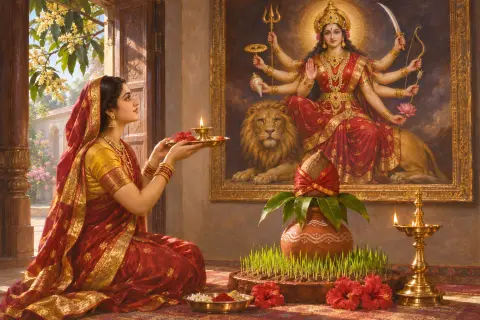
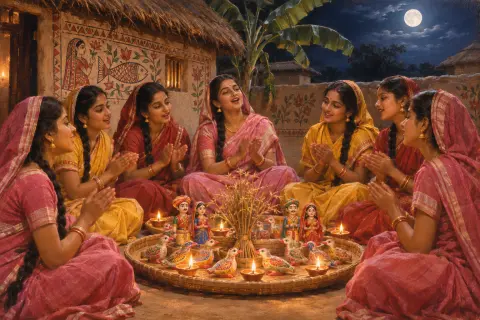
Each morning girls and women gather, often in a group from the same lane, with brass pots of water, flowers and doob grass, and worship the idols of Isar and Gauri. Many songs begin with the line "Gor gor gomti, Isar puje Parvati". The pot of sprouted wheat or barley grows green over the days, a sign of fresh life after the winter.
The day before the main Gangaur is Sinjara, or Sindhara. Parents send the daughter gifts of clothes, bangles and sweets, especially ghewar, and women put mehndi on their hands. In parts of Marwar, girls carry an earthen pot with many holes and a lamp inside, called a ghudlia, from house to house in the evenings and sing for small gifts.
The last day and the procession
On Chaitra Shukla Tritiya, married women fast, dress in their finest clothes and jewellery, hear the katha and offer the idols their final worship. In the afternoon or evening, the idols of Gauri and Isar are carried in procession, and finally immersed in a lake, river or well. That farewell is the end of Gangaur.
In Jaipur, the royal Gangaur idol comes out of the City Palace and moves through the old city's bazaars with elephants, horses, bands and crowds of women singing. In Udaipur, women bring their idols down to Gangaur Ghat on Lake Pichola, and there is a boat procession on the lake. Gangaur is also widely kept in the Malwa and Nimar regions of Madhya Pradesh, in north Gujarat, and by Rajasthani families wherever they have settled.
Parvati's worship in the story is small and hidden: sand, a riverbank, two grains for prasad. Yet it moves Shiva. In the Gita (17.3) Krishna says that every person is made of their faith: as a person's faith is, so they become. Parvati set her heart on Shiva, held to it through years of penance, and became his wife. Gangaur asks women and girls to keep that kind of faith day after day, through songs, sprouted wheat and simple offerings, and to let it shape who they become.