The Story
The rite of Hartalika is set out in old Sanskrit vrata manuals such as the Haritalika Vrata Kalpa, and the katha read on the day is attributed by tradition to the Bhavishya Purana. They say that Parvati's father had promised her to Vishnu, so her friends carried her away to a forest, where on the third day of the bright half of Bhadrapada she worshipped a linga made of sand, fasted and stayed awake all night, and Shiva accepted her as his wife. The name comes from this: harita, carried away, and aalika, by her friends. Women keep the day as Parvati did, for a long and happy married life, and girls keep it hoping for a husband as true as Shiva. The older story of Parvati's tapas, without the friends, is told by the poet Kalidasa in the Kumarasambhava (canto 5), the verse above.
Parvati's tapas
Parvati, daughter of Himavan, the king of the mountains, had loved Shiva since she was a girl. But Shiva was lost in meditation after the death of his first wife Sati, and when Kama, the god of love, tried to wake desire in him, Shiva burned Kama to ash with the fire of his third eye. Kalidasa's Kumarasambhava says Parvati went home ashamed of her beauty, and decided that beauty alone would never win such a husband.
So she gave up her jewels and soft clothes, put on bark, and went to the mountains to do tapas. She stood among fires in summer and in icy water in winter. In the end she lived only on fallen leaves, and then gave up even those, which is why she is called Aparna, the one without even a leaf.
In Kalidasa's telling, Shiva came to her disguised as a young ascetic and mocked the god she was praying for: he wears ash and snakes, rides an old bull and lives in cremation grounds. Parvati answered him sharply and turned to leave. Then Shiva showed himself and said that from that day he was hers, bought by her tapas.
Promised to Vishnu, carried away by her friends
The Teej katha tells it differently. Here the sage Narada comes to Himavan and says that Vishnu himself wishes to marry his daughter. Himavan is delighted and gives his word. (In the Shiva Purana, by contrast, Narada tells Himavan that Parvati will marry Shiva. Accounts differ, and the Teej story keeps its own version.)
When Parvati heard of the promise, she was heartbroken. She had already given her heart to Shiva. She told her friends that she would rather give up her life than marry anyone else.
Her friends did not argue with her. They took her by the hand and slipped away with her into a thick forest, where her father could not find her. This is the moment that gives the day its name: Parvati carried away by her friends, so that she could stay true to her own choice.
The sand linga and the night without sleep
In the forest, by a river, Parvati shaped a linga from sand. On the third day of the bright half of Bhadrapada she worshipped it with flowers and leaves. She ate nothing and drank nothing, and she stayed awake all night, singing and praying.
Shiva was moved. He appeared before her and told her to ask for a boon. She asked only that he become her husband, and he agreed. The next morning she offered the sand linga into the river and broke her fast.
Just then Himavan, who had been searching everywhere, found his daughter. Parvati told him she would come home only if he gave her to Shiva. Himavan agreed, and in time Shiva and Parvati were married. In the katha, Shiva tells this story to Parvati himself and says that any woman who keeps this vrata with faith will be blessed in her marriage.
Teej in Bihar
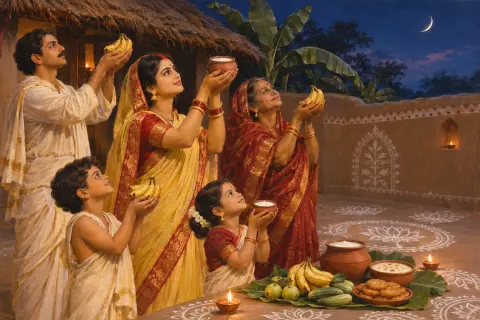
In Bihar, in Mithila, Bhojpur, Magadh and Anga alike, Hartalika Teej is simply called Teej, and it is one of the hardest fasts of the year. Most married women keep it nirjala, without food or water, from the morning of Teej until after the puja the next morning. Many eat a light meal the night before. In many families, once a woman starts keeping Teej, she keeps it every year.
In the days before, the kitchen fills with the smell of thekua, crisp sweet cakes of wheat flour and jaggery, and pidukiya, fried pastries filled with sweet khoya or semolina. Women put on mehndi, buy new bangles, and on the day itself bathe and dress like brides in red, yellow or green saris, with sindoor in the parting of their hair. Families often send new clothes and sweets to a daughter for her first Teej after marriage.
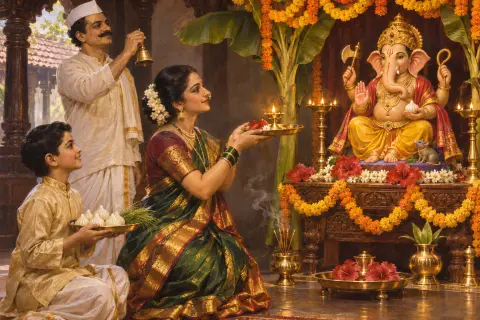
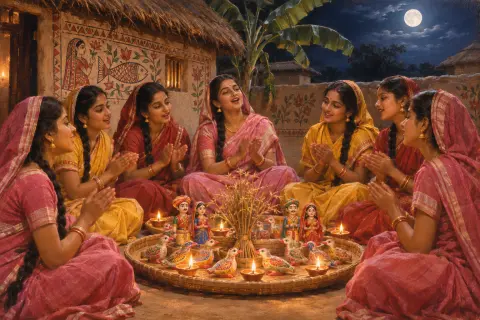
In the evening, women make small images of Shiva, Parvati and Ganesha from clay or sand and set them on a low platform, often under a canopy of flowers. They offer bel leaves, dhatura and flowers to Shiva, and sindoor, bangles, a bindi and other signs of a married woman to Parvati, along with thekua, fruit and sweets. Women gather in one home or courtyard to hear the Teej katha together, and many stay awake through the night with songs and bhajans.
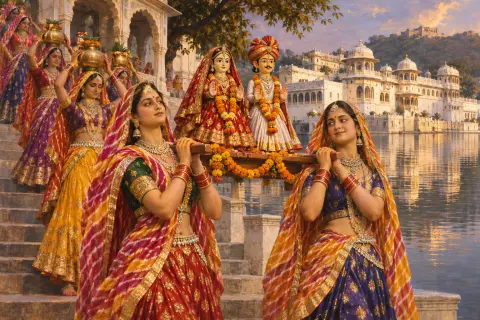
The next morning, after a final puja, the clay images are taken to a pond or river and immersed. Women touch the feet of elders, give the suhaag items to an older married woman, and only then break their fast, usually with water and the prasad of thekua.
Hartalika across India and Nepal
In Uttar Pradesh and Jharkhand, the day is kept much as in Bihar, with a nirjala fast, clay images, the katha and a night vigil. In Maharashtra, Hartalika is kept the day before Ganesh Chaturthi with a fast and the worship of Parvati with her friend and a Shiva linga. In Chhattisgarh it is Teeja: married women go to their parents' home for the festival and keep the fast there. Karnataka and Andhra Pradesh keep Gauri Habba, or Swarna Gauri Vratam, on the same day, worshipping Parvati as Gauri before her son Ganesha arrives.
In Nepal, Haritalika Teej is one of the biggest festivals of the year for women, and the government gives women a public holiday for it. Women gather in red saris on the eve for a feast called dar, fast through the day, and crowd the Pashupatinath temple in Kathmandu, singing and dancing.
Hartalika is one of three Teejs of the rainy season. Hariyali Teej comes a month earlier, in Shravana, with swings and green clothes, and Kajari Teej falls in between, with the Kajari songs of the Bhojpuri region. Hariyali Teej has its own page on this site. Hartalika is the strictest of the three.
Parvati was offered a perfectly good match, and her own father had agreed to it. She chose to stay with what she believed in, and she backed her choice with a fast and a night of prayer. In the Gita (7.21) Krishna says that whatever form a person worships with faith, he makes that faith steady. Teej honours that kind of steady faith: not a wish made once, but a choice held through hunger, tiredness and doubt until it bears fruit.