
Sita
Daughter of the earth, wife of Rama
Sita is the heroine of the Ramayana, the wife of Rama and the daughter of King Janaka of Mithila, who found her as a baby in the furrow of a ploughed field. She went with Rama into fourteen years of exile, was carried off to Lanka by Ravana, refused him for months in the Ashoka grove, and after Rama's victory walked through fire to prove her faithfulness. In the last book of the Valmiki Ramayana she is sent away by Rama, raises their twin sons in Valmiki's hermitage, and finally returns to the earth she came from. She is worshipped as a form of Lakshmi, and loved above all in Mithila, where her birth is kept on Sita Navami and her wedding on Vivah Panchami.
Also called: Janaki and Maithili (daughter of Janaka, of Mithila), Vaidehi (princess of Videha), Bhumija and Bhumisuta (daughter of the earth), Siya, Ramā and Shri (as Lakshmi), Janaknandini
Mother: Bhumi, the Earth, from whose furrow she rose
Foster parents: King Janaka (Siradhvaja) of Mithila and his queen, called Sunayana in later tellings
Sister: Urmila, Janaka's own daughter, who married Lakshmana
Cousins: Mandavi and Shrutakirti, daughters of Janaka's brother Kushadhvaja, who married Bharata and Shatrughna
Husband: Rama of Ayodhya
Sons: the twins Lava and Kusha, born in Valmiki's hermitage
Homes: Mithila (Videha), then Ayodhya; Sitamarhi in Bihar and Janakpur in Nepal both claim her birthplace
शक्या लोभयितुं नाहमैश्वर्येण धनेन वा। अनन्या राघवेणाहं भास्करेण प्रभा यथा॥
śakyā lobhayituṃ nāham aiśvaryeṇa dhanena vā, ananyā rāghaveṇāhaṃ bhāskareṇa prabhā yathā.
I cannot be tempted by power or by wealth. I am one with Raghava, as light is one with the sun.
Stories
Sita's story is told first in the Valmiki Ramayana. The Bala Kanda tells of her birth and wedding, the Aranya Kanda of her abduction, the Sundara Kanda of her months in the Ashoka grove, the Yuddha Kanda of her ordeal by fire, and the Uttara Kanda of her exile and her return to the earth. Later tellings change her story more than almost anyone's. The Adhyatma Ramayana and Tulsidas's Ramcharitmanas say that the Sita Ravana carried off was only a shadow, while the real Sita waited in the fire. Kamban's Tamil Ramayana has Ravana lift her together with the ground she stood on, so that he never touches her. The Adbhuta Ramayana goes further and has Sita herself, as the goddess, kill a thousand-headed Ravana. Women's songs in Mithila and Awadh have their own Sita, a daughter who left home and suffered and never stopped being loved.
The girl from the furrow
In the Valmiki Ramayana, King Janaka tells the sage Vishvamitra how his daughter came to him (Bala Kanda, sarga 66). He was ploughing a field to prepare the ground for a sacrifice, and a girl rose up out of the earth from the line the plough had cut. He named her Sita, which means furrow, raised her as his own, and called her ayonija, one not born from a womb.
Janaka also had Shiva's great bow in his keeping, and he decided that only the man who could string it would marry his daughter. Many kings came to Mithila and could not even lift it.
Mithila tells this story with great love. Sitamarhi in Bihar points to Punaura as the field where she was found, and Janakpur in Nepal, Janaka's capital, has the great Janaki Mandir. Her birth is kept on Sita Navami, the ninth day of the bright half of Vaishakha, a month after Ram Navami.
The wedding, and choosing the forest
Rama broke the bow, and Janaka gave Sita to him with the words: this is Sita, my daughter, she will walk the path of dharma with you, take her hand in yours (Bala Kanda, sarga 73). Her sister Urmila married Lakshmana in the same ceremony. Mithila still sings wedding songs that tease the groom's party from Ayodhya, and keeps the wedding every year on Vivah Panchami.
Twelve years later Rama was sent into exile, and he told Sita to stay behind in the palace. She refused. A wife's place, she said, is with her husband, and the forest with him would be sweeter than a palace without him. When he still hesitated, she spoke sharply and wept until he agreed (Ayodhya Kanda, sargas 26 to 30). She left Ayodhya in bark clothes, and the Ramayana says the whole city cried for her.
Carried off to Lanka
At Panchavati a golden deer appeared, and Sita asked Rama to catch it for her. It was the demon Maricha. When a cry for help came in Rama's voice, Sita begged Lakshmana to go, and when he hesitated she accused him of bad intentions until he went. Then Ravana came to the door as a wandering ascetic, and Sita, following the duty of hospitality, gave him water and a seat. He showed his true form and carried her off through the sky (Aranya Kanda, sarga 49).
Over the hills of Kishkindha she saw five vanaras below, tied her jewels in her upper cloth and dropped them, hoping Rama would find them. Later Sugriva showed these jewels to Rama. The Lakshmana rekha, a line Lakshmana drew that Sita should not cross, is not in Valmiki; it comes from later retellings, and the Ramcharitmanas mentions it only in passing, in Mandodari's words to Ravana.
Months in the Ashoka grove
Ravana kept Sita in the Ashoka grove of his palace, guarded by demon women. He came to her with promises of wealth and power. She placed a blade of grass between them, as if to speak to him through it, and answered with the verse at the top of this page: she could not be tempted, she was one with Rama as light is with the sun (Sundara Kanda, sarga 21). Ravana gave her two months to change her mind, and threatened to have her killed if she did not (sarga 22).
Only one of the guards, Trijata, was kind. She dreamed that Rama would win and Ravana would fall, and told the others to stop tormenting Sita (sarga 27). Sita, at the end of her strength, was ready to take her own life with her own long braid when Hanuman, hidden in the tree above, began softly to tell Rama's story.
Hanuman gave her Rama's ring, and she wept to hold it. He offered to carry her back across the sea on his shoulders that very night. Sita refused: Rama himself must come and win her back, she said, and she would not willingly touch any man other than her husband (sarga 37). She gave Hanuman her hair jewel, the chudamani, to take to Rama, along with a memory only the two of them shared, so that Rama would know the message was true.
The ordeal by fire
When the war was won, Rama had Sita brought before him, and spoke to her coldly in front of the army. He had fought, he said, to wipe away the insult to his family, and she was free to go wherever she wished. Sita answered him with dignity: her heart had always been his, and what had been done to her body was not in her power. Then she asked Lakshmana to build a fire and walked into it (Yuddha Kanda).
Agni, the god of fire, rose out of the flames holding her unharmed and gave her back to Rama, saying she had never been unfaithful in word, thought or glance. Rama answered that he had known it all along, but that the world had to see it with its own eyes. The Ramcharitmanas tells it differently: before the abduction the real Sita had been placed in the fire for safekeeping and only her shadow went to Lanka, so the ordeal simply brings the true Sita back.
Exile in the forest and return to the earth
The Uttara Kanda of the Valmiki Ramayana goes on where many tellings stop. Back in Ayodhya, Sita was pregnant and happy. Then Rama learned that people in the city were saying that a king who took back a wife from another man's house set a bad example. He decided to send Sita away, and ordered Lakshmana to leave her in the forest near Valmiki's hermitage on the bank of the Ganga. Lakshmana did so in tears. Sita sent back a message that she bore Rama no ill will and that he should care for his people as he would for his brothers.
Valmiki took her in, and her twin sons Lava and Kusha were born in his hermitage. He taught them the Ramayana, and years later they sang it at Rama's great horse sacrifice. Rama recognised them as his sons and sent for Sita, asking her to swear her purity before the assembly so that the people would accept her.
Sita came, dressed in ochre, with her hands joined and her eyes on the ground. She said: if I have never thought of anyone but Rama, may the Earth goddess open and take me in. The ground split, a throne rose out of it, and the Earth took her daughter in her arms and carried her back down (Uttara Kanda, sarga 97). Rama's grief was terrible, but she did not return. The Ramcharitmanas leaves this ending out. Many people, especially women, remember Sita through it all the same: as someone who was wronged and kept her own dignity to the end.
How to recognise
- •A young woman with a fair or golden complexion and two arms, in a red or yellow sari, standing or seated on Rama's left. In temple images she often holds a lotus, the flower of Lakshmi.
- •In the Ram Darbar picture she sits beside Rama on the throne, with Lakshmana standing near and Hanuman kneeling at their feet.
- •In the Ashoka grove scenes she is thin and alone under a tree, in a single faded yellow cloth with her hair in one plain braid, as the Sundara Kanda describes her, surrounded by sleeping or watching demon guards.
- •Bridal scenes from Mithila show her in red with a garland in her hands for Rama. Madhubani (Mithila) paintings of her wedding are painted on the walls of the kohbar, the newly married couple's room, to this day.
- •Coming out of the furrow as a glowing baby while Janaka holds the plough, or sinking into the open earth in the arms of the Earth goddess at the end of her life: the two pictures that frame her story.
- •Her colour and lotus link her to Lakshmi. The Vishnu Purana (Book 1, chapter 9) says Lakshmi takes birth beside each avatar of Vishnu, and was Sita when he was Rama.
Festivals
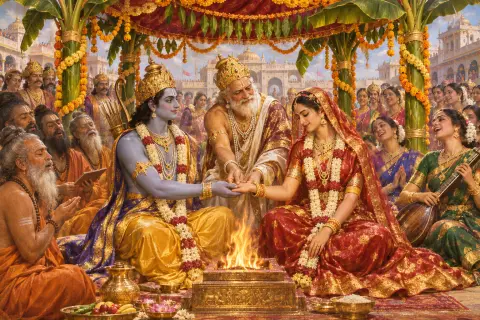 Vivah PanchamiDec 14, 2026The anniversary of her wedding to Rama in Mithila, when temples in Janakpur, Sitamarhi and Ayodhya stage the wedding all over again.
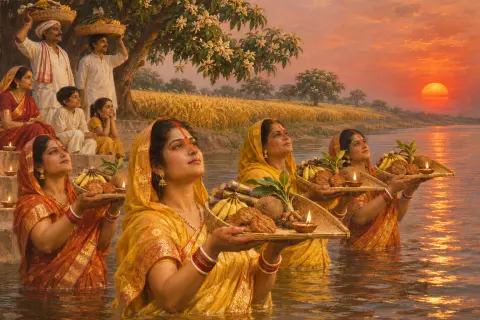 Chaiti ChhathApr 10 - Apr 13, 2027At Munger people point to Sita Charan, a rock in the Ganga, and say Sita kept Chhath there on the advice of the sage Mudgal.
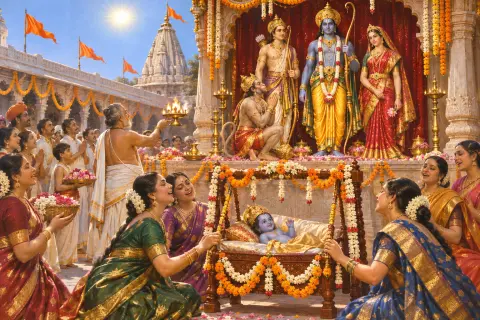 Ram NavamiApr 15, 2027She is worshipped beside Rama in the shrines and processions of his birthday.
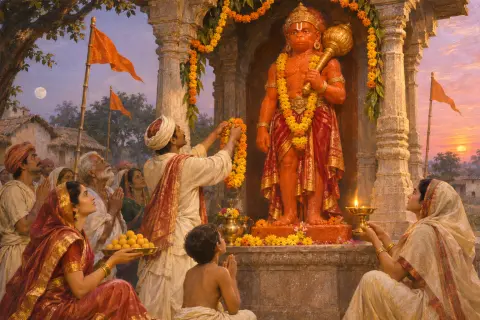 Hanuman JayantiApr 20, 2027The stories told are of Hanuman finding her in Lanka and carrying her message back to Rama.
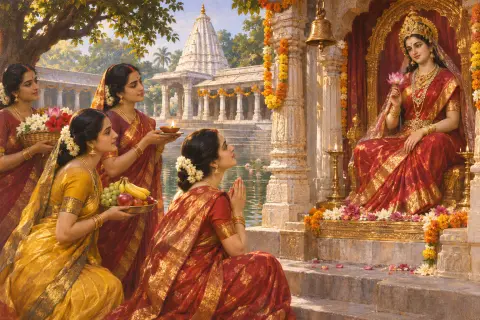 Sita NavamiMay 14, 2027The festival of her birth, when Janaka found her in the furrow, kept on Vaishakha Shukla Navami, especially in Mithila.
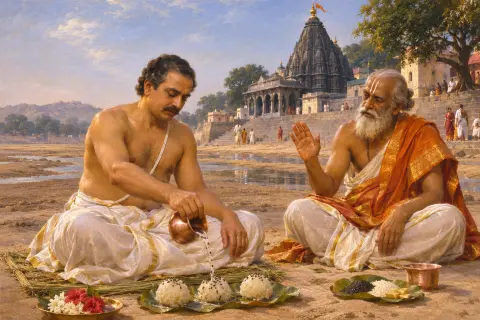 Pitru PakshaSep 15 - Sep 29, 2027A local Gaya tradition says she offered pindas of sand for Dasharatha on the Phalgu when the time for the rite ran out.
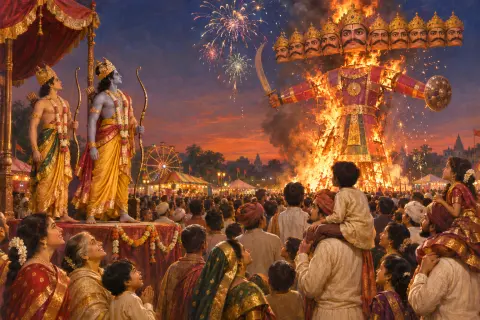 DussehraOct 9, 2027Rama's victory over Ravana, kept on Dussehra, was the war fought to bring her back.
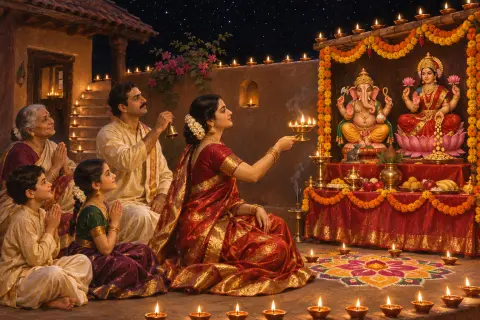 DiwaliOct 29, 2027North India lights lamps for her homecoming to Ayodhya with Rama and Lakshmana.
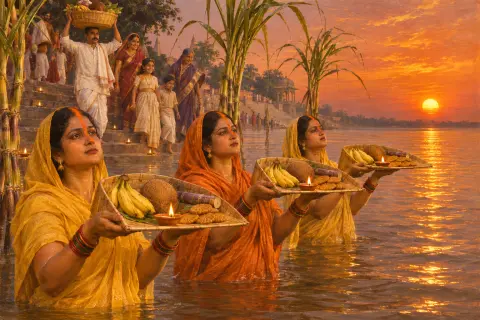 Chhath PujaNov 2 - Nov 5, 2027Bihar tradition says she and Rama kept the first Chhath fast to the sun after returning to Ayodhya.
Paintings
5 paintingsAsk about Sita
Ask Gita Chat about Sita and what their story can teach you.