The Story
The oldest account of Sita's appearance is in the Valmiki Ramayana, Bala Kanda, sarga 66. There King Janaka tells the sage Vishvamitra that while he was ploughing and clearing a field, a girl rose up from the earth at the plough's blade, that he named her Sita, and that she grew up as his daughter, born from no mother's womb (verses 13 and 14). Sita means the furrow made by a plough. Valmiki does not give the day this happened. The date kept today, the ninth day of the bright half of Vaishakha, comes from later tradition and the vrata calendars, and on it devotees remember Sita's appearance as Rama's is remembered on Ram Navami.
The Girl in the Furrow
Janaka was the king of Videha, the land of Mithila, and the Ramayana remembers him as a wise and gentle king. He tells his story simply. He was ploughing a field and clearing the ground, and a girl came up out of the earth with the plough. He took her home and raised her as his own child.
Because she came from the earth and not from a mother, Janaka calls her ayonija, born from no womb. Her name, Sita, is the word for a furrow. Over time she gathered other names: Janaki, daughter of Janaka; Vaidehi, princess of Videha; Maithili, girl of Mithila; and Bhumija, daughter of the earth.
The story is short in Valmiki, but it sets up everything that follows. Because she was a gift from the earth, Janaka would not give her to just anyone. He set the test of Shiva's bow, which only Rama could pass.
Sitamarhi: Where Mithila Says She Appeared
Valmiki does not name the field. Local tradition in Bihar places it in Sitamarhi district. Punaura Dham, about five kilometres from Sitamarhi town, is revered as Sita's birthplace. The local story says Mithila was suffering from drought, and Janaka took up the plough himself to please Indra and bring rain. As he ploughed, an earthen pot came out of the ground, and in it was the infant Sita.
Behind the Sita temple at Punaura Dham is the Janaki Kund, a pond where pilgrims bathe. Tradition says the name Punaura comes from the sage Pundarika, whose ashram stood there. Haleshwar Sthan, a Shiva temple near Sitamarhi, is linked in local belief with the place where Janaka began his ploughing, and Janaki Sthan in Sitamarhi town is another old centre of Sita's worship.
On Sita Navami these places fill with pilgrims from Bihar and Nepal. The Bihar government has also begun a large redevelopment of Punaura Dham as a pilgrimage centre.
Janakpur: The City of Her Childhood
Across the border in Nepal, Janakpur is held to be Janaka's capital, the city where Sita grew up and married Rama. Its Janaki Mandir, a white marble temple completed in 1910 by Queen Vrishabhanu of Tikamgarh, stands where, by tradition, the ascetic Shurkishordas found images of Sita in the seventeenth century.
So Mithila has two great centres for Sita. Sitamarhi says this is where she came out of the earth, and Janakpur says this is where she was raised as a princess. The two do not really compete. For people of Mithila on both sides of the border, she belongs to all of them.
On Sita Navami the Janaki Mandir holds special worship, and the city keeps the day as the birthday of its own princess.
Two Birthdays for Sita
Calendars give Sita two different appearance days, and both are kept. Sita Navami, on the ninth day of the bright half of Vaishakha, is the date followed in north India, Mithila and Nepal. It falls one lunar month after Ram Navami, which many devotees find fitting.
Janaki Jayanti, also called Sita Ashtami, falls on the eighth day of the dark half of the month. In the north Indian purnimanta calendar, where the month ends on the full moon, that day is in Phalguna. In the amanta calendar used in Gujarat, Maharashtra and south India, where the month ends on the new moon, the very same day is counted in Magha. So the name of the month differs, but it is one date, about two months before Sita Navami.
The two dates come from different traditions and texts, and no single scripture settles the question. Many devotees simply honour Sita on both days.
How the Day Is Kept
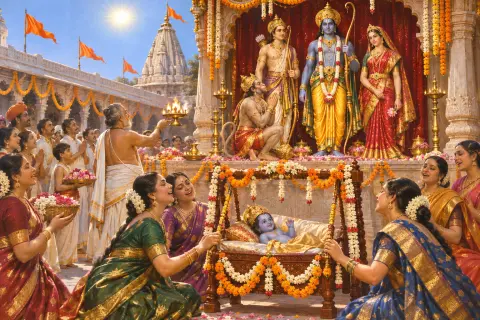
Many married women fast on Sita Navami and pray for their husbands' long life and a peaceful home, as Sita is seen as the model of a devoted wife. Others fast simply out of love for Sita. The worship is usually done around midday, the time tradition gives for her appearance, with Rama worshipped beside her.
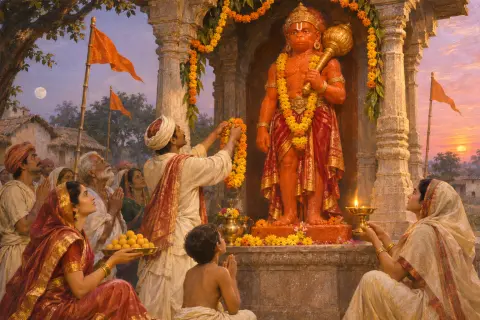
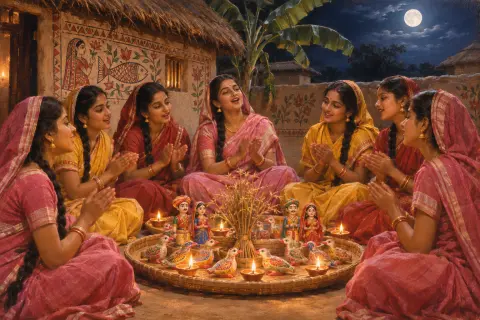
Families set up images of Sita and Rama, offer flowers, fruit, sweets, red cloth and the things of a married woman such as sindoor and bangles, and read from the Ramayana or the Ramcharitmanas. In Mithila homes, women sing songs about Janaki, the daughter of their own land.
Because Sita came from a ploughed field, the day also carries a quiet respect for the earth, the farmer's work and the harvest that feeds everyone.
In the Gita (7.4) Krishna says that earth, water, fire, air and space, together with mind, intellect and the sense of self, are his own nature, divided eightfold. Sita rose from that earth, out of a furrow made by a farmer's plough. Sita Navami asks us to see the sacred in the ground under our feet and in the work that brings food out of it, and to treat both with care.