Yama is the Hindu god of death and the judge of the dead, also called Yamaraja and Dharmaraja, the king of dharma. In the Rigveda he is the first mortal who died and found the road to the world of the ancestors, and he rules over them there. In the Katha Upanishad he teaches the boy Nachiketa about the soul that never dies, and in the Mahabharata he gives Satyavan back to Savitri. Families remember him with a lamp on Dhanteras, with Yamuna and Chitragupta on Bhai Dooj, and during Pitru Paksha.
Also called: Yamaraja (king Yama), Dharmaraja (king of dharma), Vaivasvata (son of Vivasvat, the Sun), Kala (time), Antaka (the ender), Kritanta (who brings an end), Mrityu (death), Pitripati (lord of the ancestors), Samavartin (who treats all alike), Dandadhara (holder of the staff), Yamunabhrata (Yamuna's brother)
Parents: Vivasvat or Surya, the Sun, and Saranyu, called Sanjna in the Puranas
Twin sister: Yami, who in the Puranas becomes the river Yamuna
Brothers: Vaivasvata Manu; Shani is his half brother through Chhaya
Wife: Dhumorna in the Mahabharata and the Vishnudharmottara Purana; other texts give other names
Son: Yudhishthira, born to Kunti from Dharma, whom many identify with Yama
Mount: a black water buffalo
Home: Yamaloka in the south, with its city Samyamani (Bhagavata Purana, Book 5, chapter 21)
Court: Chitragupta keeps the records; the Yamadutas are his messengers
Honour with an offering King Yama, son of Vivasvat, who gathers all people together: he went along the great steep slopes and found the path for many.
Stories
Yama is one of the oldest figures in Hindu scripture, and he changes a great deal over the centuries. In the Rigveda (Book 10, hymns 10, 14 and 135) he is a king of the ancestors, the first human to die and find the way to the next world, honoured with offerings and not feared. In the Katha Upanishad he is a teacher who explains the self that does not die. In the Mahabharata he is Dharmaraja, strict but open to reason, who can be moved by a wise and loving wife. In the Puranas he becomes the judge of the dead, with Chitragupta reading out each person's deeds and his messengers fetching souls to his city in the south. Festival customs keep all of these sides alive.
The First to Walk the Road
The Rigveda's funeral hymn (Book 10, hymn 14) opens by asking people to honour King Yama, son of Vivasvat, who went over the great slopes and found the path for many. The next verse says Yama was the first to find the way for us, a pasture that can never be taken away, where our fathers went before us. The Atharvaveda (18.3.13) says it plainly: he was the first of mortals to die and the first to go to that world.
So the Vedic Yama is not a monster. He is the first ancestor to make the journey, and he waits at the end of it to welcome those who follow. The hymn tells the dead person to go by the old paths, to meet the fathers and Yama, and to leave all fault behind. Two broad-nosed, four-eyed dogs, sons of Sarama, guard the road, and the hymn asks them to let the traveller pass safely.
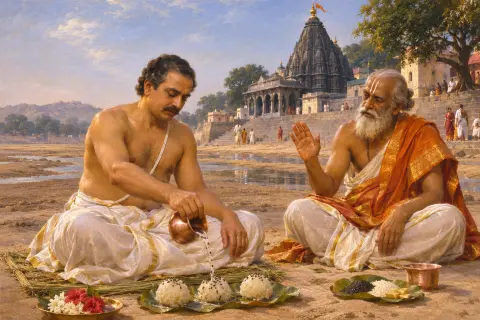
This is why Yama is the lord of the pitrs, the ancestors. When families offer food and water to their dead during Pitru Paksha, facing south, they are offering into the world over which he rules.
Yama and Yami
Yama had a twin sister, Yami. In Rigveda Book 10, hymn 10, the two of them speak in turns. Yami, lonely in a world with no one else, asks her brother to be her husband so that the human race can continue. Yama refuses. He says it is not right between brother and sister, that the gods watch everything, and that she should find another husband.
The hymn ends with the refusal. It is one of the oldest discussions of right and wrong in any Indian text, and it shows Yama already holding to dharma when it is hard to say no.
Later the Puranas tell the twins' story differently. The Markandeya Purana (chapters 77 and 78) says their mother Sanjna could not bear the Sun's heat and left her shadow, Chhaya, in her place. Chhaya favoured her own children, and when the young Yama raised his foot at her in anger, she cursed it. The Sun softened the curse, and later made Yama the lord of the dead and of dharma, while Yami became the river Yamuna. The Matsya Purana (chapter 11) tells the same story with small differences.
Nachiketa at Yama's Door
Yama comes home to find Nachiketa, who has waited three nights at his door.
The Katha Upanishad (chapter 1), which builds on an older telling in the Taittiriya Brahmana, begins with a sacrifice. Vajashravasa was giving away all he owned, but the cows he gave were old and dry. His young son Nachiketa was troubled and asked, "To whom will you give me?" He asked twice, and a third time. His father, angry, answered: "To Death I give you."
Nachiketa went to the house of Yama. Yama was away, and the boy waited at his door for three nights without food. When Yama returned, he was upset that a Brahmin guest had gone hungry in his house, and he offered three boons, one for each night.
For the first, Nachiketa asked that his father be calm and welcome him back. For the second, he asked to learn the fire sacrifice that leads to heaven, and Yama taught it and named it the Nachiketa fire after him. For the third, he asked what happens to a person after death. Yama tried to put him off. He offered long life, sons and grandsons, cattle, gold, horses and kingdoms instead. Nachiketa said all of these last only until tomorrow, and kept to his question.
Pleased, Yama taught him. There is the good and there is the pleasant, he said, and the wise choose the good. The self is not born and does not die; it is not killed when the body is killed. The Gita later says almost the same thing in its second chapter. In this story the god of death is the teacher of what lies beyond death.
Savitri Follows Yama
The Mahabharata (Vana Parva, chapters 277 to 283 of the Critical Edition) tells how the princess Savitri married Satyavan knowing he had one year to live. On the last day she went with him into the forest. He lay down with his head in her lap, and she saw a tall, dark, shining figure in red with a noose in his hand. Yama told her that because Satyavan was a good man, he had come himself instead of sending his messengers.
Yama drew out Satyavan's soul and walked south. Savitri followed. Each time he told her to go back, she spoke about dharma, about friendship with good people, about the kindness of the good. Each time he was pleased and gave her a boon, except her husband's life: her father-in-law's sight, his lost kingdom, sons for her father, sons for herself.
When he offered a last boon with no condition, she asked for Satyavan's life, since he had just promised her sons by him. Yama was not tricked. He was moved, and he freed Satyavan gladly and blessed them both with a long life. The story shows Yama as a lord of dharma who listens to good reasoning. Women remember it each year on Vat Savitri.
Dharma: the Sage Mandavya and Yudhishthira
In the Mahabharata, Yudhishthira, the eldest Pandava, is the son of Kunti and the god Dharma (Adi Parva). Yama is called Dharmaraja, and many readers and later traditions take Dharma and Yama to be the same god, though some passages of the epic keep them separate. Yudhishthira is himself often called Dharmaraja after his father.
The Adi Parva (chapter 101 of the Critical Edition) tells how Dharma was once judged himself. The sage Mandavya was wrongly impaled as a thief. When he asked Dharma why, Dharma said that as a child Mandavya had pierced an insect with a blade of grass. Mandavya replied that the punishment was far too heavy for a child's act, and declared that from then on nothing done before the age of fourteen would count as sin. He also cursed Dharma to be born as a human, and Dharma was born as the wise Vidura.
Dharma tests his son twice. In the Vana Parva (chapters 297 and 298) he appears as a yaksha at a lake and asks Yudhishthira a long chain of questions. At the very end of the epic, in the Mahaprasthanika Parva, a dog follows Yudhishthira all the way to heaven's gate. Yudhishthira refuses to enter without it, and the dog reveals himself as Dharma.
Yamuna, Chitragupta and the Lamp at the Door
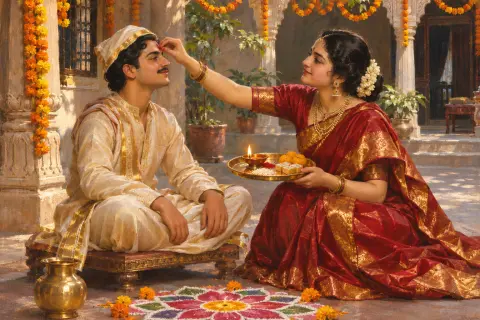
In the Puranas and in household custom, Yama is someone families speak to directly. The Padma Purana (Uttara Khanda, chapter 122) tells how, on the second day of the bright half of Kartika, Yama ate at the home of his sister Yamuna. Pleased, he blessed every brother who visits his sister on that day. That day is Yama Dwitiya, or Bhai Dooj, and in Mathura brothers and sisters bathe together in the Yamuna at Vishram Ghat and worship at the Yamuna and Dharmaraj temple there.
The same day is Chitragupta Puja. Chitragupta, born from Brahma's body with a pen and an inkpot, keeps the record of every person's deeds at Yama's court. The Garuda Purana describes souls arriving before Yama and Chitragupta reading out what they did, so that the judgement is fair.
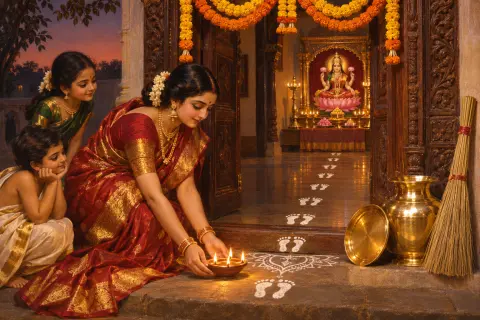
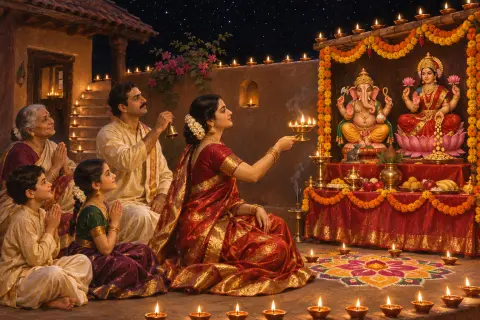
The same Padma Purana chapter asks households to set a lamp outside for Yama on the evening of the thirteenth day of the dark half of Kartika. This is Yama Deepdaan on Dhanteras. Many families in Bihar and Uttar Pradesh light a four-wick lamp for him on Naraka Chaturdashi as well. The lamp faces south, his direction, and the prayer is simple: keep untimely death away from this house.
How to recognise
•Skin dark, like a rain cloud. The Mahabharata (Vana Parva) describes him as dark and shining, with red eyes, a crown on his head and red clothes, and that is how most paintings show him.
•A rope noose (pasha) in one hand. With it he draws the life out of the body; in the Savitri story he binds Satyavan's soul with it.
•A staff or mace (danda) in the other hand. The danda is the rod of justice and punishment, which is why he is called Dandadhara, the holder of the staff.
•His mount is a black water buffalo, often with a bell at its neck. He rides it or it stands beside him.
•Chitragupta often sits near him with a pen and a book of records, and in temple carvings the Vishnudharmottara Purana also places Kala (time) beside him.
•Two four-eyed dogs, Shyama (dark) and Shabala (spotted), guard his road in the Rigveda (10.14.10 to 12). They appear in older art more than in modern pictures.
•On temple walls he guards the south as one of the eight dikpalas, the guardians of the directions. The lamp for him on Dhanteras faces south for the same reason.
I am Ananta among the Nagas; I am Varuna among water-deities; Aryaman among the Manes I am; I am Yama among the governors.
Krishna says, "Among those who keep order and restraint, I am Yama." Yama is named here as the one who governs and holds everything to its law, the side of him the title Dharmaraja points to.
Thou art Vayu, Yama, Agni, Varuna, the moon, the Creator, and the great-grandfather. Salutations, salutations unto Thee, a thousand times, and again salutations, salutations unto Thee.
After seeing the cosmic form, Arjuna praises Krishna as Vayu, Yama, Agni, Varuna and the Moon. Yama is named among the great gods who are all seen as forms of the one Lord.