The Story
The oldest written account of Bhai Dooj is in the Padma Purana (Uttara Khanda, chapter 122). It says that on the second day of the bright half of Kartika, Yama, the god of death, ate a meal at the home of his sister Yamuna, and so on this day brothers should go to their sisters' homes, eat from their hands and give them gifts. That is why the day is also called Yama Dwitiya. Families tell the fuller story like this.
Yamuna Waits for Her Brother
Yama and Yamuna are twins, the children of Surya, the sun god, and his wife Sanjna. Yama became the lord of death and the keeper of dharma for those who have died. Yamuna became the river that flows past Mathura and Vrindavan. The family story told around Bhai Dooj begins after they had grown up and gone their separate ways.
Yamuna loved her brother and missed him. Again and again she sent word asking him to come to her home and eat with her. Yama always meant to go, but his work never stopped. Every moment, somewhere in the world, someone was dying and he had to be there. Years passed this way, with invitations sent and visits put off.
Many people recognise themselves in this part of the story. A sister keeps calling, a brother keeps saying he will come soon, and life keeps getting in the way. The story does not blame Yama for being busy. It simply shows how easily the people who love us can be left waiting.
Yama Finally Comes Home
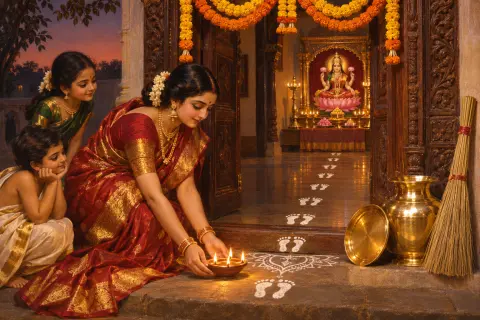
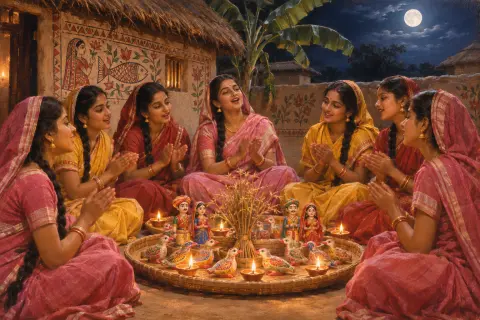
On the second day of the bright half of Kartika, Yama finally set his work aside and went to see his sister. Yamuna was overjoyed. She bathed and dressed with care, welcomed him at the door, put a tilak on his forehead, performed aarti and cooked a meal for him with her own hands.
Yama was moved. Nobody looked forward to a visit from the god of death, yet here was someone who had waited for him for years and greeted him with nothing but love. He asked Yamuna to choose a boon. She did not ask for anything for herself. She asked that he come to her every year on this day, and that any brother who visits his sister on this day and accepts her tilak and food should be free from the fear of an untimely death.
Yama granted it. From then on, the tradition says, this day became Yama Dwitiya, and a brother who goes to his sister's home on it carries her blessing and Yama's promise. In the Braj region many people also bathe in the Yamuna on this day, especially at Vishram Ghat in Mathura, with brothers and sisters going into the river together.
Krishna and Subhadra
A second story, told especially in the Krishna tradition, connects Bhai Dooj with the Diwali days before it. The demon king Narakasura had held thousands of women captive and frightened the gods. Krishna, with his wife Satyabhama beside him, fought and killed him. That victory is remembered on Naraka Chaturdashi, a day before the Diwali new moon.
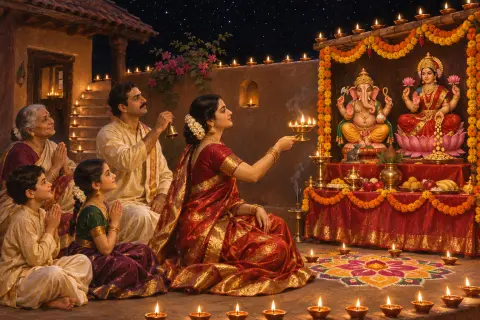
After the battle, Krishna went to visit his younger sister Subhadra. She was so happy to see him safe that she welcomed him with a lamp, sweets and flowers, and put a tilak on his forehead. Families who tell this version say the custom of sisters putting tilak on brothers on this day comes from that welcome.
The two stories have the same heart. In both, a brother comes home after hard work or danger, and a sister is waiting to receive him with a lamp and food. Which story your family tells usually depends on where your family comes from.
One Day, Many Names
In Bengal the day is Bhai Phonta. The sister puts a phonta, a small mark of sandalwood paste, kajal and curd, on her brother's forehead with her little finger, and says a short rhyme asking that thorns be laid at Yama's door so that her brother may live long. Many sisters fast until the phonta is done.
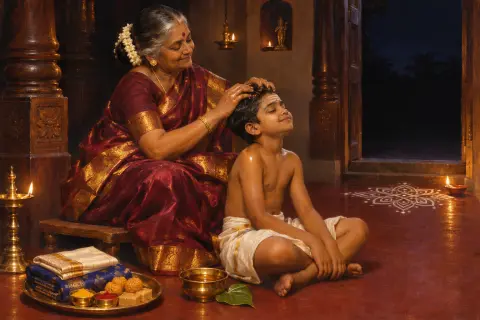
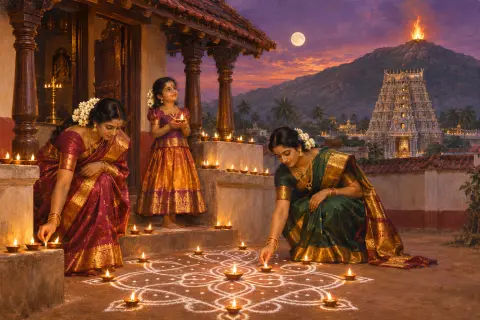
In Maharashtra, Goa and parts of Karnataka it is Bhau Beej. The brother sits on a low seat, often inside a rangoli, the sister does aarti, applies tilak and serves a meal, and the brother gives her a gift. In some Maharashtrian homes, a girl who has no brother does the aarti to the moon instead, treating him as her brother.
In Nepal, Bhai Tika is the last and biggest day of Tihar. The sister walks around her brother, pours a ring of oil and water around him for protection, and puts on his forehead a tika of seven colours, the saptarangi tika, with a garland of makhamali flowers that stay fresh for a long time. The brother gives her a tika in return. In north India the day is mostly called Bhai Dooj or Bhaiya Dooj. The same day is also Chitragupta Puja, when many Kayastha families worship Chitragupta, Yama's record keeper, along with their pens and account books.
In Bihar, Jharkhand and the Bhojpuri speaking districts of eastern Uttar Pradesh, the morning starts with Godhan kutai. Women shape Godhan from cow dung in the courtyard or near the door, often as a small enclosure standing for Yama's world, with figures of Yama, his sister Yami, snakes and scorpions. Then comes the part that surprises outsiders: each sister "curses" her brother, even wishing him dead, and then pricks her own tongue with a thorn of the rengni, a thorny wild plant, as penance for the harsh words and to take the curse back.
The women then pound the Godhan with a wooden pestle while singing songs that ask for Yama's door and the brother's enemies to be beaten away. The belief, told in a local folk story, is that Yama cannot take a brother whose sister has cursed him, so the curse becomes a shield. After the pounding the sisters put tilak on their brothers, feed them and pray for their long life, and the brothers give gifts. This is a folk custom of the region, not something found in the Puranas.
How It Differs From Raksha Bandhan
People often compare Bhai Dooj with Raksha Bandhan, and both are about brothers and sisters. But they feel different. On Raksha Bandhan the sister ties a rakhi on her brother's wrist and he promises to protect her. On Bhai Dooj there is no thread. The centre of the day is the tilak and the meal.
The direction of travel is different too. In the old custom, the brother goes to his sister's home, often her married home, and she hosts him. It is the sister's prayer for her brother's long life that the day is built around, and the brother's part is to show up, eat what she has made and give her something in thanks.
Yama could stop every life in the world, and still he could not refuse a sister who had waited so long for him. Bhai Dooj asks for something simple: go to the people who love you, sit at their table, and let them care for you. A visit you keep postponing may matter more than you think.