The Story
The oldest written instruction for this day is in the Padma Purana (Uttara Khanda, chapter 122), the same chapter that gives the rule for Yama Dwitiya, the last day of Diwali. It tells households to set a lamp outside for Yama at dusk on the thirteenth day of the dark half of Kartika, so that untimely death stays away from the home. The day is also kept as the birthday of Dhanvantari, the physician of the gods, whose rising from the churned ocean with a pot of nectar is told in the Bhagavata Purana (Canto 8, chapter 8). The Bhagavata does not give a date for that; the link with this Trayodashi comes from later tradition. The name is read two ways: "dhan" as wealth or as Dhanvantari, and "teras" as the thirteenth day.
Day One of Five
Diwali is a run of five days, and Dhanteras opens it. Next comes Naraka Chaturdashi, also called Chhoti Diwali, when Krishna's defeat of the demon Narakasura is remembered. Then Diwali itself, the new moon night of Lakshmi Puja. Then Govardhan Puja, for the hill Krishna lifted to shelter Braj from Indra's rain. And last, Bhai Dooj, when sisters welcome their brothers home.
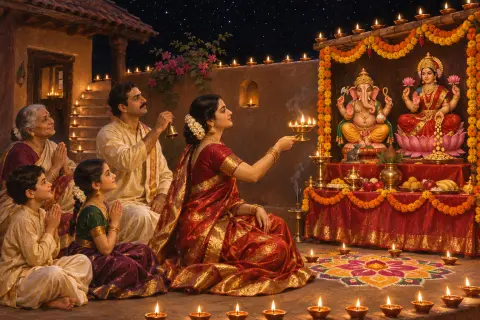
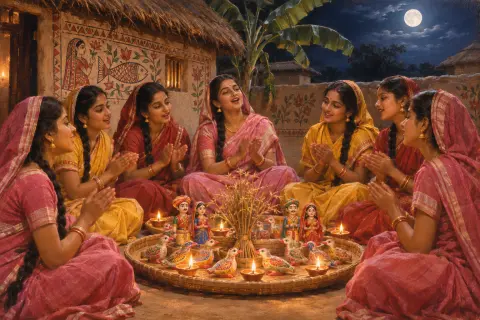
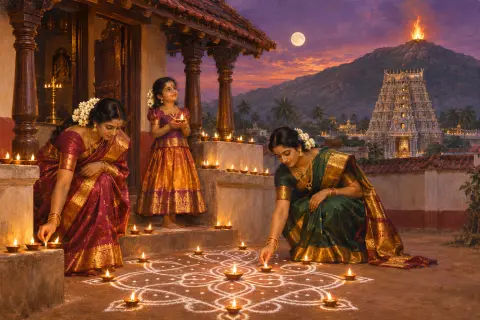
Dhanteras sets the tone for the rest. The house has been cleaned and whitewashed, the first lamps go up, and families bring home something new to welcome Lakshmi. Depending on how the lunar days fall, two of the five days sometimes share one date.
Dhanvantari Rises From the Ocean
The Bhagavata Purana tells how the gods and the demons, wanting the nectar of immortality, churned the ocean of milk using Mount Mandara as the churning rod and the serpent Vasuki as the rope. One after another, wonders rose from the water: the wish-giving cow, the white horse Uchchaihshravas, the elephant Airavata, the Kaustubha jewel, the Parijata tree, and the goddess Lakshmi, who chose Vishnu.
Last of all, the text says (8.8.31 to 35), a wonderful person rose from the ocean. He was young and dark, with long strong arms, a broad chest and curling hair, dressed in yellow, wearing pearl earrings and bangles, and in his hand he held a jar filled to the brim with nectar. This was Dhanvantari, a partial form of Vishnu, who knew the whole science of medicine.
The demons snatched the jar from his hands, and Vishnu had to win it back as Mohini. But Dhanvantari stayed in memory as the god of healing and the teacher of Ayurveda. That is why on this day Ayurvedic physicians and many households worship him and pray for health before wealth.
King Hima's Son
The best known Dhanteras story is a vrat katha, told in homes rather than taken from a Purana. King Hima had a son. When the boy's horoscope was cast, it said he would die of a snakebite on the fourth day after his wedding.
When that night came, his young wife would not let him sleep. She heaped all her jewellery and the gold and silver coins of the house at the door of their room, lit lamps all around, and kept him awake with stories and songs through the night.
Yama came as a serpent. But the shine of the lamps and the gold dazzled his eyes and he could not get through the door. He climbed onto the heap of jewels and sat there listening to her songs, and when morning came he quietly went away. Families say this is why gold and lamps belong to this night, and why a lamp is set out for Yama.
The Lamp for Yama
At dusk on Dhanteras, many households place a lamp outside the main door, facing south, the direction of Yama. It is often a clay or wheat flour lamp with four wicks and mustard oil. This is Yama Deepdaan, the gift of a lamp to the lord of death, asking him to keep untimely death away from the family.
A verse is often said with it: "mṛtyunā pāśadaṇḍābhyāṃ kālena śyāmayā saha, trayodaśyāṃ dīpadānāt sūryajaḥ prīyatāṃ mama", "may the son of the Sun, with Death, his noose and staff, Time and his consort Shyama, be pleased by this lamp given on the thirteenth day". A similar verse is given in the Padma Purana, and puja manuals print it with small differences in wording.
The lamp is not lit for the gods inside the house. It is set outside, at the edge of the home, for the one guest no family wants. That makes it one of the most honest rituals of Diwali: before the celebration, a family quietly asks for the gift of more time together.
New Metal, a New Broom, and Bihar's Dhanteras
Buying something in metal on Dhanteras is a custom across north and west India. Families who can afford it buy gold or silver coins or jewellery; most buy at least one new brass, copper or steel utensil. Many people bring home a new broom too, since the broom is thought of as Lakshmi's, sweeping poverty out of the house. These are customs of faith rather than rules of scripture. In the evening Lakshmi is worshipped, and in many homes Kubera, the treasurer of the gods, and Dhanvantari as well. In Gujarat and Maharashtra traders also honour their account books and stock around these days.
In Bihar, across Mithila, Bhojpur, Magadh and Anga, Dhanteras evening means a trip to the bazaar for a new utensil, and the bazaars of Patna and the district towns are crowded until late. At dusk the Yama diya is set outside the main door facing south, and a small puja is done at home, with the big Lakshmi Puja left for Diwali night.
Dhanteras is also Dhanvantari Jayanti. When the Government of India started National Ayurveda Day in 2016, it chose this day for it. Because Dhanteras moves between mid-October and mid-November, the Ministry of Ayush fixed Ayurveda Day on 23 September every year from 2025. Ayurvedic colleges and physicians still worship Dhanvantari on Dhanteras.
In the Gita (17.8) Krishna says that the foods dear to the sattvic person increase life, purity, strength, health, joy and contentment. Dhanteras puts things in that order too: Dhanvantari before Lakshmi, a lamp against untimely death before the lamps of celebration. An old saying puts it simply: the first happiness is a healthy body. Wealth is welcome, but it is worth most in a house where everyone is still there to share it.