Vishnu is the Hindu god who keeps the world going and comes down to set it right when dharma fails. In the Rigveda he is a smaller god, praised for the three great strides with which he measured the worlds. In the Mahabharata, the Vishnu Purana and the Bhagavata Purana he becomes the supreme god for his devotees, who rests on the serpent Shesha in the ocean of milk with Lakshmi at his feet and is born again and again as avatars such as Rama and Krishna. He is worshipped across India, on every Ekadashi, through the four months of Chaturmas, and at Diwali, Janmashtami, Ram Navami and Onam.
Also called: Narayana (the one who rests on the waters), Hari (the one who takes away sorrow), Keshava, Madhava, Govinda, Achyuta (the one who never falls), Janardana, Vasudeva, Padmanabha (lotus-navelled), Trivikrama (the one of three strides), Upendra, Hrishikesha, Damodara, Jagannath, Vitthal and Vithoba (in Maharashtra), Venkateswara and Balaji (at Tirumala), Ranganatha (at Srirangam), Perumal (in Tamil)
Wives: Lakshmi (also called Shri); Bhudevi, the earth; in South Indian temples also Nila
Mount: Garuda
Bed: the serpent Shesha (Ananta) on the ocean of milk
Home: Vaikuntha; in the Puranas also Shvetadvipa in the ocean of milk
Born from his navel: Brahma, on a lotus
Vedic family: one of the twelve Adityas, sons of Aditi and Kashyapa, and the younger brother of Indra (hence Upendra)
Day: Thursday, and the eleventh day of each lunar fortnight (Ekadashi)
तद्विष्णोः परमं पदं सदा पश्यन्ति सूरयः ।
दिवीव चक्षुराततम् ॥
tad viṣṇoḥ paramaṃ padaṃ sadā paśyanti sūrayaḥ,
divīva cakṣur ātatam.
The wise always see that highest step of Vishnu, spread out like an eye in the sky.
Stories
Vishnu's story grows over two thousand years. The Rigveda has only a handful of hymns to him, mainly 1.154 to 1.156 and 7.99 to 7.100, where he is a friend of Indra who strides across the three worlds. The Brahmanas link him to the sacrifice itself. In the Mahabharata, with the Bhagavad Gita and the Narayaniya section of the Shanti Parva, Vishnu and Narayana become one supreme god who takes birth whenever the world needs him. The Vishnu Purana and later the Bhagavata Purana tell his stories in full, and their lists of avatars shaped the familiar ten. The stories below follow those texts in order.
The Three Strides in the Rigveda
The oldest hymns to Vishnu praise one deed above all. Rigveda 1.154 asks who can tell of the heroic deeds of Vishnu, who measured out the earthly regions and propped up the upper dwelling, striding three times. In his three wide steps, the hymn says, all creatures live. His highest step is a place of joy where there is a spring of honey, and where those devoted to the gods find delight.
Hymn 1.22 says it shortly: Vishnu strode across this world and set down his foot three times (verse 17); he is the protector who cannot be harmed (verse 18); watch his deeds, he is Indra's close friend (verse 19). Verse 20 is the one at the top of this page: the wise always see his highest step, spread like an eye in the sky.
The Shatapatha Brahmana (1.2.5) gives the strides a story. The gods and the asuras were dividing the earth. The asuras, sure of themselves, said the gods could have as much as Vishnu could lie on, and Vishnu was a dwarf. But Vishnu was the sacrifice, and by worshipping him the gods won the whole earth. This is the seed of the later tale of Vamana and King Bali.
Narayana on the Waters: Shesha and Yoga-nidra
Vishnu asleep on Shesha, with Lakshmi at his feet and Brahma on the lotus from his navel.
The name Narayana is often explained by a verse found in the Manusmriti (1.10) and the Mahabharata: the waters are called nara, and since they were his first resting place, he is called Narayana. Between one world and the next, when everything has dissolved into a single ocean, he lies on the serpent Shesha, whose other name, Ananta, means the endless. The Vishnu Purana (Book 2, chapter 5) says Shesha also holds the earth on his hoods.
This sleep is yoga-nidra, a sleep of deep awareness rather than dullness. From Vishnu's navel a lotus grows, and Brahma is born on it to make the world again. The Devi Mahatmya (chapter 1) tells how two demons, Madhu and Kaitabha, sprang from Vishnu's ears while he slept and went to kill Brahma. Brahma praised the goddess Yoganidra who held Vishnu in sleep; she left his body, he woke and killed them (the Navaratri page tells this).
The yearly calendar repeats this rest. On Devshayani Ekadashi in Ashadha (June or July) Vishnu is said to lie down on Shesha, and on Prabodhini or Dev Uthani Ekadashi in Kartika (October or November) he wakes. The four months between are Chaturmas, when many families avoid weddings and monks stay in one place. The Narada Purana gives the prayer said at this time: when you sleep, Lord, the world sleeps; when you wake, it wakes with you.
Gajendra, the Elephant Who Called Him
The Bhagavata Purana (Book 8, chapters 2 to 4) tells of Gajendra, a king of elephants, who went to bathe in a lotus lake with his herd. A crocodile seized his leg. They struggled for a thousand years, the Purana says, and slowly the elephant's strength gave out, while his family could do nothing.
At last Gajendra stopped trusting his own strength. He lifted a lotus in his trunk and prayed to the one beyond all forms, without naming any god. Vishnu heard him and came at once on Garuda, pulled him out of the water with the crocodile and cut the crocodile's mouth open with his discus.
The Purana says the crocodile was a gandharva freed from a curse, and Gajendra was a king who had once ignored a sage. The prayer, the Gajendra Stuti, is still recited by people in trouble, and local tradition places the fight at Sonepur, where the Gandak meets the Ganga and a great fair is held on Kartik Purnima.
The Thousand Names
In the Anushasana Parva of the Mahabharata, Bhishma lies on his bed of arrows after the war, and Yudhishthira asks him who is the one god and what prayer frees a person. Bhishma answers with a thousand names of Vishnu, the Vishnu Sahasranama, starting with Vishva, the whole universe.
The hymn is chapter 135 of the Anushasana Parva in the Pune critical edition and chapter 149 in older printed editions. Adi Shankara wrote a commentary on it, and so did teachers of other schools. It is recited daily in many homes and temples, and the opening salutation to Vyasa as a form of Vishnu is on the Guru Purnima page.
Lord of Temples and Pilgrims
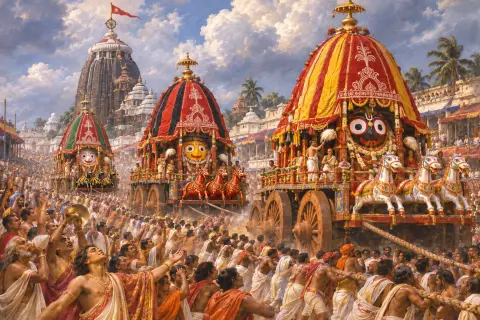
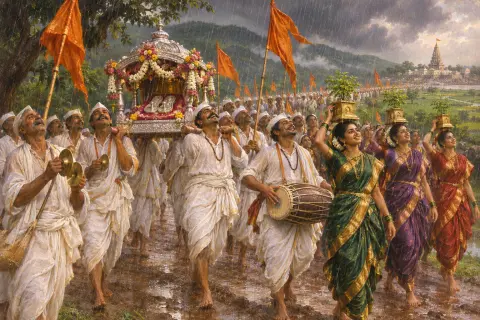
Vishnu is worshipped under many local names. At Tirumala in Andhra Pradesh he is Venkateswara, one of the most visited temples in the world. At Srirangam on an island in the Kaveri he is Ranganatha, lying on Shesha, and at Thiruvananthapuram he is Padmanabha, so long that devotees see him through three doors. At Puri he is Jagannath, and at Pandharpur he is Vitthal, standing on a brick.
The Tamil Alvar poets, between about the sixth and ninth centuries, sang of 108 holy places of Vishnu, the Divya Desams. Their songs, collected as the Divya Prabandham, are still sung in South Indian temples. In the north, Badrinath in the Himalaya is one of the four great pilgrimages.
At home, devotees fast on Ekadashi, worship a Shaligram stone with tulsi leaves and say his names. The Tulsi Vivah, when the tulsi plant is married to the Shaligram, comes right after he wakes on Dev Uthani Ekadashi.
The Ten Avatars
In the Gita (4.7 and 4.8) Krishna says that whenever dharma declines he takes birth age after age, to protect the good and set things right. The Gita does not give a list. Lists of Vishnu's avatars come later and do not agree: the Narayaniya in the Mahabharata names ten that begin with a swan, Hamsa; the Bhagavata Purana (1.3) names twenty-two and says they are countless. The list most people know today is the one Jayadeva sings in the Gita Govinda (12th century): Matsya, Kurma, Varaha, Narasimha, Vamana, Parashurama, Rama, Balarama, Buddha and Kalki. Many lists put Krishna in place of Balarama.
Matsya, the fish, saves Manu from the great flood; the Shatapatha Brahmana (1.8.1) already tells this, without naming Vishnu, and the Matsya and Bhagavata Puranas make the fish Vishnu. Kurma, the tortoise, holds Mount Mandara on his back during the churning of the ocean. Varaha, the boar, dives into the cosmic ocean and lifts up the earth goddess on his tusks; the Taittiriya Samhita (7.1.5) tells this of Prajapati, and the Puranas of Vishnu (the Raja Parba page tells this). Narasimha, the man-lion, comes out of a pillar at dusk to kill Hiranyakashipu and save the boy Prahlada (Bhagavata Purana, Book 7; the Holi page tells this).
Vamana, the dwarf, asks King Bali for three steps of land and grows into Trivikrama, who covers the worlds; this is the Vedic three strides told as a story (Bhagavata Purana, Book 8; the Onam page tells this). Parashurama, Rama with the axe, is a Brahmin warrior who fights the proud kings. Rama of Ayodhya is the hero of the Ramayana, and Krishna, born at midnight in Mathura, speaks the Gita.
Balarama is Krishna's elder brother, the ploughman. Many Puranas include the Buddha as an avatar, though the Buddhist tradition itself does not see him so. Kalki, the tenth, has not yet come: the Vishnu Purana (Book 4, chapter 24) and the Bhagavata (Book 12, chapter 2) say he will appear on a white horse at the end of the Kali Yuga to begin a new age.
How to recognise
•He has dark blue or dark cloud-coloured skin, the colour of the sky and of deep water. He stands, sits or lies on a serpent, and almost always has four arms.
•His four hands hold the Sudarshana discus, the Panchajanya conch, the Kaumodaki mace and a lotus. The order of the four changes from image to image, and South Indian temple traditions give a name to each arrangement (Keshava, Narayana, Madhava and so on).
•He wears a tall crown (kirita), yellow silk (pitambara), the Kaustubha jewel on his chest beside the Shrivatsa mark, and a long garland of forest flowers called the vanamala or vaijayanti.
•The Vishnu Purana (Book 1, chapter 22) explains the symbols: the Kaustubha is the pure soul of the world, the Shrivatsa is primal matter, the mace is the intellect, the conch and the bow are the two sides of the ego, and the discus is the mind, faster than the wind.
•His mount is Garuda, the eagle-man, often kneeling before him with folded hands. His bed is Shesha, also called Ananta, a serpent with five or seven hoods spread over his head like a canopy.
•In the reclining form, Anantashayana, he sleeps on Shesha in the ocean of milk. Lakshmi sits at his feet, and a lotus grows from his navel with Brahma seated on it. Great temples at Srirangam and Thiruvananthapuram show him this way.
•Many Vaishnava homes and temples worship him without any image, as a black Shaligram stone from the Gandaki river, or as the tulsi plant's companion.
Among the (twelve) Adityas, I am Vishnu; among luminaries, the radiant sun; I am Marichi among the (seven or forty-nine) Maruts; among stars the moon am I.
Among the Adityas, Krishna says, I am Vishnu. In the Vedas Vishnu is one of the twelve sons of Aditi, and the Gita names him as the greatest of them.
On seeing Thee (the Cosmic Form) touching the sky, shining in many colours, with mouths wide open, with large fiery eyes, I am terrified at heart and find neither courage nor peace, O Vishnu.
Seeing the universal form touching the sky, Arjuna is shaken and cries out, O Vishnu, I find no courage and no peace. Here Arjuna addresses Krishna directly by the name Vishnu.
Thou lickest up, devouring all the worlds on every side with Thy flaming mouths. Thy fierce rays, filling the whole world with radiance, are burning, O Vishnu!
Arjuna calls him Vishnu again: your fierce rays fill the whole world and scorch it, O Vishnu. In chapter 11 the name stands for the all-pervading god Arjuna now sees.
I desire to see Thee as before, crowned, bearing a mace, with the discus in hand, in Thy former form only, having four arms, O thousand-armed, Cosmic Form (Being).
Arjuna asks to see him again with a crown, a mace and a discus in hand, in his four-armed form. This is the familiar image of Vishnu. In 11.50 Krishna takes on his own gentle form again.
Whenever there is decline of righteousness, O Arjuna, and rise of unrighteousness, then I manifest Myself.
Whenever dharma declines and adharma rises, Krishna says, I bring myself forth. The verse does not name Vishnu, but the whole later idea of Vishnu's avatars rests on it.
For the protection of the good, for the destruction of the wicked and for the establishment of righteousness, I am born in every age.
To protect the good, to end the wicked and to set dharma firmly in place, I am born age after age. The Puranas use these words to explain why Vishnu comes again and again.
I am Ananta among the Nagas; I am Varuna among water-deities; Aryaman among the Manes I am; I am Yama among the governors.
Among the nagas, Krishna says, I am Ananta. Ananta is another name of Shesha, the serpent on whom Vishnu rests in the Puranas; the Gita names him but does not mention the bed.