The Story
The oldest written source for the day is a verse in the Narada Purana (Purva Bhaga, chapter 110, verse 5), in its chapter on the pratipada vows of the twelve months. It says that Brahma created the whole world on the first day of the bright half of Chaitra, at sunrise. That is why this day is counted as the first day of the year. Many popular accounts credit the same idea to the Brahma Purana. The gudi itself is not described in the Puranas. It is a Maharashtrian custom, and families explain it with the stories below.
The day the world began
The oldest reason given for the day is that it is when Brahma began creation. The Narada Purana puts it in one line: in the month of Chaitra, on the first day of the bright half, at sunrise, Brahma created the entire world. That is why this day, and not some other, is counted as the start of the year.
So the new year is not only a change of calendar page. It is remembered as the morning of everything. People bathe early, often with oil, put on new clothes, and clean the house and doorway as if setting things in order for the first time.
Rama comes home
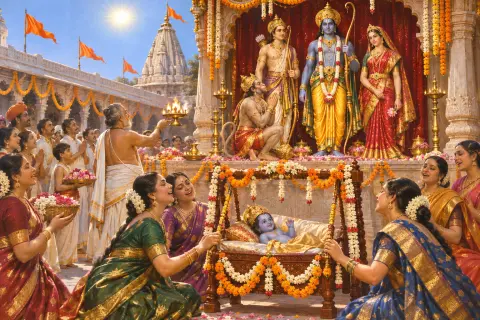
In Maharashtra many families say the gudi is a victory flag for Rama. In this telling, Rama returned to Ayodhya after defeating Ravana and ending his fourteen years of exile, and the people raised flags on their houses to welcome him. The gudi, standing high at the doorway, is that flag.
It is worth saying plainly that this is a popular regional belief. The Valmiki Ramayana does not tie Rama's return to this date, and in much of north India his homecoming is remembered at Diwali. But the feeling behind the gudi is the same in both: someone you love has come home, and the house shows it.
The start of the Shaka era
Gudi Padwa also begins a new year of the Shaka era, the calendar that Maharashtra and many other regions use for religious dates. Tradition names it after King Shalivahana, a Satavahana ruler of the Deccan, and the Marathi new year is often called the start of the Shalivahana Shaka.
A well-known folk story says Shalivahana made an army out of clay figures, breathed life into them and defeated his enemies, and that the era was counted from his victory. Historians treat the link between the king and the era as tradition rather than settled fact. Either way, the day carries a sense of a people starting to count their own time.
Raising the gudi
The gudi is put up soon after sunrise. The pole is washed, a new cloth (often a silk piece or a saree, in green, yellow or red) is tied near the top, and neem leaves, mango leaves, a flower garland and a string of sugar crystals called gathi are added. The upturned pot sits over the tip. A rangoli is drawn on the ground beneath it.
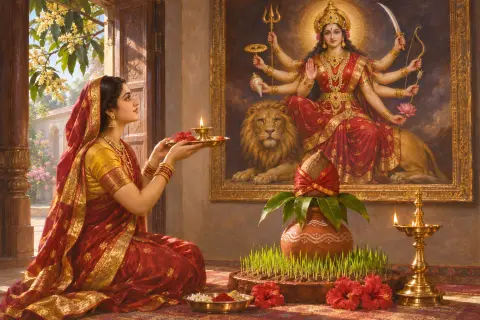
The family offers haldi, kumkum, flowers and a lamp to the gudi and prays for a good year. It is raised on the right side of the entrance or at a window where everyone can see it. Around sunset it is taken down with the same care, and the sugar garland is shared among the children.
Neem, jaggery and a new year's meal
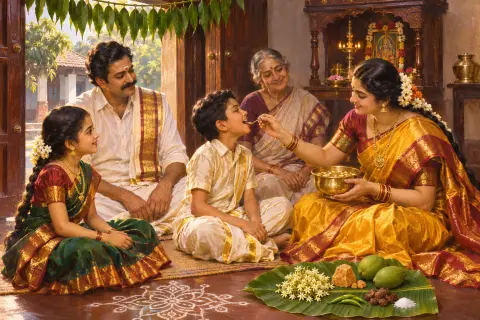
Before anything sweet, many families eat a small paste of tender neem leaves mixed with jaggery, and sometimes tamarind, cumin or soaked lentils. It is bitter first and sweet after. Elders say it is good for the body as summer begins, and that it reminds you the year will bring both kinds of days.
Then comes the feast: shrikhand with puris, puran poli, and seasonal dishes made with the first raw mangoes. Konkani families in Goa call the day Samsar Padvo and keep similar customs. Many people also read or listen to the panchang for the new year, and Gudi Padwa is counted as one of the most auspicious days of the year to start something new, buy gold or move into a new home.
Gudi Padwa remembers the morning Brahma began creation. In the Gita (3.10) Krishna tells the same beginning from another side: in the beginning the Creator made people together with yajna, the spirit of offering, and told them to grow and prosper through it. The gudi, the prayers and the shared meal are small offerings of that kind, made at the start of the year. The bitter leaf eaten with jaggery keeps it honest: even a good year has hard days, and what matters is meeting them with a steady and grateful heart.