The Story
The oldest written mention of the Kartika full moon as a holy day is in the Mahabharata. In the Vana Parva (chapter 82 in the common edition), the sage Pulastya, describing the holy places of India, says that whoever goes to Pushkar on the full moon of Kartika and bathes there wins lasting worlds in Brahma's realm. Later texts gathered more around the day. The Kartikamasa Mahatmya of the Skanda Purana praises bathing at dawn and offering lamps through the whole month, and ritual digests such as the Nirnayasindhu say that on the evening of this full moon lamps should be lit as the Tripurotsava, the festival of Shiva's victory over the three cities. So the day is kept for two reasons: a bath that completes a month of vows, and lamps that remember Shiva as Tripurari.
Shiva and the Three Cities
The story of Tripura is very old. The Mahabharata tells it in the Karna Parva, where Duryodhana recounts it to Shalya, and the Shiva Purana tells it at length in the Yuddha Khanda of the Rudra Samhita. In the Shiva Purana, the three sons of the demon Taraka, named Tarakaksha, Kamalaksha and Vidyunmali, pleased Brahma with long penance. They asked for three cities that no one could destroy. Brahma said every created thing must end, so they set a condition: the cities could fall only when all three came into one line, and only to a single arrow.
The architect Maya built them a city of gold in heaven, one of silver in the sky and one of iron on the earth. For a long time the brothers ruled well. Then pride set in, the cities began to oppress gods and people alike, and the gods went to Shiva for help.
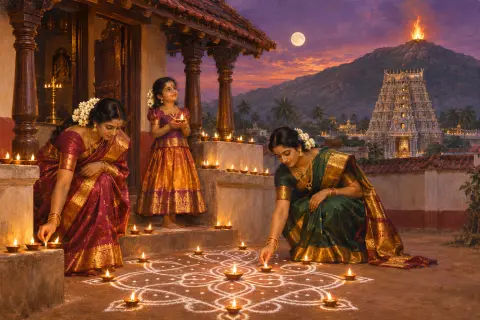
The gods built Shiva a chariot out of the whole world. In the Shiva Purana the earth is its body, the sun and moon its wheels, Brahma its charioteer, Mount Meru the bow, the serpent Vasuki the bowstring and Vishnu himself the arrow. When the three cities finally moved into line, Shiva released one arrow and they burned together. The gods lit lamps in joy. That is why this full moon is called Tripuri Purnima, and why people light lamps at dusk on this day in Shiva temples.
Dev Deepawali in Varanasi
In Varanasi the evening of Kartik Purnima is Dev Deepawali, the Diwali of the gods. The belief is that the gods come down to the Ganga on this night to bathe and to celebrate Shiva's victory. People light earthen lamps on the steps of the ghats from Ravidas Ghat in the south to Raj Ghat in the north, and the whole curve of the river glows.
The evening Ganga aarti is especially large on this night, and families float small lamps on leaf boats. Boats crowd the river so people can see the lit ghats from the water.
Fifteen days earlier, on Diwali, people light lamps for Lakshmi and for Rama's return. Dev Deepawali completes that season of light, this time for the gods themselves.
Kartik Purnima in Bihar: Bathing From Buxar to Bhagalpur
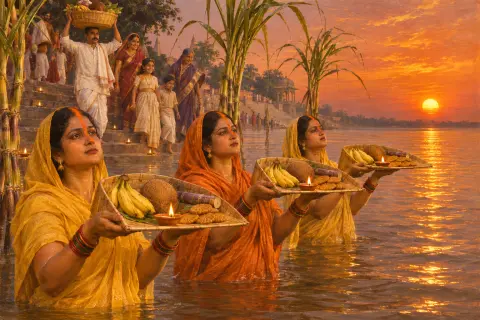
In Bihar this day is mostly called Kartik Purnima or simply Ganga Snan, and the bath is the heart of it. Before sunrise, people walk to the river in the cold, women carrying baskets of flowers, rice, lamps and sesame. All along the Ganga, from Buxar and Arrah in Bhojpur through Patna in Magadh to Munger and Bhagalpur in Anga, the ghats fill with families who bathe, offer water to the sun, give alms and light lamps on the water. Many households also hold a Satyanarayan katha at home that day.
In Mithila, Simaria Ghat on the Ganga in Begusarai is one of the busiest bathing places. Local tradition remembers it as a place where King Janaka did penance and says he started the Kalpavas fair there. Every Kartika many devotees live by the river for the whole month in simple huts, bathe every morning, eat once a day and listen to katha. Kartik Purnima is the last and largest bath of that month.
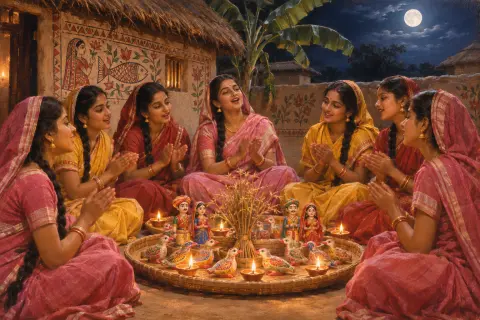
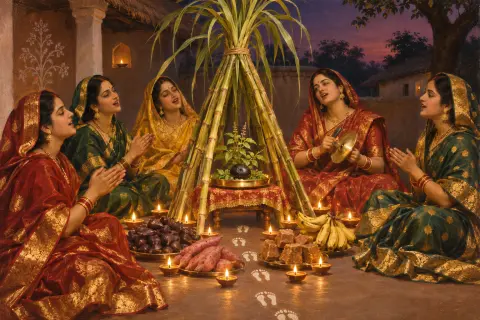
For girls and young women in Mithila, Kartik Purnima is also the farewell day of Sama Chakeva, the sibling festival in which sisters make clay figures of Sama, her brother Chakeva and the tale bearer Chugla, sing to them every evening, and pray for their brothers. On the last night they burn Chugla's moustache, say goodbye to Sama and set the figures in the fields or in water, asking her to come back next year. Sama Chakeva has its own page on this site.
Sonepur: The Elephant Who Called Out
Across the river from Patna, where the Gandak meets the Ganga, lies Sonepur, also called Harihar Kshetra. Its Harihar Nath temple holds Hari (Vishnu) and Hara (Shiva) together. On Kartik Purnima, crowds bathe at the confluence, at Sonepur and at Konhara Ghat on the Hajipur side, and then go for darshan at the temple. The same day the Sonepur Mela begins and runs for about a month. It was famous for centuries for its cattle, horses and elephants, and today it is also a fair of crafts, food, music and theatre.
The story told here is the Gajendra Moksha, from the Bhagavata Purana (Book 8, chapters 2 to 4). Gajendra, a mighty elephant king, went into a lake to drink and play, and a crocodile seized his leg. They struggled for a very long time. His herd could not help him, and his strength ran out. At last Gajendra stopped relying on his own power. He lifted a lotus in his trunk and prayed to the Lord who is the source of all. The prayer he spoke, beginning 'om namo bhagavate tasmai' (8.3.2), is still recited by many people in times of trouble.
Vishnu came at once on Garuda, cut the crocodile's jaws with his Sudarshana discus and pulled Gajendra out of the water. The Bhagavata places the lake on Mount Trikuta and says Gajendra had been King Indradyumna in a past life, cursed by the sage Agastya, and the crocodile had been the gandharva Huhu, cursed by the sage Devala. Local tradition in Bihar holds that the struggle happened here at the meeting of the Gandak and the Ganga, and the name Konhara is linked to it. Both are told with love, and nobody at the fair worries much about the difference.
Pushkar, Odisha's Little Boats and Other Places
In Rajasthan, the Pushkar fair builds up to Kartik Purnima. Pilgrims bathe in the Pushkar lake, the place the Mahabharata praises for this day, and visit the Brahma temple there. Many Vaishnava families also say Vishnu took his first avatar, Matsya the fish, on this day, though the better known Matsya Jayanti falls in Chaitra. Kartik Purnima is also the last day for Tulsi Vivah, which begins on Dev Uthani Ekadashi.
In Odisha the day is Boita Bandana. Before dawn, families go to rivers, ponds and the sea and float small boats made of banana bark, paper or cork, with betel leaves, flowers and a lit lamp inside, singing 'Aa ka ma bai'. They remember the Sadhabas, the sea traders of old Kalinga who sailed to Bali, Java and Sri Lanka on the winter winds. In Cuttack the Bali Jatra fair begins on the banks of the Mahanadi the same day.
In Andhra Pradesh and Telangana, Karthika Pournami is the high point of Karthika masam. People crowd Shiva temples, women float lamps on rivers and ponds, and many temples light a jwala thoranam, an arch of fire, in the evening. The same full moon is also Guru Nanak Gurpurab, when Sikhs celebrate the birth of Guru Nanak Dev with prayer, processions and langar. Jains begin the yatra to the hill shrines of Palitana in Gujarat on this day too.
In the Gita (7.16) Krishna names four kinds of people who turn to him: the one in distress, the one who wants to understand, the one who seeks some good in life, and the wise. Gajendra in the lake was the first kind, and he was heard. On Kartik Purnima millions of people step into the river in the dark and come out to see the sun rise, each carrying their own need, and the bath is a way of saying what Gajendra finally said in the lake: my own strength is not enough, and I am open to grace. The lamps at dusk say the rest. One small flame, offered with care, is enough to push back a little of the dark.