Krishna is the god who speaks the Bhagavad Gita. Most Hindus see him as Vishnu born on earth, and many traditions worship him as the Supreme God himself. He was born to Devaki and Vasudeva in Kamsa's prison in Mathura and grew up among cowherds in Gokul and Vrindavan, where he stole butter, played the flute, lifted Govardhan hill and danced the Raas with the gopis. Later he killed Kamsa, ruled from Dwaraka by the sea, and became the friend, adviser and charioteer of Arjuna in the Mahabharata war. His life is told in the Mahabharata, the Harivamsa, the Vishnu Purana and above all the tenth book of the Bhagavata Purana, and his birth is kept on Janmashtami.
Also called: Govinda (protector of cows), Gopala (cowherd), Vasudeva (son of Vasudeva), Keshava (the one with beautiful hair), Madhava, Madhusudana (slayer of the demon Madhu), Hrishikesha (lord of the senses), Janardana, Achyuta (the one who never falls), Murari (enemy of Mura), Damodara (the one tied round the waist), Parthasarathi (Arjuna's charioteer), Kanha or Kanhaiya, Shyam (the dark one), Dwarkadhish (lord of Dwaraka), Ranchhod (the one who left the battlefield)
Parents: Devaki and Vasudeva, of the Yadava (Vrishni) clan of Mathura
Foster parents: Yashoda and Nanda, cowherds of Gokul
Brother: Balarama, son of Rohini; sister: Subhadra, later the wife of Arjuna
Uncle and enemy: Kamsa, Devaki's cousin and king of Mathura
Wives: eight chief queens, led by Rukmini, Satyabhama and Jambavati; the Bhagavata Purana adds sixteen thousand one hundred princesses he freed from Narakasura
Children: Pradyumna (son of Rukmini), Samba (son of Jambavati) and many others; grandson Aniruddha
Cousins and friends: the Pandavas, whose mother Kunti was Vasudeva's sister
Homes: Mathura, Gokul and Vrindavan in Braj, and later Dwaraka on the western sea
All these are parts and portions of the Supreme Person, but Krishna is the Lord himself. Age after age they bring comfort to a world troubled by the enemies of Indra.
Stories
The oldest mentions of Krishna are short. The Chandogya Upanishad (3.17.6) names a Krishna, son of Devaki, who learned from the sage Ghora Angirasa; scholars still argue whether this is the same Krishna. The grammarian Panini mentions people devoted to Vasudeva, and around the second century BCE a Greek envoy named Heliodorus set up a pillar at Besnagar to Vasudeva, god of gods. The Mahabharata is the first long text about him, but there he is a prince of Dwaraka, adviser to the Pandavas and Arjuna's charioteer; it barely mentions his childhood. The Harivamsa, added to the Mahabharata as an appendix, first tells the cowherd childhood in full, and the Vishnu Purana (Book 5) tells it again. The fullest and most loved account is the tenth book of the Bhagavata Purana, ninety chapters long, which made Krishna's childhood in Vrindavan the heart of devotion. Later poets such as Jayadeva, Surdas and Mirabai, and teachers such as Vallabha and Chaitanya, built on it.
Born at midnight in Kamsa's prison
Kamsa, the cruel king of Mathura, was driving his cousin Devaki and her new husband Vasudeva home after their wedding when a voice from the sky told him that Devaki's eighth child would kill him (Bhagavata Purana 10.1). He drew his sword to kill her on the spot. Vasudeva saved her by promising to hand over every child she bore. Kamsa locked them in prison and killed their first six sons. The seventh child was moved by Vishnu's power from Devaki's womb to that of Rohini, Vasudeva's other wife, in Gokul. That child was Balarama.
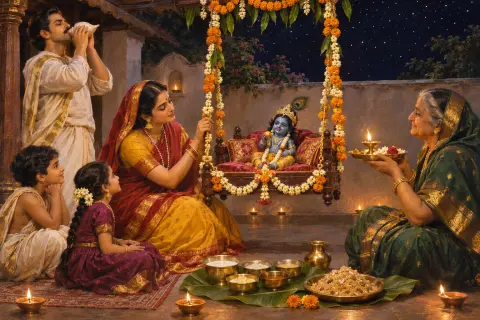
The eighth child was born at midnight on the eighth day of the dark half of Bhadrapada (10.3). The Bhagavata says he first appeared to his parents as Vishnu, with four arms holding a conch, discus, mace and lotus, then became an ordinary baby at their request. The chains fell away, the guards fell asleep and the doors opened. Vasudeva carried the baby out through the rain, and the serpent Shesha spread his hoods over them. The flooded Yamuna made way for him.
In Gokul, Yashoda, wife of the cowherd chief Nanda, had just given birth to a daughter. Vasudeva left his son beside her and carried the girl back to the prison. When Kamsa came and tried to dash the baby girl against a stone, she slipped from his hands and rose into the sky as the goddess Yogamaya with eight arms, telling him that the one who would kill him was already born somewhere else (10.4).
Childhood in Gokul and Vrindavan
Yashoda sees the whole universe in her little son.
Kamsa sent demons to find and kill the child. The Bhagavata Purana tells how the demoness Putana came disguised as a beautiful woman and offered him her poisoned breast, and the baby drank her life away (10.6). A whirlwind demon, a cart demon and others followed, and each one failed.
Most of all, the Bhagavata remembers a naughty, much loved child. Krishna and his friends stole butter and curd from the cowherd homes and fed it to the monkeys. One day the other boys told Yashoda that he had eaten earth. She made him open his mouth, and inside it she saw the whole universe: the sky, the stars, mountains, oceans, and even her own village with herself in it (10.8). Then the vision faded, and she simply loved him as her son again.
Another day, after he broke a pot of curd, Yashoda tried to tie him to a heavy wooden mortar. Every rope she brought was two fingers too short, until he saw how tired she was and let himself be tied (10.9). That is why he is called Damodara, the one with a rope round his waist. When the family moved to Vrindavan, Krishna grew up herding calves and cows by the Yamuna. He danced on the hoods of the serpent Kaliya, who had poisoned the river, and then let him go at the pleading of his wives (10.16).
Lifting Govardhan hill
Every year the cowherds of Vraja held a great offering to Indra, the god of rain. The boy Krishna asked his father Nanda why. Their life, he said, came from their cows, the forest and the hill Govardhan that fed them, so they should worship the hill and the cows and the brahmins instead (Bhagavata Purana 10.24). The people agreed and offered their food to Govardhan.
Indra was furious and sent storm clouds to flood Vraja. Rain and hail lashed the village for days. Krishna lifted Govardhan hill with one hand, as easily as a child picks up a mushroom, says the Bhagavata, and held it up like an umbrella for seven days while the people and their cattle sheltered beneath (10.25).
In the end Indra came, ashamed, and asked forgiveness. Surabhi, the mother of cows, bathed Krishna with her milk, and Indra named him Govinda, chief of the cows (10.27). Govardhan Puja and the Annakut feast the day after Diwali remember this.
The Raas on autumn nights
The Bhagavata Purana gives five chapters (10.29 to 10.33), called the Rasa Panchadhyayi, to the nights of autumn when the moon was full and Krishna played his flute in the forest. The gopis, the cowherd women of Vraja, left whatever they were doing and ran to him. He teased them and told them to go home to their families, but they would not.
When they grew proud that he was theirs, he disappeared. They searched the forest for him, asking the trees and creepers, acting out his deeds and singing the song known as the Gopi Gita. Then he came back, and in the dance that followed, the Raas, there was a Krishna beside every gopi in the circle.
For the devotional traditions this is the highest picture of love for God: the gopis drop everything for him and want nothing for themselves. The Bhagavata does not name Radha. One gopi whom Krishna takes away alone is later read as Radha by many teachers, and the poets after Jayadeva placed her at the centre. Sharad Purnima is kept as the night of the Raas.
Mathura, Kamsa and the city of Dwaraka
When Krishna and Balarama were boys, Kamsa sent Akrura to bring them to Mathura for a festival of the bow, planning to kill them there (Bhagavata Purana 10.39). Vraja wept to see them go. In Mathura Krishna broke the great bow, killed the mad elephant Kuvalayapida at the gate, and with Balarama defeated Kamsa's wrestlers Chanura and Mushtika. Then he leapt onto Kamsa's high seat, pulled him down and killed him (10.44). He freed his parents Devaki and Vasudeva and made Kamsa's father Ugrasena king again.
Kamsa's father-in-law Jarasandha, king of Magadha, attacked Mathura again and again. The Bhagavata says seventeen times; on the eighteenth he came together with another enemy, Kalayavana. To keep his people safe, Krishna had a fortified city built in the sea, Dwaraka, and moved the Yadavas there (10.50). Because he once left the battlefield rather than fight, Gujarat lovingly calls him Ranchhod, the one who left the battle.
In Dwaraka he married Rukmini, the princess of Vidarbha, who had sent him a letter asking him to carry her away before her forced wedding (10.52 to 10.54), and later Satyabhama, Jambavati and others. It was here too that his poor childhood friend Sudama came with a cloth bundle of flattened rice, and Krishna welcomed him as a brother (10.80 to 10.81).
The Mahabharata, the Gita and the end
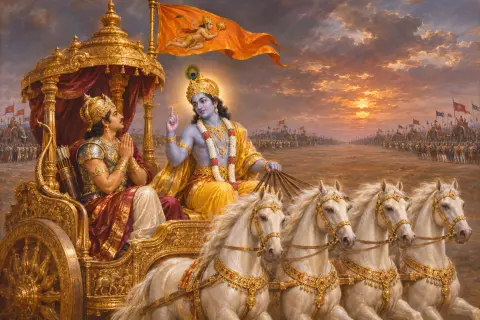
The Mahabharata shows the grown Krishna. He is the cousin and closest friend of the Pandavas, above all of Arjuna. He is at Draupadi's swayamvara when Arjuna wins her (Adi Parva), receives the first honour at Yudhishthira's royal sacrifice and kills Shishupala when he insults him (Sabha Parva). Before the war he goes to Hastinapura as a messenger of peace and is refused (Udyoga Parva). When Arjuna and Duryodhana both ask for his help, he offers his army to one and himself, unarmed, to the other. Arjuna chooses Krishna, and Krishna becomes his charioteer.
On the first day of the war at Kurukshetra, Arjuna sees his teachers and relatives in the opposite army and lays down his bow. Krishna's answer to him is the Bhagavad Gita, eighteen chapters in the Bhishma Parva (chapters 23 to 40 in the Critical Edition). In it Krishna teaches duty without attachment, knowledge, meditation and devotion, and shows Arjuna his universal form. Through the war he guides the Pandavas, sometimes with tricks that the epic itself questions.
After the war the grieving Gandhari curses him that his own clan will destroy itself (Stri Parva). Thirty six years later, says the Mausala Parva, the Yadavas killed each other in a drunken quarrel at Prabhasa. Krishna sat under a tree in yoga, and a hunter named Jara, taking his foot for a deer, shot him with an arrow. So Krishna left the world, and the sea swallowed Dwaraka. The Bhagavata Purana tells the same end in its eleventh book.
How to recognise
•Dark skin, painted blue or blue-black in most art. The name Krishna itself means dark. The Bhagavata Purana compares his colour to a fresh rain cloud.
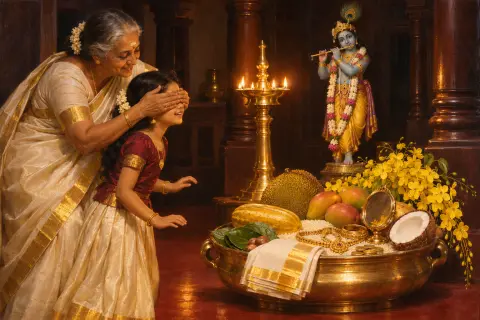
•Two arms, holding a bamboo flute (murali or bansuri) to his lips, often standing with one leg crossed over the other in a gentle three-bend pose (tribhanga). The flute is the sound that called the gopis and the cows in Vrindavan.
•A crown or headband with a peacock feather, a yellow silk dhoti called pitambara, and a long garland of forest flowers (vanamala). Vishnu's marks, the Shrivatsa curl on the chest and the Kaustubha jewel, are often shown too; the Bhagavata Purana (10.3) describes the newborn Krishna with both.
•As a child he is Bal Gopal or Laddu Gopal, a crawling baby holding a ball of butter, or Damodara, tied to a grinding mortar with a rope round his waist, as in Bhagavata Purana 10.9.
•As Govardhanadhari he holds up a hill on one finger or one hand, with cowherds and cows sheltering below. Shrinathji at Nathdwara in Rajasthan is this form, with the left arm raised.
•As Parthasarathi he sits in front of Arjuna's chariot holding the reins and a whip, often with one hand raised in teaching, the Gita scene. At the Parthasarathy temple in Chennai he is shown with a moustache and a conch.
•Many regional forms are Krishna: Vitthal of Pandharpur standing on a brick with hands on his hips, Guruvayurappan in Kerala (four-armed, as Vishnu appeared to Devaki), the Udupi Krishna with a churning rod, and Jagannath of Puri with his round eyes.
Though I am unborn, of imperishable nature, and though I am the Lord of all beings, yet, governing My own Nature, I am born by My own Maya.
Krishna says that though he is unborn and the Lord of all beings, he comes into being by his own power. This is the Gita's own explanation of how God can be born, as Krishna was in Mathura.
Whenever there is decline of righteousness, O Arjuna, and rise of unrighteousness, then I manifest Myself.
Whenever dharma declines and adharma rises, Krishna says, he manifests himself. Hindus read this as the reason for all of Vishnu's avatars, Krishna among them.
For the protection of the good, for the destruction of the wicked and for the establishment of righteousness, I am born in every age.
He is born age after age to protect the good, end the wicked and re-establish dharma. His killing of Kamsa and his part in the Mahabharata war are often read through this verse.
He who thus know, in their true light, My divine birth and action, having abandoned the body, is not born again, he comes to Me, O Arjuna.
Whoever truly understands his divine birth and deeds is not born again. This is why devotees tell and retell his life, and why Janmashtami is kept with stories and songs.
The same am I to all beings; to Me there is none hateful or dear; but those who worship Me with devotion are in Me and I am also in them.
He is the same to all beings, but those who worship him with love are in him and he in them. It explains the welcome he gives to cowherds, a poor brahmin like Sudama and the gopis alike.
Whatever I have presumptuously said from carelessness or love, addressing Thee as O Krishna! O Yadava! O Friend! regarding Thee merely as a friend, unknowing of this, Thy greatness.
After seeing the universal form, Arjuna asks forgiveness for having called him 'O Krishna, O Yadava, O friend' without knowing his greatness. It is the Gita's clearest picture of their friendship.
Fix thy mind on Me, by devoted to Me, sacrifice to Me, bow down to Me. Thou shalt come even to Me; truly do I promise unto thee, (for) thou art dear to Me.
Near the end of the Gita Krishna asks Arjuna to fix his mind on him, love him, worship him and bow to him, and promises that Arjuna will come to him, because he is dear to him.
Abandon all varieties of dharma and just surrender unto Me. I shall deliver you from all sinful reactions. Do not fear.
Leave all other duties and take refuge in me alone; I will free you from all sins, do not grieve. Many traditions see this as the last word of the Gita and the core of Krishna's teaching.