The Story
Karma Puja has no scripture behind it. It belongs to the oral tradition of the Adivasi peoples of the Chota Nagpur plateau and the regions around it, among them the Oraon, Munda, Santhal, Ho, Kharia and Bhumij, and of Sadan communities such as the Kudmi, who share the same villages. The story of the day, the Karam katha, is told each year by the village priest (the pahan) or an elder, and every community has its own version. Among the early written descriptions are those of the anthropologist Sarat Chandra Roy, who recorded Oraon customs in the early twentieth century. The festival is kept to thank the Karam tree and the earth for crops and children, to ask for a good harvest, and for sisters to pray for their brothers.
Karam, the Tree, and Karma, the Work
Karam is a tree of the forests of central and eastern India, and the festival is named after it. Many people also hear two other words in the name: karma, the work a person does, and karam, the fortune that comes to them. Writers on the festival in Chhattisgarh put it simply: people pray that they keep doing good work and that fortune stays with them.
The timing matters. By Bhado the paddy has been transplanted and the rain has filled the fields, but the harvest is still weeks away. Karam comes in that waiting time. It is a pause to thank the land for what has been sown and to ask it to carry the crop through.
For many Adivasi communities the year's festivals follow the life of the forest and fields. Sarhul welcomes the new sal flowers in spring, Karam comes with the growing paddy, and Sohrai honours the cattle around Diwali, as the harvest comes in.
The Story of Karma and Dharma
The best known story in Jharkhand is about two brothers, Karma and Dharma. Some say Karma stood for hard work and Dharma for right living, and that people worship Karma so their work will bear fruit. Tellings differ from village to village, but the outline is often like this.
Karma, the elder brother, went away to earn and trade, and came home with his wealth on the day of the Karam festival. He found the household singing and dancing around a Karam branch, and nobody came to greet him. In anger he pulled up the branch and threw it into the river. From that day his luck left him. His goods were lost, his fields gave nothing and hunger came to the house.
Karma set out to find his lost fortune. On the way he suffered a great deal and met people, animals and trees with troubles of their own, who asked him to find answers for them too. At last he found Karam again and begged forgiveness. He came home humbled, brought the Karam back with honour, and his family's fortune returned. In many tellings it is Dharma, the brother who kept faith, who helps him find the way.
Seven Brothers and the Karam Branch
Other communities tell it with seven brothers. In a version recorded in Sarguja, Chhattisgarh, six brothers went away to trade while the youngest stayed home. On their return the elder ones sent one brother after another to the house with news, and each one, finding the Karam dance going on, joined in and forgot to come back.
The eldest finally came home in a rage and cut the Karam branch into seven pieces. His goods turned to stone and his crops failed, while his brothers' fields grew green. When he met Karam walking on the ridges of his brothers' fields, he fell at his feet. Karam told him his fortune now lay far beyond the seas, and he had to wander a long way to win it back.
In a version told among the Oraon and Bhumij, the youngest brother stays home and dances with his sisters-in-law around the Karam, the meal for the field workers is forgotten, and the angry brothers throw the Karam into the river. All these stories carry the same warning: do not despise the thing that feeds you, and do not let pride get between you and gratitude.
Jawa: The Girls Who Grow the Seeds
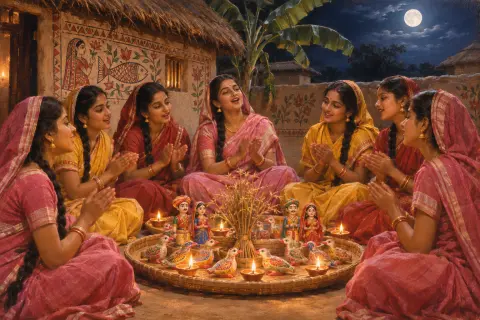
About a week before the festival, unmarried girls sow barley, wheat, maize, gram and other grains in small baskets of river sand. This is the jawa. The girls who keep the vow, sometimes called karmaiti, look after the baskets every morning and evening, water them and sing to them, and many keep a fast or eat simple food during these days.
By the day of Karam the baskets are full of pale yellow green shoots. They are placed at the foot of the Karam branch during the puja. Girls exchange jawa shoots and tuck them in their hair or behind their ears, and the exchange is a sign of friendship that can last a lifetime.
Many people see the jawa as a small test of the coming harvest, and a lesson for girls in caring for seed, which is the most precious thing a farming family owns.
The Night in the Akhra and the Morning After
On the day of Karam, young people go to the forest with drums, worship a Karam tree and cut a branch, taking care that it does not touch the ground. They carry it back singing and plant it in the akhra, the village dancing ground, or in a courtyard. The ground is plastered with cow dung and decorated, and offerings of flowers, rice, cucumber, sweets and the jawa are placed before it.
In the evening the pahan or an elder leads the worship and tells the Karam katha while everyone listens holding a few grains of rice. Sisters pray for the health and good sense of their brothers. Then the fast is broken and the dancing begins. Women link arms in long lines, men play the mandar and other drums, and the Karam songs go on until dawn.
In the morning the branch is carried in procession and immersed in a river or pond. In some places it is first taken to the fields and planted there for a while to protect the crop. Communities that make offerings in their own ways, including rice beer or animal offerings, keep them as their tradition sets out.
The people who threw away the Karam branch were not bad people. They were busy, tired and proud, and they forgot where their good fortune came from. In Gita 3.16 Krishna speaks of the wheel of giving and receiving that keeps the world turning, and says that one who does not help it turn, living only for their own pleasure, lives in vain. Karam answers that warning with a whole village: grow the seed with care, say thank you to the tree, and dance together before the harvest comes.