Surya is the sun, worshipped as a god. He is praised in many hymns of the Rigveda, where he is the eye of the gods who sees everything people do. In the epics and Puranas he rides across the sky in a chariot drawn by seven horses, with Aruna as his charioteer. He is the father of Yama, Yamuna, Shani, the Ashvins, Manu and Karna, and the ancestor of Rama's solar dynasty. Unlike most gods, he can be seen every day, and people still worship him directly with water at sunrise, most of all on Chhath, Makar Sankranti and Pongal.
Also called: Aditya (son of Aditi), Ravi, Bhaskara (maker of light), Divakara (maker of the day), Savitr or Savita (the one who stirs life; the god of the Gayatri, later seen as one with Surya), Vivasvan (the shining one), Martanda, Arka, Bhanu, Mitra, Pushan, Suryanarayana, Surya Dev, Kathiravan (in Tamil)
Parents: Kashyapa and Aditi, as one of the Adityas (the Rigveda tells his birth in several different ways)
Wives: Sanjna (Saranyu in the Rigveda), daughter of Vishwakarma or Tvashtr, and Chhaya, her shadow likeness; some texts name others
Children with Sanjna: Vaivasvata Manu, Yama, Yamuna, the Ashvins and Revanta
Children with Chhaya: Shani, Savarni Manu and the river Tapati
Other sons: Karna, born to Kunti; Sugriva, the vanara king of the Ramayana
Charioteer: Aruna, elder brother of Garuda
Chariot: one wheel, seven horses
Day: Sunday (Ravivara)
Descendants: the solar dynasty (Suryavamsha) of Ikshvaku and Rama, through his son Manu
citraṃ devānām ud agād anīkaṃ cakṣur mitrasya varuṇasyāgneḥ,
āprā dyāvāpṛthivī antarikṣaṃ sūrya ātmā jagatas tasthuṣaś ca.
The bright face of the gods has risen, the eye of Mitra, Varuna and Agni. He has filled heaven, earth and the space between. Surya is the soul of all that moves and all that stands still.
Stories
Surya is one of the oldest gods still worshipped in India. The Rigveda gives him whole hymns, such as 1.50 and 1.115, and also praises Savitr, the solar god of the Gayatri, who later became one with him. The Brahmanas and Upanishads make the sun a picture of the self and of truth. The Ramayana and Mahabharata turn him into a person with a family: Sanjna's husband, Karna's father, the giver of the Aditya Hridayam and of Yudhishthira's food vessel. The Puranas tell the full story of his marriage and children, and the Samba Purana and Bhavishya Purana tell how his temples and priests came to be. The stories below follow those texts.
The Eye of the Gods: Surya in the Rigveda
In the Rigveda the sun is first of all something you see. Hymn 1.50, by the sage Praskanva, says the rays carry the god up so that all may see Surya, and that the stars slip away with the night like thieves. In verse 8 seven bay mares draw his chariot. The hymn ends with words still said at sunrise: rising above the darkness, we have come to the highest light, Surya, god among the gods.
Hymn 1.115, by Kutsa Angirasa, is the verse at the top of this page. It calls the sun the bright face of the gods and the eye of Mitra, Varuna and Agni, and then says that Surya is the soul of all that moves and all that stands still. The next verse shows him following Ushas, the shining dawn, as a young man follows the woman he loves.
The Rigveda also has Savitr, the stirrer, a golden armed god who wakes the world in the morning and puts it to sleep at night. The Gayatri mantra (Rigveda 3.62.10), seen by the sage Vishvamitra, is addressed to Savitr: we meditate on the bright light of the god Savitr; may he stir our minds. In the Rigveda Savitr and Surya are close but separate. Later tradition treats them as one, which is why the Gayatri is said facing the sun at the sandhya prayers.
Martanda and the Twelve Adityas
The Adityas are the sons of Aditi, the boundless mother. In Rigveda 10.72 Aditi has eight sons. She takes seven of them to the gods and casts the eighth, Martanda, away, then brings him back to be born and to die. Many later writers read Martanda as the sun, and the name stayed with him.
The number grew to twelve. The Vishnu Purana (1.15) lists twelve sons of Aditi and Kashyapa: Vishnu, Shakra (Indra), Aryaman, Dhatri, Tvashtri, Pushan, Vivasvan, Savitr, Mitra, Varuna, Amsha and Bhaga. Lists differ a little from text to text. Vivasvan, Savitr, Pushan and Mitra are all names of the sun, and the Vishnu Purana (2.10) gives each month of the year its own Aditya, riding the sun's chariot in turn.
This is why Surya is called Aditya, and why the Gita (10.21) can say: among the Adityas I am Vishnu, among lights I am the radiant sun.
Sanjna, Chhaya and the Sun's Children
The story starts in the Rigveda (10.17.1-2). Tvashtr's daughter Saranyu is married to Vivasvan, the sun. The immortal bride disappears, and the gods give Vivasvan a woman 'of the same kind' in her place. Saranyu leaves behind two sets of twins, Yama and Yami and the Ashvins. The Puranas tell the full story, mainly the Vishnu Purana (3.2) and the Markandeya Purana.
In the Puranas her name is Sanjna, daughter of Vishwakarma. She bore Surya three children: Vaivasvata Manu, the father of mankind, and the twins Yama and Yamuna. But she could not bear his heat. So she made Chhaya, a shadow likeness of herself, left her in the house, and went away to the forest, where she lived as a mare.
Chhaya bore Surya three more children: Savarni Manu, Shani, the slow planet, and the river Tapati. She loved her own children more than Sanjna's. When Yama, hurt and angry, raised his foot at her, she cursed him. Surya was puzzled that a mother would curse her own son, questioned Chhaya and learned the truth. He went to the forest as a horse to find Sanjna. From their meeting the Ashvins, the twin healers of the gods, and Revanta were born.
To bring Sanjna home, her father Vishwakarma put Surya on his lathe and trimmed away part of his brightness. From the shavings he made Vishnu's discus, Shiva's trident and the weapons of the other gods (the Vishwakarma Puja page tells this part). Surya then gave his children their places: Yama became lord of the dead and of dharma, Yamuna a river, Manu the father of this age, and Shani one of the planets.
Kunti and Karna
Surya appears before the young Kunti when she tries the sage Durvasa's mantra.
In the Mahabharata (Adi Parva, retold in the Aranyaka Parva), the sage Durvasa stayed at the palace of King Kuntibhoja, and the young princess Kunti looked after him so well that he gave her a mantra to call any god she chose. Curious, and still a girl, she tried it on the rising sun. Surya came to her in person. She was frightened, but a god's call could not be undone. Their son Karna was born wearing golden armour and earrings that were part of his body.
Afraid of what people would say, Kunti placed the baby in a basket and let the river carry him away. He was found and raised by the charioteer Adhiratha and his wife Radha, and grew up as a charioteer's son who did not know he was a prince.
Surya never left his son. In the Aranyaka Parva, he comes to Karna in a dream and warns him that Indra will come disguised as a Brahmin to ask for his armour and earrings. Karna answers that he cannot refuse anyone who asks while he is worshipping, and he gives them away, receiving Indra's spear in return. Later, in the Udyoga Parva, when Kunti tells Karna that she is his mother, a voice from the sun confirms her words.
The Mahabharata has one more gift from Surya. At the start of the Pandavas' exile (Aranyaka Parva, chapter 3), Yudhishthira prays to him with his 108 names, and Surya gives him a copper vessel that feeds everyone each day until Draupadi has eaten.
The Aditya Hridayam and the Line of the Sun
Rama belongs to the Ikshvaku line, the solar dynasty, which traces itself to Manu, Vivasvan's son. In the Yuddha Kanda, as Rama faces Ravana in their last battle, tired and thoughtful, the sage Agastya comes to him and teaches him the Aditya Hridayam, a hymn to the sun. Rama says it three times, sips water, looks at the sun and goes into battle. At the end Surya, standing among the gods, tells him to hurry, for Ravana's end has come.
The hymn is sarga 105 or 107 of the Yuddha Kanda, depending on the printed edition. The Baroda critical edition, which compares the old manuscripts, does not include it in its main text, so scholars treat it as a later addition. It is still one of the best loved sun hymns, recited daily by many people.
The Ramayana gives Surya other links too. In the Bala Kanda (sarga 16 in the critical edition), the gods take birth as vanaras to help Rama, and Sugriva is the son of the sun. In the Kishkindha Kanda, Jambavan tells how the child Hanuman leapt at the rising sun thinking it was a ripe fruit (the Hanuman Jayanti page tells that story).
Samba and the Sun Temples
The story of how Surya came to have temples and priests is told in the Samba Purana, which R. C. Hazra dates to roughly 650 to 850 CE, and repeated in the Brahma Parva of the Bhavishya Purana. Samba, a son of Krishna, is struck with leprosy by a curse (the Samba Purana blames the sage Durvasa; other versions blame Krishna himself). On Narada's advice he worships Surya at Mitravana on the Chandrabhaga river, finds an image of the sun in the water, builds a temple for it and is healed. He then brings eighteen families of Maga priests from Shakadvipa to serve the temple.
Many scholars identified Mitravana with Multan, in today's Pakistan, whose great sun temple was famous for centuries and was destroyed long ago, though not all historians accept the identification. The Maga story is often read as a memory of sun priests who came from Iran, and Shakadvipi Brahmins in Bihar still trace their origin to them. In Odisha, local tradition places Samba's penance at the mouth of the Chandrabhaga near Konark, and people bathe there on Magha Saptami.
The Konark temple itself was built around 1250 CE by King Narasimhadeva I of the Eastern Ganga dynasty as a stone chariot of the sun, with 24 carved wheels and seven horses. It is a UNESCO World Heritage Site. Other old sun temples stand at Modhera in Gujarat and Martand in Kashmir, and in Bihar the temple at Deo draws huge crowds at Chhath.
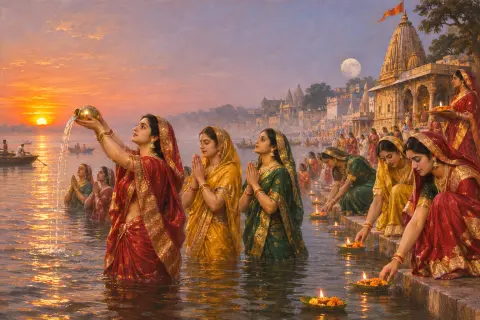
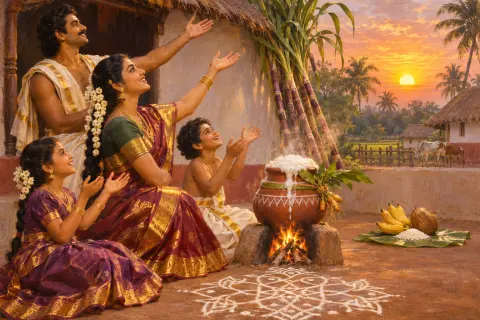
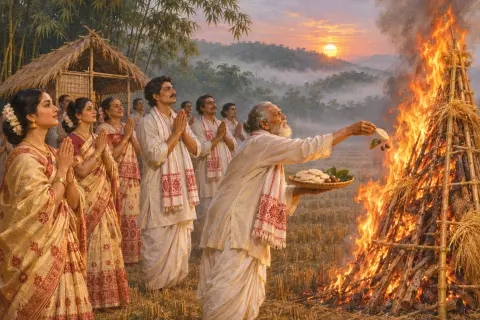
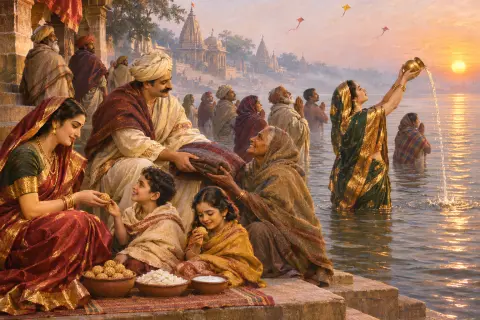
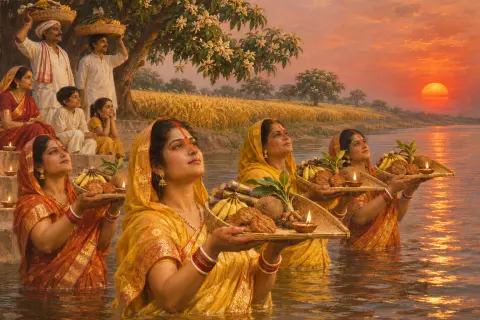
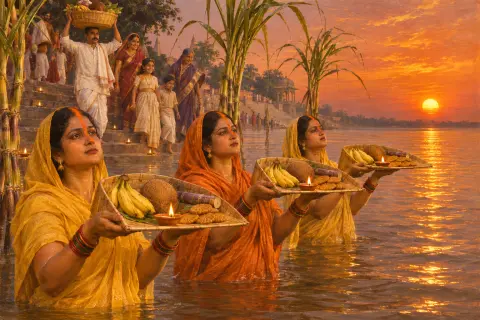
Today Surya is worshipped most at Chhath, when people stand in rivers to offer arghya to the setting and rising sun; at Makar Sankranti, Pongal and the other harvest days when he enters Makara; and at the solar new year in mid April. Surya Namaskar, the sequence of twelve postures often done with twelve of his names, is a modern practice. It was made popular in the 1920s by the Raja of Aundh, Bhawanrao Pant Pratinidhi, and later taken into yoga.
How to recognise
•He usually stands upright with two arms, holding a fully open lotus in each hand, often raised to shoulder height. The lotus opens at sunrise and closes at sunset, so it belongs to him.
•His chariot is drawn by seven horses, sometimes shown as one horse with seven heads. The Rigveda (1.50.8) already speaks of seven bay mares drawing his chariot. The Vishnu Purana (2.8) names the horses after seven Vedic metres, starting with Gayatri.
•His charioteer is Aruna, the red dawn, who sits in front of him. The Mahabharata (Adi Parva) says Aruna was born from an egg his mother Vinata opened too early, so his body was never finished, and many images show him without legs.
•He has a golden or red-gold body, a tall crown, large earrings, a breastplate and a halo of rays. In many north Indian images he also wears a long coat and high boots. The Brihat Samhita of Varahamihira (6th century) asks for this 'northern dress', and historians link it to sun worship that came from Iran and Central Asia.
•Two goddesses of dawn, Usha and Pratyusha, are often carved beside him, shooting arrows to drive away the darkness. Two attendants, Danda and Pingala, may stand at his sides, and in some temples his wives and children are shown around him.
•In south Indian temples he usually stands without boots, holding two lotuses. In a Navagraha shrine of the nine planets he is in the middle, facing east, with the other eight around him.
•Often there is no image at all. At Chhath and at the daily sandhya prayers, people simply face the rising or setting sun and pour water towards it. Red flowers, red sandalwood and Sunday, Ravivara, are his.
The Blessed Lord said: I taught this imperishable Yoga to Vivasvan; he told it to Manu; Manu proclaimed it to Ikshvaku.
Krishna says he first taught this yoga to Vivasvan, the sun, who taught it to his son Manu, who taught it to Ikshvaku, the first king of Rama's solar line. This is the Gita naming Surya directly as the first teacher of its wisdom on earth.
Among the (twelve) Adityas, I am Vishnu; among luminaries, the radiant sun; I am Marichi among the (seven or forty-nine) Maruts; among stars the moon am I.
Among the Adityas, Krishna says, I am Vishnu, and among lights I am the radiant sun (ravir amshuman). Surya is one of the Adityas and the brightest light there is, so he appears here twice.
That light which residing in the sun illumines the whole world, that which is in the moon and in the fire know that light to be Mine.
Krishna says that the light in the sun, which lights up the whole world, is his own light. The Gita does not set Surya against Krishna; it says the sun shines with a light that comes from God.
I am the sapidity in water, O Arjuna; I am the light in the moon and the sun; I am the syllable Om in all the Vedas, sound in ether and virility in men.
I am the light of the moon and the sun, Krishna says. As in 15.12, the sun's radiance is named as one of the ways God can be seen in the world.
I see Thee without beginning, middle or end, infinite in power, of endless arms, the sun and the moon being Thy eyes, the burning fire Thy mouth, heating the whole universe with Thy radiance.
In the universal form Arjuna sees the sun and the moon as God's eyes. This echoes the Rigveda, which calls Surya the eye of the gods.
Just as the one sun illumines the whole world, so also the Lord of the field (Supreme Self) illumines the whole field, O Arjuna.
As the one sun lights up this whole world, so the knower of the field lights up the whole field. The verse uses the sun as a picture of the self, as the Upanishads often do.