
Ganesha
Remover of obstacles, lord of beginnings
Ganesha is the elephant-headed son of Shiva and Parvati, the remover of obstacles and the god worshipped first at the start of almost every Hindu rite, journey, wedding and new account book. He is also called Ganapati and Vinayaka, the lord of Shiva's ganas. The Shiva Purana and the Brahma Vaivarta Purana tell different stories of how he got his elephant head, and he has two Puranas of his own, the Ganesha and Mudgala Puranas. A much loved later story makes him the scribe of the Mahabharata. His great festival is Ganesh Chaturthi, and he sits beside Lakshmi in the Diwali puja and on the first page of new ledgers.
Also called: Ganapati and Ganesha (lord of the ganas), Vinayaka (the leader), Vighneshvara and Vighnaharta (lord and remover of obstacles), Gajanana (elephant faced), Ekadanta (one tusked), Vakratunda (curved trunk), Lambodara (big bellied), Gajavaktra, Heramba, Siddhidata (giver of success), Pillaiyar in Tamil, Ganpati Bappa in Marathi
Parents: Shiva and Parvati; in the Shiva Purana Parvati makes him herself
Brother: Kartikeya (Skanda, Murugan)
Wives: Siddhi (success) and Buddhi (wisdom) in the Shiva Purana; north India often says Riddhi and Siddhi. Much of south India sees him as unmarried
Sons: Kshema and Labha in the Shiva Purana; popular custom writes Shubh and Labh on doors and ledgers
Mount: a mouse or rat (mushika)
Home: Mount Kailash with his parents
Office: lord of Shiva's ganas, given first place in worship by Brahma, Vishnu and Shiva
एकदन्ताय विद्महे वक्रतुण्डाय धीमहि । तन्नो दन्ती प्रचोदयात् ॥
ekadantāya vidmahe vakratuṇḍāya dhīmahi, tanno dantī pracodayāt.
We come to know the one tusked god, we meditate on him of the curved trunk. May that tusked one awaken our minds.
Stories
Ganesha is younger in the texts than many gods. The Rigveda (2.23.1) uses the name ganapati for Brihaspati, lord of the hosts of prayer, and that verse is now chanted for Ganesha. Older law books such as the Yajnavalkya Smriti speak of Vinayakas who cause obstacles and must be calmed. The elephant-headed god appears in sculpture around the Gupta period, and from then on his place grows quickly. The Shiva Purana (Rudra Samhita, Kumara Khanda) and the Brahma Vaivarta Purana (Ganapati Khanda) tell his birth in very different ways. The Ganesha Purana, the Mudgala Purana and the Ganapati Atharvashirsha belong to the Ganapatya tradition, which worships him as the highest God. Folk tradition, the vrata stories and Maharashtra's public festival make him the most familiar god in Indian homes.
From the Lord of Hosts to the Remover of Obstacles
The famous verse ganaanaam tvaa ganapatim havaamahe, "we call on you, lord of the hosts", comes from the Rigveda (2.23.1). In its own hymn it is addressed to Brahmanaspati, the lord of prayer. Later tradition took it over for Ganesha, and it is still the first mantra in many Ganesha pujas.
Old ritual texts know a darker group called Vinayakas. The Manava Grihya Sutra and the Yajnavalkya Smriti describe them as beings who cause bad dreams and failure, and give rites to calm them. Over time these many obstacle makers became one god, Vinayaka, who can place obstacles and so can also remove them.
That is why he is worshipped first. A rite begun with his name will go well. Children start writing with Shri Ganeshaya namah, traders write it on the first page of the new ledger, and invitations to weddings carry his picture on top.
Two Stories of the Elephant Head
The Shiva Purana (Rudra Samhita, Kumara Khanda, chapters 13 to 18) gives the best known version. Parvati shapes a boy from the paste she rubs off her body and sets him to guard her door. Shiva, coming home, is stopped by this stranger, and after a fight he cuts off the boy's head. Parvati's grief and anger shake the world. The gods bring the head of the first creature they meet in the north, an elephant, fix it on the boy and bring him back to life. Shiva makes him chief of the ganas and the one to be worshipped first.
The Brahma Vaivarta Purana (Ganapati Khanda) tells a different story. There Parvati keeps a long vow and Krishna himself is born as her son. All the gods come to see the baby, but Shani, whose look brings misfortune, keeps his eyes down. Parvati insists he look, and when he does, the child's head falls off. Vishnu flies north on Garuda and brings back the head of a young elephant.
The Shiva Purana itself says the story is told differently in different ages. Every version ends the same way: the son of Parvati is given first place among the gods.
Circling His Parents
The Shiva Purana (Rudra Samhita, Kumara Khanda, chapters 19 and 20) tells how Shiva and Parvati's two sons both wanted to be married first. The parents set a test: whoever went around the whole earth and came back first would marry first.
Kartikeya set off at once on his peacock. Ganesha, with his heavy body and his small mouse, thought about it. Then he seated his parents together, walked around them with joined hands and bowed. When they asked what he was doing, he said that the scriptures teach that going around one's parents with devotion is the same as going around the whole earth. Pleased, Shiva and Parvati married him to Siddhi and Buddhi, the daughters of Prajapati Vishvarupa, and he had two sons, Kshema and Labha. When Kartikeya came back and heard, he was hurt and went away to the Krauncha mountain.
In the Tamil version told at Palani, the prize is a single sacred fruit brought by the sage Narada, not a wedding. Ganesha wins it in the same way, and Murugan leaves home and stands on Palani hill as a young renunciant. Shiva and Parvati follow him and tell him, "You yourself are the fruit", pazham nee in Tamil.
The Scribe of the Mahabharata
The best known Ganesha story outside the Puranas comes from the opening of the Mahabharata. Vyasa had the whole epic in his mind and needed someone to write it down. Brahma advised him to ask Ganesha. Ganesha agreed on one condition: Vyasa must never stop dictating. Vyasa agreed and added his own: Ganesha must understand every verse before he wrote it. Whenever Vyasa needed time to think, he recited a verse so dense that even Ganesha had to pause over it.
This scene is found in many manuscripts of the Adi Parva, but the scholars who made the Pune critical edition judged it a later addition and moved it out of the main text. It is still loved, and it is why Ganesha is the patron of writers, students and scholars. Popular tellings add that when his pen broke, he snapped off his own tusk and kept writing.
The God Worshipped First
For the Ganapatya tradition Ganesha is not only a doorkeeper but the highest God. The Ganapati Atharvashirsha, a short Upanishad recited in Maharashtra and beyond, says to him, "You alone are the visible truth; you alone create, sustain and destroy." The Ganesha Purana tells of four forms he takes in the four ages, and the Mudgala Purana of eight forms, such as Vakratunda and Ekadanta, each defeating a demon who stands for a human failing like pride, greed or anger.
In Maharashtra, eight ancient Ganesha shrines around Pune, the Ashtavinayaka, are visited as one pilgrimage, beginning and ending at Morgaon. In Tamil Nadu he is Pillaiyar, the dear child, sitting under countless pipal trees and at the foot of temple steps. In Bengal he stands beside Durga in the puja pandal. In homes across north India he sits next to Lakshmi on Diwali night, so that wealth comes in without obstacles.
From the Home Shrine to the Street
The Shiva Purana says Ganesha was born on a Chaturthi of Bhadrapada and sets out a vow for that day, which is why the fourth lunar day is his. For centuries Ganesh Chaturthi was mainly kept at home. The Peshwas of Pune, whose family deity was Ganesha, kept it with great ceremony.
In 1893 Lokmanya Bal Gangadhar Tilak used his newspaper Kesari to promote a public ten day Ganeshotsav, with the image in a shared pandal, music and lectures, as a way of bringing people together under British rule. Some Pune mandals say they began public images a year or more before his call, and the question is still argued. The idea spread across Maharashtra and beyond, to Mumbai's Lalbaugcha Raja and Hyderabad's Khairatabad Ganesh, and on Anant Chaturdashi the images are carried to the water with the cry "Ganpati Bappa Morya, come back soon next year."
How to recognise
- •An elephant's head on a child's or a young man's body, with a big round belly, which gives him the name Lambodara. His skin is often red, pink or golden yellow in paintings.
- •One tusk whole and the other broken, so he is Ekadanta, the one tusked. He often holds the broken piece in one hand. The texts give different reasons: in the Brahma Vaivarta Purana Parashurama breaks it with his axe, and in the popular story of the Mahabharata he breaks it to use as a pen.
- •Usually four arms. Common objects are an elephant goad (ankusha) or an axe, a rope noose (pasha), a modak or bowl of sweets, and a hand raised in blessing. The goad and noose are read as guiding and restraining the mind, a later interpretation.
- •His trunk usually curves to his left toward the modak in his hand. Images with the trunk turned to his right are rarer and are treated with special care in many temples.
- •His mount is a mouse or rat (mushika), which sits at his feet or carries him. A snake is often tied round his belly as a belt, and he wears a sacred thread.
- •Offerings he loves: modaks (sweet dumplings), red flowers such as hibiscus, and durva grass. Many images show these at his feet.
- •In homes and shops he often sits beside Lakshmi, and in Bengal's Durga Puja image he stands at Durga's right, with Lakshmi, Saraswati and Kartikeya around her.
Festivals
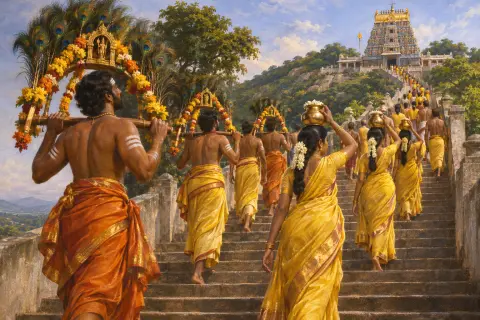 ThaipusamJan 22, 2027In the Palani story he wins the sacred fruit by circling his parents, and Murugan leaves home for the hill.
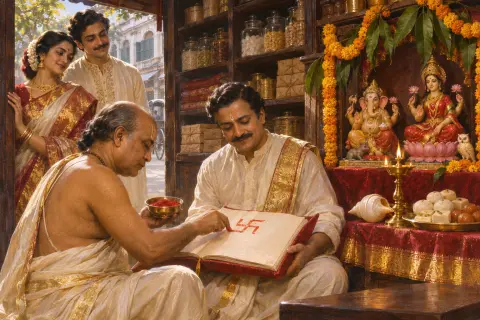 Pohela BoishakhApr 15, 2027Bengali traders worship him with Lakshmi before opening the new red account book.
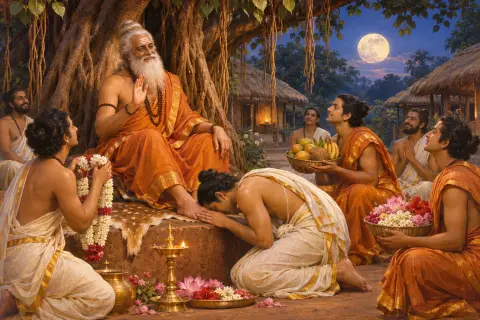 Guru PurnimaJul 18, 2027A well loved story makes him the scribe who wrote down the Mahabharata as Vyasa recited it.
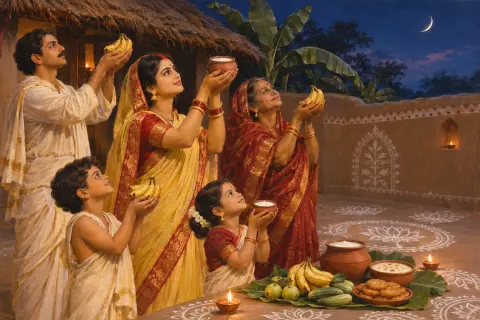 ChaurchanSep 3, 2027His curse on the laughing moon is why the moon of this Chaturthi is feared, and his blessing makes worshipping it a cure.
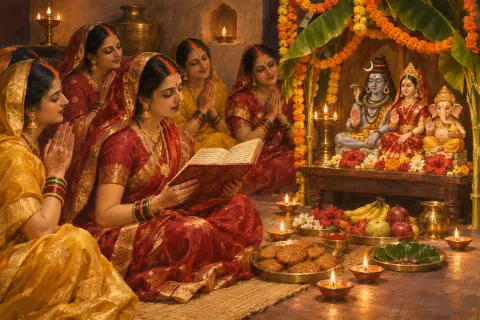 Hartalika TeejSep 3, 2027Women shape clay or sand images of him with Shiva and Parvati and worship the three together.
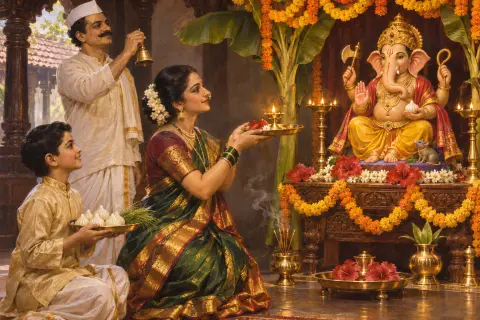 Ganesh ChaturthiSep 4 - Sep 14, 2027The festival is his birthday: he is brought home in clay, worshipped for up to ten days and given back to the water.
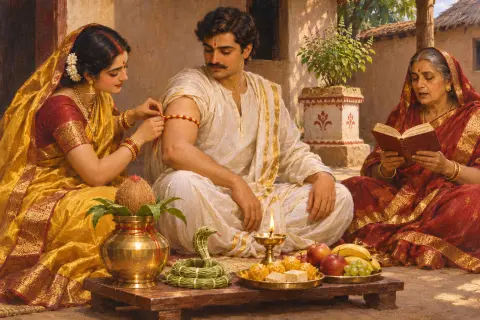 Anant ChaturdashiSep 14, 2027In Maharashtra this is the day his images are carried in procession and immersed, ending the Ganesh festival.
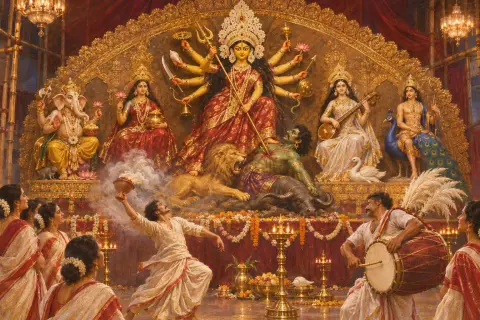 Durga PujaOct 5 - Oct 10, 2027He stands beside his mother in the pandal, and the banana plant bride, a form of the goddess, is placed next to him.
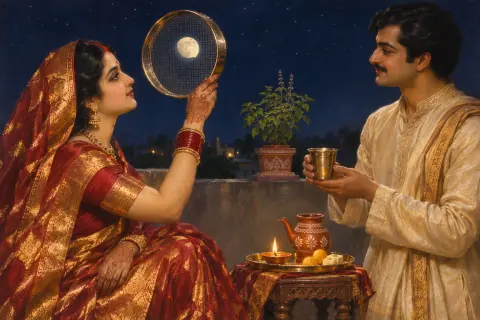 Karva ChauthOct 18, 2027He is worshipped with Parvati, Shiva and Kartikeya at the evening puja.
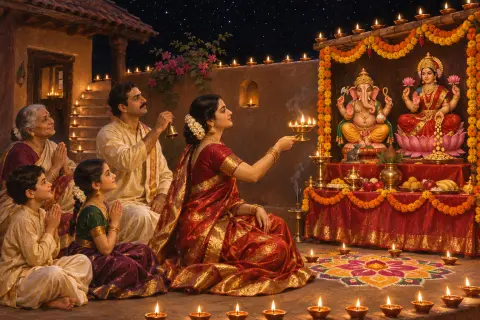 DiwaliOct 29, 2027He sits beside Lakshmi in the Diwali puja, so that the year begins without obstacles.
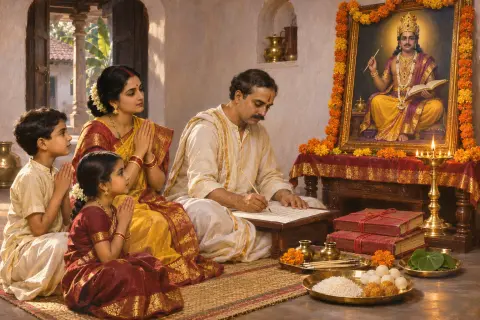 Chitragupta PujaOct 31, 2027Families write Shri Ganeshaya namah before the names of Chitragupta and the other gods on the puja page.
Paintings
8 paintingsAsk about Ganesha
Ask Gita Chat about Ganesha and what their story can teach you.