The Story
The oldest written source for the custom behind Chaurchan is the Narada Purana (Purva Bhaga, chapter 113, verses 38 and 39). Describing the Chaturthi vows of the year, it says that whoever looks at the moon on this Chaturthi will surely face a false accusation, and that to remove the fault they should recite a Puranic mantra: the verse about the lion, Prasena, Jambavan and the Syamantaka jewel. The full jewel story, in which Krishna himself is wrongly blamed, is told in the Bhagavata Purana (Book 10, chapters 56 and 57). Most of India answers this by not looking at the moon on Ganesh Chaturthi night. Mithila answers it by worshipping the moon openly, so that the moon and the family are both freed of blame. The stories families tell are these.
Ganesha and the Laughing Moon
This first story is not in the Bhagavata. It is told in Ganesh vrata kathas and by grandmothers across Mithila, with small differences. One night Ganesha was riding home on his mouse after a feast of modaks. The moon god Chandra, proud of his beauty, saw the round belly and the little mouse and laughed out loud.
Ganesha was not hurt by the joke so much as by the pride behind it. He told Chandra that because he mocked someone for how they looked, people would be afraid to look at him. Whoever saw the moon on this Chaturthi would carry a false blame, a kalank, that they had done nothing to deserve.
Chandra was ashamed. He bowed to Ganesha and worshipped him on this same tithi. A curse once spoken could not be taken back completely, so Ganesha softened it: whoever worships the moon on this day, together with Ganesha, will live without kalank. Mithila families say Chaurchan is that worship, kept on the moon's behalf and their own.
Krishna and the Syamantaka Jewel
The Bhagavata Purana (10.56) tells how false blame once fell on Krishna. Satrajit, a devotee of the sun god Surya, received the shining Syamantaka jewel as a gift from Surya. Krishna suggested he give it to King Ugrasena for the good of Dwaraka. Satrajit refused. Soon after, his brother Prasena wore the jewel on a hunt and was killed by a lion. The lion was then killed by Jambavan, the old bear king, who took the jewel to his cave for his child to play with.
When Prasena did not come back, people in Dwaraka began to whisper that Krishna had killed him for the jewel. Krishna did not argue with the gossip. He took some of the townspeople with him, followed Prasena's trail into the forest, found his body and then the lion's, and went alone into Jambavan's cave. The Bhagavata says Krishna and Jambavan fought for twenty eight days, until Jambavan recognised Krishna as his own lord Rama and gave him both the jewel and his daughter Jambavati.
Krishna came back, called Satrajit to the royal assembly and returned the jewel to him in front of everyone. Satrajit was so ashamed of the rumours that he gave Krishna his daughter Satyabhama in marriage. In many Ganesh vrata kathas, though not in the Bhagavata itself, the reason all this happened is that Krishna had looked at the moon on Bhadrapada Chaturthi.
The Jewel Goes Missing Again
The story did not end there. The Bhagavata (10.57) says Shatadhanva later killed Satrajit in his sleep and stole the jewel, then left it with Akrura and fled. Krishna and Balarama chased and killed Shatadhanva, but the jewel was not on him. Balarama did not quite believe Krishna, and the two brothers parted for a while.
Here the story touches Mithila. The Bhagavata says Balarama went to Mithila, where the king welcomed him with honour, and stayed there for some years. It was in Mithila that Duryodhana came to learn the mace from him.
In the end Akrura came back to Dwaraka. Krishna asked him gently to show the jewel to everyone, so that the doubts around Krishna's name would finally clear. The Bhagavata closes the episode by saying that whoever hears or remembers this story is freed from bad name and sin. That is why the Syamantaka verse is the mantra for this night.
Why Mithila Worships the Moon
Mithila has its own story too, told as local history. In the sixteenth century Hemangad Thakur, a king of the Khandavala line of Mithila and a learned astronomer, was held in Delhi by the Mughal court over unpaid revenue. In custody he worked out the eclipses for years ahead, and his work, remembered as the Grahan Mala, is said to have impressed the emperor so much that he was released and his lands returned.
When he came home, the story goes, Queen Hemalata said that the moon of Mithila was now free of its stain, and that this time they would look at it and worship it instead of hiding from it. Hemangad Thakur is said to have made that worship a festival for everyone. This is a Mithila tradition, told in Maithili homes and newspapers, not a scripture.
Both stories point the same way. Kalank, the fear of blame, does not go away by hiding. Mithila meets it in the open: the whole family stands in the courtyard, looks straight at the moon with an offering in hand, and asks for a life without false blame.
A Night of Dahi and Moonlight
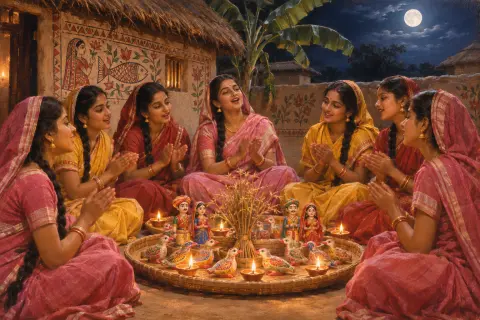
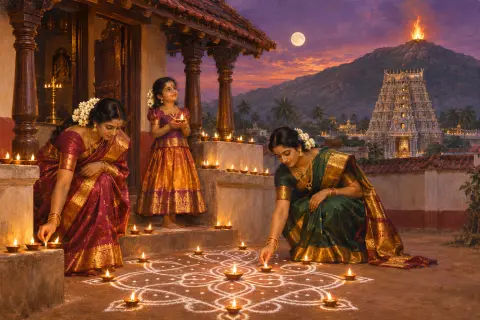
The day starts with cleaning. The courtyard or the roof is plastered with cow dung, and in the afternoon the women draw aripan with pithar, a paste of ground rice. Aripan is Mithila's floor painting, done only in white, with the moon, lotuses and old patterns drawn by hand. Banana leaves are laid on it for the offerings.
The kitchen is busy all day. There is pirukiya (a fried, half-moon shaped pastry with a sweet filling), khaja, thekua, puri, kheer and other dishes, and above all dahi, set the night before in small clay pots. Bananas, cucumbers and whatever fruit the season gives are heaped beside them. Every member of the family has their own share, often in a separate dali or basket.
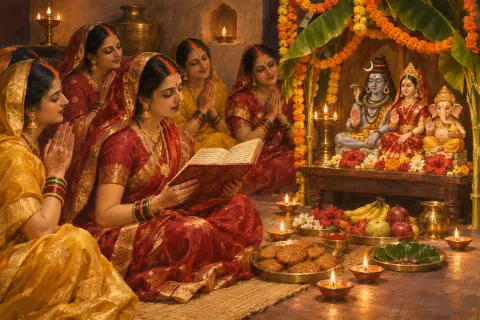
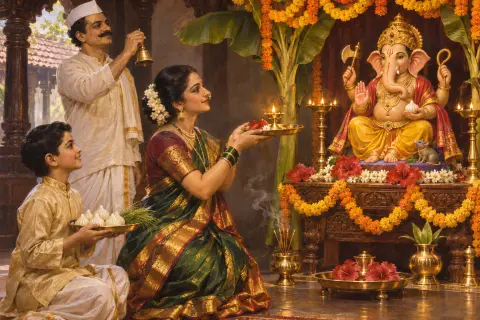
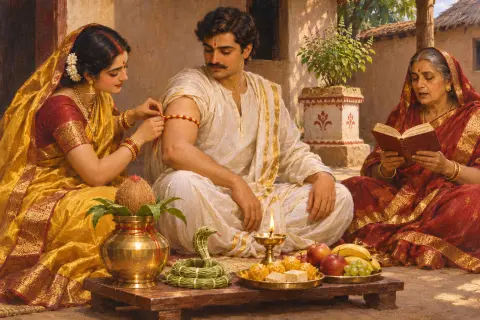
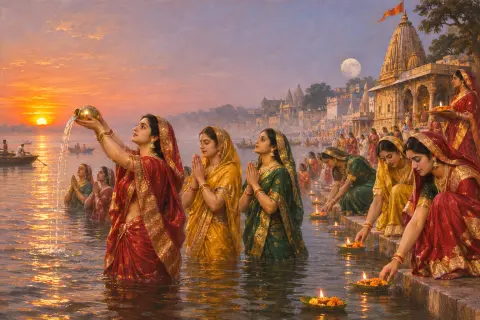
At moonrise the woman who has fasted offers arghya to the moon, with Ganesha worshipped alongside. Then each person lifts a fruit, a banana or a pot of dahi in both hands, looks at the moon and prays. Men can do the puja too. After the arghya the prasad is shared, the fast is broken, and the dahi everyone has waited for is finally eaten under the moon.
In the Bhagavata, Krishna is blamed for something he did not do, and he neither sulks nor shouts. He walks into the forest and brings back the truth. In Gita 12.19 he describes the person dear to him as one to whom blame and praise are the same, steady and content. Chaurchan teaches that steadiness in a Mithila way: do not hide from the moon or from what people might say. Stand in the open with clean hands and an offering, and let your life answer for you.