The Story
The oldest written source that historians usually connect with the Bengali year is the Ain-i-Akbari of Abul Fazl, the record of the Mughal emperor Akbar's reign, which describes the new solar era, the Tarikh-i-Ilahi, that Akbar brought in. Many historians think the Bengali year grew out of Akbar's reform, which let land revenue be collected after the harvest. Others credit the ancient Bengal king Shashanka or later sultans of Bengal, and no document settles it. There is no myth of gods behind the day. It is kept because it is the first day of the Bengali solar year: traders close the old accounts and open new ones, and families begin the year together. For many Hindu families it is also a day of prayer to Ganesh and Lakshmi; for many Bangladeshis it is above all a secular celebration of being Bengali.
The last day of Chaitra
The new year really begins the day before, on Chaitra Sankranti, the last day of the old year. Houses are cleaned, old things are cleared out, and shops hold their end of year sales. In many villages of West Bengal this is also the day of Gajan and Charak Puja, folk festivals of Shiva, with devotees who keep hard vows and fairs that run late into the night.
Boishakh is also the month of the kalboishakhi, the sudden evening storms of early summer that come with dark clouds, wind and hail. Bengalis have long seen them as a sign of the season turning. In Rabindranath Tagore's song "Esho he Boishakh", sung on this day almost everywhere, the poet calls on Boishakh to come and sweep away the dust and tiredness of the old year.
Where the Bengali year comes from
The Bengali calendar is a solar calendar. Its months begin as the sun moves through the signs of the zodiac, and the year begins with Boishakh, after the sun enters Mesha. In India the date is still set by the traditional almanac, the panjika, so it usually lands on 14 or 15 April.
The two main views explain the same number in different ways. The Bengali year count starts from about 593 CE, close to the reign of King Shashanka, which is why some credit him. Those who credit Akbar say his revenue year took the count of the Islamic lunar calendar at the time of his accession and ran it on as a solar year, which lands on the same starting point. Both are reasoned guesses, and neither is proven.
In Bangladesh the Bangla Academy revised the calendar so that its months have fixed lengths, which puts Pohela Boishakh on 14 April every year. West Bengal kept the traditional reckoning, so the two sides of Bengal sometimes celebrate a day apart.
Haal Khata: a new ledger with a blessing
For traders, Pohela Boishakh is the day of Haal Khata, the new account book. Shopkeepers close the old year's accounts and open a fresh ledger, traditionally bound in red cloth. Customers who owe money come in to settle their dues, and they are welcomed with sweets, a cold drink and often a new Bengali calendar for the wall.
In Hindu shops the new book is begun with prayer. Shopkeepers worship Ganesh, the remover of obstacles, and Lakshmi, the goddess of wealth and good fortune, at the shop or at home. In Kolkata, long queues form from early morning at Kalighat and Dakshineswar as traders bring their ledgers to be blessed. A priest marks the first page with a swastika in vermilion, and the shop door is hung with mango leaves.
It is a very practical ritual. The old debts are cleared, the relationship with the customer is renewed with a sweet, and the new year's work is offered to God before the first entry is made.
Dawn in Dhaka
In Bangladesh the day belongs to everyone, whatever their religion. At sunrise the cultural organisation Chhayanaut holds a concert under the banyan tree at Ramna Park in Dhaka, a tradition going back to the 1960s, and thousands gather to hear songs of Tagore and other Bengali poets.
Then comes the Mangal Shobhajatra, a procession started in the late 1980s by students of the Faculty of Fine Arts at Dhaka University. People walk with huge painted masks and figures of birds, fish and animals, wishing for good and standing against evil and fear. UNESCO lists it as part of the intangible cultural heritage of humanity.
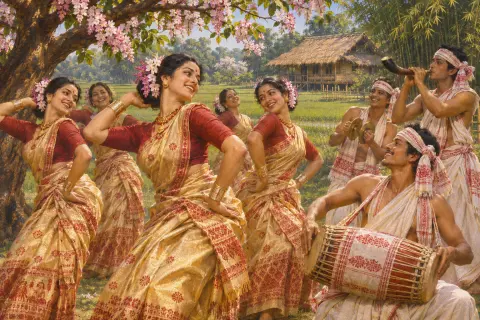
Women wear white saris with red borders, men wear panjabis, and faces are painted with flowers and designs. Many city families eat panta bhat, soaked rice, with fried hilsa fish, a custom that is fairly new but now loved. Boishakhi fairs fill towns and villages with crafts, toys, food and music.
At home in West Bengal
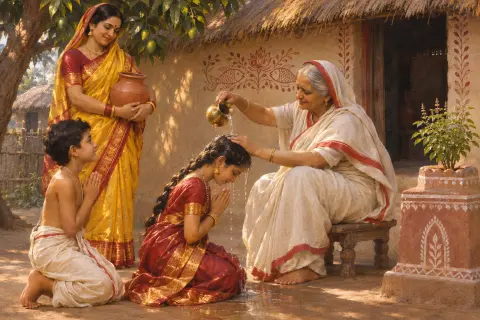
In West Bengal, Tripura and Bengali homes everywhere, the day starts with a bath, new clothes and a pranam to the elders, touching their feet for blessings. Many families do a small puja at home, and temples are busy all day.
Lunch is a long Bengali meal, with fish for many families and sweets like rosogolla and sandesh for everyone. Neighbours and friends visit, and the phrase of the day, Shubho Noboborsho, is said hundreds of times. Cultural programmes and Boishakhi melas fill the evening.
Whether the day is kept as a puja, a business ritual or a simple celebration of language and culture, it has the same feeling: close the old book, settle what you owe, and begin again.
In the Gita (3.9) Krishna says that work binds a person only when it is done for oneself alone; work done as an offering does not, so do your work in that spirit, free of clinging. Haal Khata puts this in the plainest form: a shopkeeper offers the new ledger to Ganesh and Lakshmi before writing the first entry. Pohela Boishakh invites everyone, trader or not, to begin the year by settling what they owe and doing their daily work as an offering.