The Story
No scripture or single old text lies behind Bohag Bihu. It grew out of the farming year of the Brahmaputra valley, and its oldest record is its own folk songs, the Bihu geet, handed down by word of mouth. The oldest datable trace is royal: the Ahom kings gave Bihu a place at court, and the brick Rang Ghar in Sivasagar, built in the eighteenth century under King Pramatta Singha, was the pavilion from which they watched the Bihu games. The day is kept because it opens the Assamese year and the sowing season. Assam has three Bihus, each tied to a moment in the farming year: Magh Bihu in January after the harvest, the quiet Kati Bihu in autumn, and Bohag Bihu in April, the happy one, also called Rongali Bihu, from rong, joy.
The season of joy
Bohag is the first month of the Assamese calendar, and Bihu starts at its doorstep, when the sun moves into Mesha. Weeks before, the signs are everywhere. The kopou orchid comes into flower, the cuckoo starts calling, and the sound of the dhol carries across the fields in the evenings as young people practise.
In many homes women spend these weeks at the loom, weaving gamosas, the white cotton cloths with red borders and woven patterns that will be given as gifts. Kitchens get busy with rice: pitha of many kinds, laru, and the chira, curd and jaggery that make up a jolpan breakfast.
The festival is traditionally kept for seven days, which is why it is also called Xaat Bihu, seven Bihus. The names and order of the days vary from place to place, but almost everywhere the first two are fixed: one day for the cattle, and one day for the people.
Goru Bihu: the day of the cattle
The last day of Chot is Goru Bihu, goru meaning cattle. Early in the morning, farmers lead their cows and bullocks to a river or pond. The animals are rubbed with a paste of black gram and turmeric and washed clean, and are lightly tapped with twigs of dighloti and makhioti, plants believed to keep flies and illness away.
As they do this, people sing an old rhyme to the cattle: eat gourd, eat brinjal, grow bigger year after year. Pieces of bottle gourd and brinjal are thrown to the animals. The cattle get new ropes, and in the evening they are fed pitha and led home to a freshly cleaned shed.
For a farming family, the cattle are the reason there will be a crop at all. Goru Bihu is the day the family says so out loud. Many households also eat a dish of many different greens that day, sometimes said to be a hundred and one, to start the season in good health.
Manuh Bihu: the day of the people
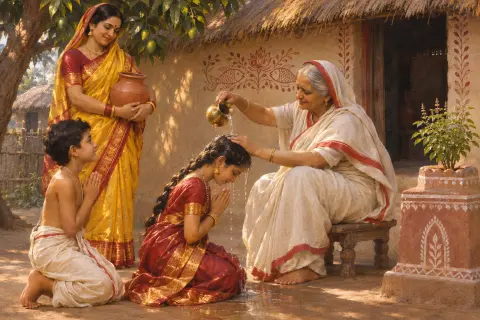
The next morning is the first of Bohag and the Assamese New Year. This is Manuh Bihu, manuh meaning people. Everyone bathes with turmeric and black gram paste, puts on new clothes, and goes to the elders of the family to bow and ask for their blessing.
The gift of the day is the gamosa. Younger people give gamosas to their elders, friends give them to each other, and a gamosa given at Bihu is called a Bihuwan. It is a small cloth, but in Assam it carries a great deal: respect, affection and a sense of belonging to the same land.
The days that follow are for visiting. Relatives come and go with pitha and jolpan, news is exchanged, and old quarrels are often quietly dropped. Some places call the second day Kutum Bihu, the day of relatives, and others Gosain Bihu, when the household deities are worshipped. The traditions differ, and both are honest descriptions of what people do.
Husori and the Bihu dance
During Bihu, groups of men and boys go from house to house singing husori. They usually begin at the village namghar, the prayer house of Assam's Vaishnava tradition. At each home they sing blessings for the family, and the household receives them with betel nut and paan on a brass sorai, and sometimes a gamosa or a little money.
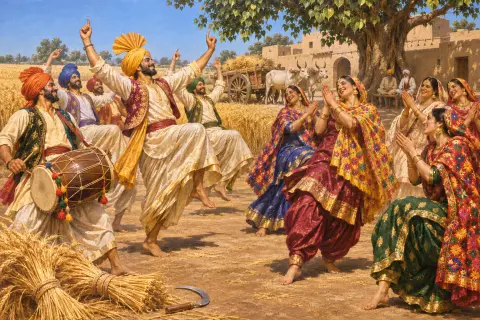
Then there is the Bihu dance. Young men play the dhol, the pepa (a pipe made from buffalo horn), the gogona (a bamboo jaw harp) and the taal, and young women in muga silk mekhela sador dance with kopou flowers in their hair. Bihu songs are mostly about youth, love and the season, and they can be cheeky.
Bihu used to be danced in open fields and under trees, a form often called mukoli Bihu. In some parts of upper Assam women keep their own Bihu, away from men. Today towns build stages, called Bihutoli, and hold Bihu functions for days. In Sivasagar, the Rang Ghar of the Ahom kings still stands beside the old festival ground.
Many peoples, one spring
Bihu is shared across Assam's communities. Hindus and Muslims, tea garden families and townspeople all keep it in their own way. Several communities have their own spring festival at the same time: the Bodos celebrate Bwisagu, their new year, with worship of Bathou and their own dances.
For Hindu families the festival also has its prayers. Husori groups start at the namghar, many people visit temples on the new year, and the second day is kept by some as a day for the gods. But Bihu has never needed a priest to be complete. A clean cowshed, a new gamosa and a drum in the evening are enough.
That is perhaps why Bihu feels so personal to people from Assam, wherever they live. It is the smell of pitha, the sound of the pepa and a bow to grandparents, all on the day the year turns.
In the Gita (7.10) Krishna says: know me as the eternal seed of all beings. Bohag Bihu comes just as the first rains soften the fields and the seed goes into the ground. It honours the cattle that work the soil, the elders who bless, and the life that returns to the land each spring, and it reminds you that the divine is not far away. It is in the earth you sow and in the lives that share your work.