Shiva is one of the great gods of Hinduism, worshipped as Mahadeva, the great god, and for Shaivas as the highest reality itself. He grew out of Rudra, the fierce and healing god of the Rigveda, and the Shvetashvatara Upanishad already calls Rudra the one Lord. The Mahabharata and the Puranas tell his stories: his marriage to Sati and then to Parvati, the burning of Kama, the poison he drank to save the world, and his appearance as an endless column of light. He is worshipped most often as the linga, and he is at the heart of Maha Shivaratri, the Shravan pilgrimage to Deoghar, Teej, Gangaur and Karthigai Deepam.
Also called: Mahadeva (the great god), Rudra (the roaring or fierce one), Shankara (who brings peace), Shambhu (source of happiness), Bholenath (the simple, easily pleased lord), Neelakantha (blue throated), Pashupati (lord of creatures), Tryambaka (three eyed), Gangadhara (who holds the Ganga), Chandrashekhara (moon crowned), Nataraja (king of dance), Tripurari (enemy of the three cities), Vishwanatha (lord of the universe), Ishvara or Maheshvara (the lord), Hara
First wife: Sati, daughter of Daksha, who gave up her life at her father's sacrifice
Wife: Parvati, daughter of Himavan and Mena, who is Sati born again
Sons: Kartikeya (Skanda, Murugan) and Ganesha
Daughters: none in the main Puranas; Bengali and Angika folk tradition make the snake goddess Manasa or Bishahari his daughter
Mount: Nandi, the white bull
Home: Mount Kailash in the Himalaya; tradition also says he never leaves Kashi (Varanasi)
Attendants: the ganas, his playful and strange followers, with Nandi at their head
Weapons: the trident and the bow Pinaka; his drum is the damaru
We worship the three eyed one, fragrant, who makes us grow strong. As a ripe cucumber is freed from its stalk, may I be freed from death, and not from the deathless.
Stories
Shiva's story runs through more of Indian scripture than almost any other god's. In the Rigveda he is Rudra, a god of storms and wild places, feared but also prayed to as the best of healers (hymns 1.43, 1.114, 2.33 and 7.46). The Yajurveda's Shatarudriya praises him with the words namah shivaya, bowing to the kind one, and the Shvetashvatara Upanishad makes Rudra the one Lord behind the world. In the Mahabharata he is the great god who grants weapons and wrecks Daksha's sacrifice. The Puranas, above all the Shiva Purana and the Linga Purana, give him a family on Kailash and the stories most people know today. Along the way the fierce outsider of the Vedas becomes the gentle Bholenath, easily pleased by a little water and a bilva leaf.
Rudra, the One Lord
The Rigveda has only a few hymns to Rudra, but they draw a clear picture. He is tawny, with braided hair (kapardin, Rigveda 1.114.1), armed with bow and arrows, a god of the wild who can strike cattle and people with disease. The same hymns beg him to turn his anger away, and Rigveda 2.33.4 calls him the best physician among physicians. People feared him and trusted him at once.
In the Yajurveda, the long hymn called the Shatarudriya, or Sri Rudram, praises him by hundreds of names. One line reads namah shivaya cha shivataraya cha, homage to the kind one and to the kinder one. The word shiva, kind or auspicious, slowly became his name.
The Shvetashvatara Upanishad (chapter 3, verse 2) goes further. "Rudra is one; they do not stand for a second," it says. He rules these worlds, protects them, and at the end of time draws them back into himself. Here, centuries before the Puranas, Shiva is already the one God behind everything, which is how Shaivas still see him.
Daksha's Sacrifice and Sati
The Shiva Purana (Rudra Samhita, Sati Khanda) and the Bhagavata Purana (Book 4, chapters 2 to 7) tell how Sati, daughter of the patriarch Daksha, chose Shiva as her husband. Daksha never accepted him. To him Shiva was a wanderer covered in ash who lived among ghosts at the cremation ground.
Daksha held a great sacrifice and invited every god except Shiva. Sati went anyway, hoping to make peace. When her father insulted her husband in front of everyone, she could not bear it. The Shiva Purana (Sati Khanda, chapter 30) says she sat in silence, fixed her mind on Shiva and gave up her body by the fire of yoga.
When Shiva heard, his grief became rage. He tore a lock from his hair and from it came Virabhadra, who with Shiva's ganas broke the sacrifice and killed Daksha. In the end Shiva was calmed. He restored the sacrifice and brought Daksha back to life with the head of a goat, and Daksha bowed to him. The Mahabharata (Shanti Parva) tells an older version of the wrecked sacrifice. Later texts add that Shiva wandered the world carrying Sati's body, and that the places where parts of her fell became the Shakti Peethas.
Kama Burned to Ash
Fire from Shiva's third eye burns Kama, as Rati weeps and Parvati looks on.
After Sati's death Shiva sat in deep meditation in the Himalaya and would not look at the world. Meanwhile the demon Taraka had won a boon that only a son of Shiva could kill him. Sati had been born again as Parvati, daughter of the mountain king Himavan, and she served Shiva every day while he meditated. But he did not open his eyes.
The gods sent Kama, the god of love, to help. With spring around him, he aimed a flower arrow at Shiva just as Parvati came near. Shiva felt his mind stir, looked round, and saw Kama with his bow. Fire leapt from his third eye and burned Kama to ash on the spot. This is told in the Shiva Purana (Rudra Samhita, Parvati Khanda, chapter 19) and, most beautifully, in Kalidasa's poem Kumarasambhava (canto 3).
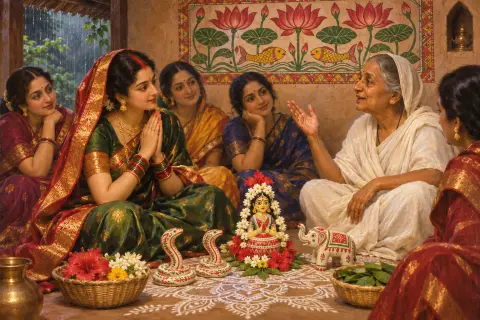
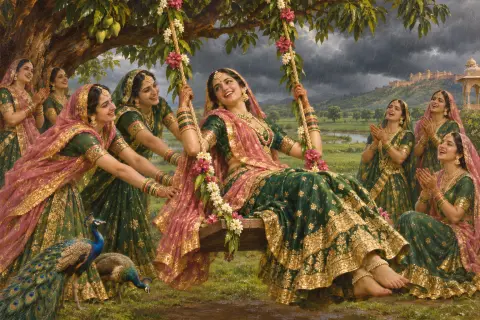
Kama's wife Rati wept, and Shiva promised that Kama would live again without a body, which is why he is called Ananga, the bodiless one. Parvati understood that beauty alone would not win Shiva. She went into the forest and did such hard penance that she gave up even eating leaves. Shiva came to test her as a young ascetic who mocked him, and when she would not hear a word against him, he showed himself and accepted her. Their wedding is the centre of Teej, Gangaur and, in popular tradition, Maha Shivaratri.
Neelakantha, the Blue Throat
When the gods and asuras churned the ocean of milk for amrit, using Mount Mandara as the churning stick and the serpent Vasuki as the rope, the first thing to rise was not nectar but a deadly poison, halahala. Its fumes began to burn all the worlds, and everyone ran to Shiva.
The Bhagavata Purana (Book 8, chapter 7) says Shiva felt pity for all living beings. He told Parvati that a great soul protects others even at a cost to himself, and with her consent he gathered the poison in his palm and drank it. He held it in his throat, which turned dark blue. The Valmiki Ramayana (Bala Kanda) and the Mahabharata (Adi Parva) also tell this story.
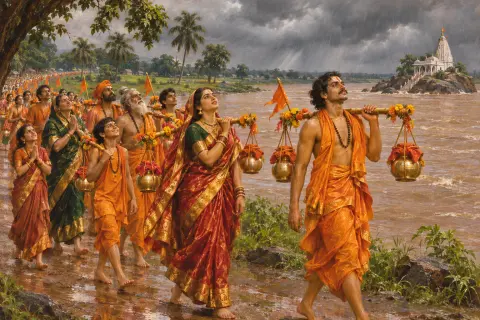
This is why he is Neelakantha. Many retellings add that Parvati held his throat so the poison would not go down. At Deoghar, pilgrims who carry Ganga water to Baba Baidyanath in the month of Shravan often say they come to cool the god who drank the poison, though the Purana itself does not make that link.
The Endless Column of Light
The Shiva Purana (Vidyeshvara Samhita, chapters 6 to 9) and the Linga Purana (Part 1, chapter 17) tell how Brahma and Vishnu once argued over which of them was greater. Suddenly a column of fire appeared between them, so tall that it had no visible top or bottom.
They agreed that whoever found its end would be the greater. Brahma became a swan and flew up; Vishnu became a boar and dug down. After a long time both gave up. Vishnu admitted he had failed. In the Shiva Purana, Brahma claimed he had seen the top and brought a ketaki flower as his false witness. Shiva then came out of the column, praised Vishnu's honesty and said Brahma would not be widely worshipped. The ketaki flower is still not offered to Shiva.
This form is called Lingodbhava, Shiva coming out of the linga, and it is carved on the back wall of many south Indian temples. The story explains what the linga means: the formless, endless god, beyond even Brahma and Vishnu. At Tiruvannamalai the column is said to have become the hill of Arunachala, and on Karthigai Deepam a great fire is lit on its summit.
How to recognise
•Pale skin smeared with white ash, which is why a well known prayer calls him karpura gauram, white as camphor. Many paintings, especially newer ones, give him a soft blue grey colour instead.
•A blue throat. It is the mark of the halahala poison he drank at the churning of the ocean (Bhagavata Purana, Book 8, chapter 7), and it gives him the name Neelakantha.
•Long matted hair (jata) piled up like an ascetic's, with a crescent moon in it and the river Ganga flowing from it. The Ramayana (Bala Kanda) tells how he caught the Ganga in his hair when she fell from heaven, so that her force would not break the earth.
•A third eye in the middle of his forehead, often over three horizontal lines of ash (the tripundra). In the Shiva Purana, fire from this eye burns Kama to ash.
•A cobra around his neck, rudraksha beads on his chest and arms, and a tiger skin round his waist. He dresses like the yogi of the mountains, not like a king.
•A trident (trishula) in his hand, often with a small hourglass shaped drum (damaru) tied to it. Later teachers read the three prongs as the three gunas or as creation, preservation and dissolution; the old texts simply give it to him as his weapon.
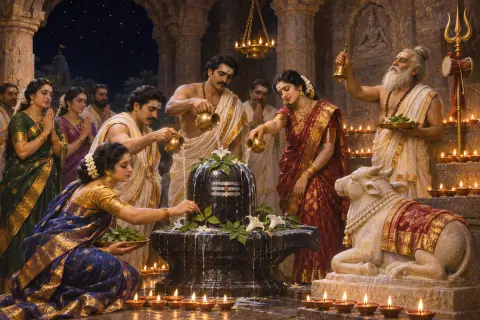
•The white bull Nandi is his mount and the guardian of his door, and in temples Nandi sits facing the shrine. At the centre of most Shiva temples there is no human image at all but a linga, the plain rounded stone that stands for him. In the south he is also shown as Nataraja, dancing inside a ring of fire, as in the Chola bronzes and at Chidambaram.
And, among the Rudras I am Sankara; among the Yakshas and Rakshasas, the Lord of wealth (Kubera); among the Vasus I am Pavaka (fire); and among the (seven) mountains I am the Meru.
Krishna says, "Among the Rudras I am Shankara." The Rudras are a group of eleven storm gods, and Shankara, Shiva, is named as the chief among them, one of the forms in which Krishna's glory shows most clearly.
Arjuna said: I see all the gods, O God, in Thy body, and (also) hosts of various classes of beings, Brahma, the Lord, seated on the lotus, all the sages and the celestial serpents.
Arjuna sees in Krishna's cosmic body all the gods and "Brahma, the lord (isha), seated on the lotus". Ramanuja and Madhva read isha here as Shiva, seen beside Brahma; Shankara does not, so the link depends on the commentator.