Brahma is the Hindu creator god, the four-faced grandfather of the worlds who sits on a lotus and rides a swan. He is not named in the Rigveda, but its creator figures, Hiranyagarbha and Prajapati, flow into him, and the Upanishads already call him the first of the gods. In the epics and Puranas he makes the world anew at the start of each cosmic day, is born on a lotus from Vishnu's navel, and grants boons to gods, sages and demons alike. With Vishnu and Shiva he forms the Trimurti, yet he has very few temples, the best known at Pushkar in Rajasthan. He appears in the stories of Ugadi, Gudi Padwa, Maha Shivaratri, Chitragupta Puja and Vasant Panchami.
Also called: Pitamaha (the grandfather), Prajapati (lord of creatures), Svayambhu (self-born), Chaturmukha or Chaturanana (four-faced), Hiranyagarbha (the golden embryo), Vidhi and Vidhata (the one who ordains fate), Dhata, Padmayoni, Kamalasana and Nabhija (lotus-born, born from the navel), Aja (unborn), Virinchi, Parameshthi, Lokesha (lord of the worlds), Hamsavahana (who rides the swan), Phra Phrom (in Thailand)
Origin: self-born from a golden egg in the waters (Manusmriti), or born on a lotus from Vishnu's navel (Vaishnava Puranas)
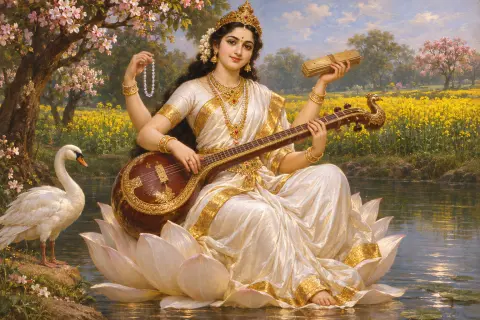
Consort: Saraswati; at Pushkar also Savitri and Gayatri, and the Matsya Purana treats several of these names as one goddess
Mind-born sons: the great sages Marichi, Atri, Angiras, Pulastya, Pulaha, Kratu, Vasishtha and others; also Narada and the four Kumaras
Other children: Daksha, born from his right thumb; Rudra, born from his anger in the Bhagavata; Svayambhuva Manu and Shatarupa, the first couple; Chitragupta, born from his body in the Padma Purana
Mount: the swan (hamsa)
Home: Brahmaloka, also called Satyaloka, the highest world
Lifespan: a hundred years of his own, each day lasting a thousand ages
Brahma came into being as the first of the gods, the maker of everything and protector of the world. He taught the knowledge of Brahman, the ground of all knowledge, to Atharvan, his eldest son.
Stories
Brahma is a later god than his role suggests. The Rigveda has no Brahma; it asks who made the world, and in hymn 10.121 praises Hiranyagarbha, the golden embryo. The Brahmanas give creation to Prajapati, lord of creatures. By the time of the Upanishads, Brahma is named as the first of the gods (Mundaka Upanishad 1.1.1), and the Maitri Upanishad (5.2) already links Brahma, Vishnu and Rudra to the three qualities of nature. The epics make him the grandfather who grants boons and settles disputes. The Puranas tell how he is born and how he creates, and also why he is worshipped so little. The stories below follow that path.
The Golden Egg
Rigveda 10.121 begins: in the beginning arose the golden embryo, Hiranyagarbha; once born, he was the one lord of all that exists. He held up the earth and the sky. Each verse ends with a question: to which god shall we offer our worship? The hymn praises a maker of the world without yet giving him the name Brahma.
The Manusmriti (1.8 to 1.13) turns this into a story. The self-existent one first made the waters and placed a seed in them. The seed became a golden egg, as bright as the sun, and in it was born Brahma, the grandfather of all the worlds. He lived in the egg for a year, then split it in two by thought alone, and made heaven from one half and earth from the other.
Many Puranas keep this egg, the Brahmanda, which is why the universe itself is called the egg of Brahma.
Born on the Lotus
The Vaishnava Puranas tell his birth another way. At the end of a cosmic age, Vishnu sleeps on the serpent Shesha in the single ocean. From his navel a lotus grows, and on it Brahma opens his four eyes and four faces and sees only water and darkness. In the Bhagavata Purana (Book 3, chapter 8) he climbs down the lotus stem for a hundred years looking for where he came from, and finds nothing.
He returns to his seat, and a voice says two syllables to him: tapa, tapa, do austerity (Book 2, chapter 9). He sits still for a thousand divine years, and then sees Vishnu and is given the power to create. The Gita's chapter 11 has Arjuna see Brahma seated on this lotus inside Krishna's universal form.
His time is vast. The Gita (8.17) says a day of Brahma lasts a thousand ages and his night is just as long. The Vishnu Purana (Book 1, chapter 3) works it out: a thousand cycles of four yugas make one day, about 4.32 billion human years. Each morning he creates the worlds, each night they dissolve, and he lives a hundred such years.
The First Children
The Bhagavata Purana (Book 3, chapter 12) tells how Brahma began. First he made the four Kumaras, Sanaka, Sanandana, Sanatana and Sanatkumara, from his mind. They were born wise and refused to have children, choosing a life of meditation. Brahma's anger at this burst out from between his brows as Rudra, who wept as he was born.
Then he made the great sages from his mind: Marichi, Atri, Angiras, Pulastya, Pulaha, Kratu, Bhrigu, Vasishtha, Daksha and Narada. Daksha came from his thumb, Narada from his lap. Still the world did not grow, so he divided his own body in two, and from the halves came Svayambhuva Manu, the first man, and Shatarupa, the first woman. Their children filled the earth.
The Matsya Purana (chapter 3) tells a stranger story about his heads. The goddess he made from himself, called Shatarupa, Savitri, Saraswati and Gayatri, was so beautiful that he could not stop looking at her. As she walked around him to honour him, a face grew on each side so he could keep watching, and when she rose into the sky a fifth face appeared on top. Shiva later cut that fifth head off, which is why he has four.
The Grandfather Who Grants Boons
In the epics and Puranas Brahma is the one gods and demons alike go to when they practise long austerities, and he rarely refuses them. Hiranyakashipu won from him a boon that he could not be killed by man or beast, by day or night, inside or outside, and Vishnu had to come as Narasimha (Bhagavata Purana, Book 7; the Holi page tells this). Ravana won the boon that no god, demon or celestial being could kill him, and forgot to include men (the Ram Navami page tells this).
His boons are not always dangerous. When the child Hanuman was struck down by Indra, Brahma gave him the gift that no weapon would kill him (the Hanuman Jayanti page tells this). When the gods are in trouble, they usually go to Brahma first, and he takes them to Vishnu or Shiva.
He is also the first teacher. The Mundaka Upanishad, in the verse at the top of this page, says he taught the knowledge of Brahman to his eldest son Atharvan, and Narada, his son, carries his teaching through the worlds.
Why Brahma Has So Few Temples
The texts give several reasons, and they do not agree. In the Shiva Purana (Vidyeshvara Samhita), Brahma and Vishnu argue over who is greater, and a column of fire appears between them. Brahma flies up as a swan to find its top, cannot, and falsely claims he has seen it, with a ketaki flower as his witness. Shiva, appearing from the column, declares that Brahma will not be worshipped (the Maha Shivaratri and Karthigai Deepam pages tell this). The Shiva Purana and other texts also tell how Shiva, as Bhairava, cut off Brahma's fifth head for his pride.
The second reason comes from Pushkar. In the Padma Purana's account (Srishti Khanda, chapters 16 and 17), Brahma holds a great sacrifice there, and his wife Savitri is late. Since the rite cannot begin without a wife beside him, he marries Gayatri, and the angry Savitri curses him. In the summary of Vettam Mani's Puranic Encyclopedia she limits his worship to the month of Kartika; the version told at Pushkar today says he would be worshipped only at Pushkar. Both are told, and devotees at Pushkar tell the second.
Historians give a different answer. They note that Brahma was the god of the old Vedic sacrifice, while the devotion that grew in the first millennium turned to Vishnu, Shiva and the Goddess. The Puranas of those traditions kept Brahma as the creator but made him work under their own god, born from Vishnu's navel or humbled by Shiva. Images of Brahma are found in many old temples, but almost no great temples were built to him alone.
Pushkar and Brahma's Other Shrines
Brahma lets the lotus fall, and where it lands the lake of Pushkar appears.
The Padma Purana (Srishti Khanda) says Brahma was looking for a place for his sacrifice. He let a lotus (pushkara) fall from his hand, and where it struck the earth, water sprang up. That is how Pushkar in Rajasthan got its name, and tradition says the lotus touched the ground in three places, making the three lakes of Jyeshtha, Madhya and Kanishtha Pushkar.
The Brahma temple at Pushkar, with its red spire and a swan over the gate, is the best known of his temples, rebuilt many times over the centuries. Savitri's temple stands on Ratnagiri hill above the lake, and Gayatri has her own shrine on another hill. At Kartik Purnima, pilgrims bathe in the lake and the great Pushkar fair is held; the Mahabharata already praises bathing at Pushkar on the full moon of Kartika (the Kartik Purnima page tells this).
There are a few other Brahma temples: at Asotra in western Rajasthan, at Khedbrahma in north Gujarat, at Kumbakonam in Tamil Nadu, and the Brahma shrine at Thirupattur near Tiruchirappalli, where devotees pray to have their fate rewritten. Outside India, the Erawan Shrine in Bangkok to Phra Phrom, the Thai name for Brahma, draws crowds every day.
Brahma is also remembered on the first day of the year. The Narada Purana says he created the world at sunrise on the first day of the bright half of Chaitra, which is kept as Ugadi and Gudi Padwa (those pages tell this).
How to recognise
•He has four heads, facing the four directions, so that he sees everything he has made. Paintings usually show three of them. He is often bearded and elderly, the grandfather of the worlds, with a crown on each head.
•His four hands commonly hold the Vedas (a book or palm-leaf bundle), a water pot (kamandalu), a string of prayer beads (akshamala) and a ladle for pouring ghee into the sacred fire (sruva). Some images give him a lotus instead of the ladle. The objects mark him as the priest of the first sacrifice and the source of the Vedas.
•His colour is red or golden, and he wears white or saffron cloth with a sacred thread across his chest, like a Vedic priest.
•He sits on a lotus, the one that grew from Vishnu's navel in the Puranas, or rides a white swan (hamsa). The swan is said to separate milk from water, and is often read as the power to tell the true from the false; that reading belongs to later tradition.
•In South Indian Shiva temples a standing Brahma is often carved in a niche on the north wall of the inner shrine, facing out. Many people worship him there without knowing they are at one of his few shrines.
•He is shown with Saraswati, and at Pushkar also with Savitri and Gayatri. The fifth head he once had, which Shiva cut off in the Puranic stories, is never shown.
Those people who know the day of Brahma which is of a duration of a thousand Yugas (ages) and the night which is also of a thousand Yugas duration, they know day and night.
Those who know day and night know that a day of Brahma lasts a thousand ages and his night another thousand. This is the Gita's measure of cosmic time, and the Puranas build their whole chronology on it.
(All) the worlds including the world of Brahma are subject to return again, O Arjuna; but he who reaches Me, O son of Kunti, has no rirth.
All the worlds, up to Brahma's own world, are places of return, Krishna says; only one who reaches him is not reborn. Even Brahma's heaven, the highest world, is not the final goal.
Arjuna said: I see all the gods, O God, in Thy body, and (also) hosts of various classes of beings, Brahma, the Lord, seated on the lotus, all the sages and the celestial serpents.
Inside the universal form Arjuna sees all the gods and Brahma, the lord, seated on his lotus seat. This is the Puranic picture of Brahma on the lotus, already in the Gita.
And why should they not, O great Soul, bow to Thee Who art greater (than all else), the primal cause even of the Creator (Brahma), O Infinite Being, O Lord of the gods, O Abode of the universe; Thou art the imperishable, the Being, the non-being and That which is the supreme (that which is beyond the Being and the non-being).
Arjuna asks why the gods would not bow to Krishna, who is greater even than Brahma and the first creator. Brahma here stands for the highest being in the created world.
Thou art Vayu, Yama, Agni, Varuna, the moon, the Creator, and the great-grandfather. Salutations, salutations unto Thee, a thousand times, and again salutations, salutations unto Thee.
Arjuna calls Krishna Prajapati and the great-grandfather (prapitamaha). Since Brahma is the grandfather, Pitamaha, commentators read this as calling Krishna the father of Brahma himself.
The Creator, having in the beginning (of creation) created mankind together with sacrifice, said, "By this shall ye propagate; let this be the milch cow of your desires (the cow which yields all the desired objects).
In the beginning Prajapati created beings together with sacrifice. The Gita uses the Vedic name Prajapati; many commentators identify him with Brahma, the creator.