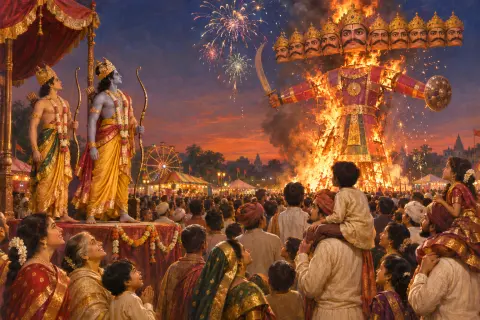
Rama is the prince of Ayodhya and the hero of the Ramayana, the eldest son of King Dasharatha and Queen Kausalya, worshipped as the seventh avatar of Vishnu. He is known for keeping his word at any cost: he gave up the throne and went to the forest for fourteen years so that his father's promise would hold, lost his wife Sita to Ravana, crossed the sea with an army of vanaras to win her back, and came home to rule a kingdom remembered as Ram Rajya. His story is told first in Valmiki's Sanskrit Ramayana, then in hundreds of later tellings, among them Kamban's Tamil Ramayanam and Tulsidas's Ramcharitmanas. His birth is kept on Ram Navami, his wedding on Vivah Panchami, his victory on Dussehra and his homecoming on Diwali.
Also called: Ramachandra, Raghava and Raghunatha (of the line of Raghu), Dasharathi (son of Dasharatha), Kaushalya Nandan (son of Kausalya), Sitapati (husband of Sita), Kodandapani (holder of the bow Kodanda, a southern name), Maryada Purushottama (the best of men, who keeps every limit of dharma), Ramabhadra
Parents: King Dasharatha of Ayodhya and Queen Kausalya
Stepmothers: Kaikeyi, mother of Bharata, and Sumitra, mother of Lakshmana and Shatrughna
Brothers: Bharata, Lakshmana and Shatrughna
Wife: Sita, daughter of King Janaka of Mithila
Sons: the twins Lava and Kusha, born in Valmiki's hermitage (Uttara Kanda)
Sister: Shanta; accounts differ, Valmiki calls her the daughter of King Romapada, later tellings make her Dasharatha's daughter
Family line: the Ikshvaku or Raghu dynasty, the solar line descended from Surya
Teachers: Vasishtha, the family priest, and Vishvamitra, who taught him the use of divine weapons
Home: Ayodhya on the river Sarayu
सकृदेव प्रपन्नाय तवास्मीति च याचते।
अभयं सर्वभूतेभ्यो ददाम्येतद्व्रतं मम॥
sakṛd eva prapannāya tavāsmīti ca yācate,
abhayaṃ sarvabhūtebhyo dadāmy etad vrataṃ mama.
To anyone who comes to me even once for refuge and asks, saying 'I am yours', I give safety from all beings. This is my vow.
Stories
The oldest account of Rama is the Valmiki Ramayana, a Sanskrit epic of about 24,000 verses in seven books (kandas). Many scholars think the core is the five middle books, and that the first (Bala Kanda) and last (Uttara Kanda) were added later; it is in those two books that Rama is most clearly called Vishnu. In the Mahabharata, the sage Markandeya tells Rama's story to Yudhishthira in the Vana Parva (the Ramopakhyana). Later poets retold it in every Indian language. Kamban's Tamil Ramavataram (Kamba Ramayanam), usually dated to the twelfth century, and Tulsidas's Awadhi Ramcharitmanas, begun in 1574, are the two most loved. Each one changes some scenes, and the Rama of the Ramcharitmanas is above all God, the object of bhakti. The stories below follow Valmiki and say when a detail comes from another telling.
Birth in Ayodhya and the journey with Vishvamitra
King Dasharatha had no son, so he held a great fire sacrifice. A being rose from the fire and gave him a bowl of payasam to share among his queens (Bala Kanda, sarga 16). Rama was born to Kausalya on the ninth day of the bright half of Chaitra, under the star Punarvasu (sarga 18). Bharata was born to Kaikeyi, and the twins Lakshmana and Shatrughna to Sumitra. Lakshmana was devoted to Rama from childhood and never left his side.
When Rama was barely sixteen, the sage Vishvamitra came to the court and asked for him to protect his sacrifice from demons. Dasharatha could hardly bear it, but he had given his word. On the road the sage taught both brothers the mantras bala and atibala, so that they would feel no hunger or tiredness. Rama killed the demoness Tataka and drove off Maricha and Subahu, and the sage gave him a whole set of divine weapons.
On the way to Mithila they passed the hermitage of Gautama. In Valmiki, Gautama's wife Ahalya had lived there unseen for years under her husband's curse, and when Rama arrived she became visible again and greeted him (sargas 48 and 49). In the Ramcharitmanas she has been turned to stone, and the touch of Rama's foot brings her back to life. This is the version most people know.
The broken bow and the wedding in Mithila
King Janaka of Mithila had a great bow that once belonged to Shiva, and he had promised his daughter Sita to whoever could string it. Kings had come and failed. Vishvamitra asked Janaka to show it to Rama. Five thousand men pulled it in on an eight-wheeled cart. Rama lifted it easily, strung it, and drew it back so far that it broke in the middle with a sound like thunder (Bala Kanda, sarga 67).
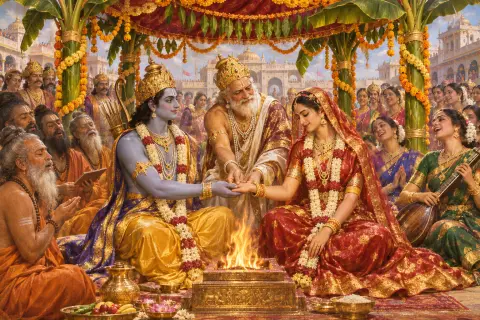
Janaka sent word to Ayodhya, and Dasharatha came with the whole court. Rama married Sita, and his three brothers married Urmila and Janaka's nieces Mandavi and Shrutakirti in the same ceremony (sarga 73). Mithila keeps this wedding every year on Vivah Panchami.
Kamban's Tamil Ramayana adds a moment that Valmiki does not have. Walking through Mithila the day before, Rama looks up and sees Sita on a palace balcony, and she sees him. Kamban says their eyes met and each took the other in. So in the Tamil telling they already love each other before the bow is lifted.
Fourteen years in the forest
Dasharatha decided to make Rama crown prince. The night before, Kaikeyi's maid Manthara reminded her of two boons the king had once promised her. Kaikeyi asked for them now: that Bharata be crowned, and that Rama live in the forest for fourteen years (Ayodhya Kanda). The king begged her to change her mind, but a promise was a promise. Rama heard the news calmly, said he would go gladly to keep his father's word, and left in bark clothes with Sita and Lakshmana, who refused to stay behind.
Dasharatha died of grief soon after. Bharata, who had been away, came home horrified, refused the throne and went to the forest at Chitrakuta to bring Rama back. Rama would not break his father's promise. In the end Bharata took Rama's sandals, set them on the throne and ruled from the village of Nandigram as Rama's stand-in, wearing bark clothes himself, until his brother came home.
The years in the forest took the three of them through the hermitages of the sages, from Chitrakuta to the Dandaka forest and finally to Panchavati on the Godavari. Many places across India, from Chitrakoot in central India to Panchavati near Nashik and Bhadrachalam in Telangana, keep memories of where they stayed.
Losing Sita, and Shabari's welcome
Rama accepts fruit from Shabari by Lake Pampa.
At Panchavati, Ravana's sister Shurpanakha tried to win Rama and then attacked Sita, and Lakshmana cut off her nose and ears. To take revenge, Ravana sent the demon Maricha in the form of a golden deer. Sita longed for it, Rama went after it, and Maricha, dying, cried out in Rama's voice. Lakshmana went to help, and Ravana, dressed as a wandering ascetic, carried Sita away to Lanka (Aranya Kanda). The old vulture king Jatayu fought him and fell, and lived just long enough to tell Rama which way Ravana had gone.
Rama searched the forest in deep grief. Near Lake Pampa he came to the hermitage of Shabari, an old woman ascetic who had served the sages there and had waited years for him. She welcomed the brothers, washed their feet and gave them fruits she had gathered by the lake (Aranya Kanda, sarga 74). Then, her waiting over, she entered the fire and rose to heaven.
In the Ramcharitmanas, Rama teaches Shabari the nine forms of devotion (navadha bhakti) and tells her that he sees no caste or birth, only love. The well known detail that Shabari tasted each berry first to give Rama only the sweet ones is a later folk telling. It is in neither Valmiki nor Tulsidas, but it has become one of the best loved pictures of Rama: a god who would rather have love than ceremony.
Refuge for Vibhishana, and the war in Lanka
With Hanuman's help Rama made friends with the vanara prince Sugriva and helped him win back his kingdom from his brother Vali. Rama shot Vali from hiding while the brothers fought (Kishkindha Kanda), and the dying Vali reproached him for it. Rama gave his answer, but readers have argued about this scene for two thousand years, and many tellings, Kamban's among them, treat it as a hard moment.
When the army reached the sea, Ravana's brother Vibhishana, thrown out of Lanka for telling Ravana to return Sita, flew across and asked for refuge. Sugriva warned that he might be a spy. Rama answered with the verse at the top of this page: whoever comes to him even once and says 'I am yours' will be protected, even if it is Ravana himself (Yuddha Kanda, sarga 18). Vishnu's devotees take this as Rama's promise to every soul.
The vanara Nala built a bridge across the sea, and the army crossed. In the long war that followed, Kumbhakarna and Indrajit fell. Before the last fight, the sage Agastya taught Rama the Aditya Hridayam, a hymn to the sun. Rama killed Ravana with a weapon given by Brahma, and crowned Vibhishana king of Lanka.
The return, the reign, and the hard last book
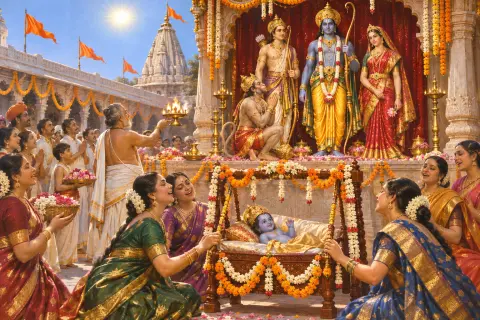
When Sita was brought to him, Rama spoke to her harshly in front of everyone, saying he had fought to clear his family's name. Sita, deeply hurt, asked Lakshmana to build a fire and walked into it. Agni, the fire god, rose with her unharmed and gave her back to Rama, declaring her pure. Rama said that he had never doubted her himself, but that the world had to see it (Yuddha Kanda). Then they flew home to Ayodhya in the Pushpaka chariot, where Bharata was waiting, and Rama was crowned in the last sarga of the book. The Yuddha Kanda ends with a picture of his reign: no widows mourned, no one died young, and the rains came on time.
The Uttara Kanda goes on. Gossip in Ayodhya about Sita's stay in Ravana's house reached Rama, and as king he sent her away to the forest, though she was pregnant. She found shelter in Valmiki's hermitage, where her twin sons Lava and Kusha were born. Years later the twins sang the Ramayana at Rama's horse sacrifice. Rama sent for Sita and asked her to prove her purity before the assembly. Sita called on the Earth, her mother, to take her back if she had been true. The ground opened, and she was gone (Uttara Kanda, sarga 97).
Rama ruled for many more years. At last he handed the kingdom to his sons and nephews, walked into the river Sarayu with the people of Ayodhya following him, and returned to his form as Vishnu (Uttara Kanda, sarga 110). Many people find this last book painful, and the Ramcharitmanas ends with the coronation and leaves out Sita's exile. But it is part of how the story has been told, and it is why Rama is so often called a king who put his duty to his people above his own happiness.
How to recognise
•Dark blue or dark green skin. Valmiki calls him shyama, dark like a rain cloud, and painters show this as blue. He has two arms, never more, because he lived as a man.
•A tall bow in his left hand and an arrow or a raised hand of blessing in his right, with a quiver on his back. In the south the bow is called Kodanda, which is why he is worshipped as Kodandarama.
•In palace scenes and at the coronation he wears a gold crown, yellow silk (pitambara) and jewels. In forest scenes he wears bark cloth or plain ochre, with his hair tied up in matted locks, as the Ayodhya Kanda describes when he leaves for exile.
•Ram Darbar, the picture found in many homes and temples: Rama sits or stands with Sita on his left, Lakshmana beside them with his own bow, and Hanuman kneeling at their feet with folded hands. Bharata and Shatrughna are sometimes added.
•Rama Pattabhishekam, the coronation, is a favourite subject in south Indian painting: Rama and Sita on the throne, Vasishtha pouring water, the brothers holding the royal umbrella and fly whisks.
•A vertical Vaishnava tilak on his forehead and a garland of forest flowers are common in temple images. These come from temple practice, not from the Ramayana.
Among the purifiers (or the speeders) I am the wind; Rama among the warriors am I; among the fishes I am the shark; among the streams I am the Ganga.
Krishna says: among those who bear weapons, I am Rama. The verse gives only the name, but commentators such as Ramanuja read it as Rama of the Ramayana, the avatar of Vishnu. It is the one place in the Gita where Rama is named.