The Story
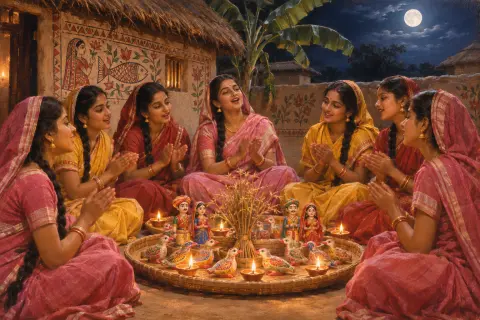
Nuakhai has no single scripture of its own. The idea behind it is very old: the Vedic ritual texts describe the agrayana, an offering of the first grain of a new harvest to the gods before anyone eats it. Nuakhai is western Odisha's own form of that idea, carried by local tradition and the region's temples rather than by one book. Families keep the day to thank the goddess for the paddy, to eat the first rice together, and to renew the bonds of the household. Nua means new and khai means eating.
The first grain belongs to the goddess
In western Odisha the paddy is still green and heavy in the fields during Bhadrapada. Nuakhai comes at this point, often before the main harvest is in. Families go out to find the first ripe ears, or buy new rice from a farmer who has it, so that the season's grain can be offered on the right day.
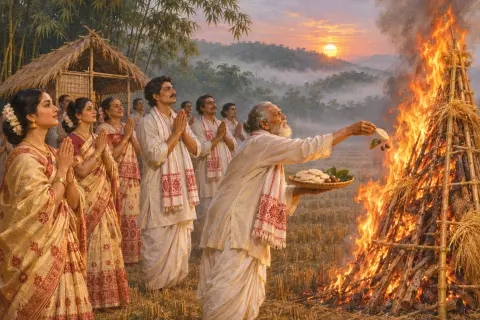
The idea is old and simple. What the earth gives is not ours to eat first. It is first given back, to the goddess and to the household deity, and only after that does it become food for people. Many people link this to the old Vedic custom of offering the first fruits of a crop. Local tradition also says the festival was given its shape by Ramai Deo, the first Chauhan king of Patnagarh, who is remembered for encouraging settled farming in the region. This is a living tradition rather than a recorded date, so it is best taken as the region's own story about itself.
Samaleswari and the lagna
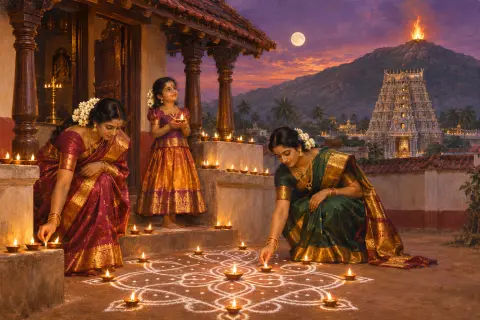
Maa Samaleswari is the presiding goddess of Sambalpur, and her temple on the bank of the Mahanadi sits at the heart of Nuakhai. Each year the auspicious moment for the offering, called the lagna, is calculated by priests and astrologers linked to her temple. At that moment the new rice, cooked as nabanna, is first offered to her.
Other towns have their own goddesses and do the same. In Patnagarh it is Pataneswari, in Bhawanipatna Manikeswari, in Sonepur Sureswari. Once the goddess has received the offering, homes across the region make theirs, often facing the same direction and timed to the same lagna. In the past each area chose its own day. Today the whole region keeps a common day, Bhadrapada Shukla Panchami.
Weeks of getting ready
Nuakhai is not prepared for in a day. People in the region describe a chain of steps that runs for weeks. The date and lagna are announced. Families invite those who live away to come home. Houses are cleaned, plastered and painted. New clothes are bought. The new paddy is located and brought in.
Many people working in Bhubaneswar, Raipur, Delhi or abroad try hard to get home for this one day. Buses and trains to Sambalpur fill up. A family that cannot gather on Nuakhai feels the gap, which is why the festival is often called the Diwali of western Odisha, though its mood is quieter and closer to home.
The meal and Nuakhai Juhar
At home the nabanna is first offered to the household deity. Then the eldest member of the family hands out the new rice to everyone, and they eat it together. It is a small portion, but it carries the whole year's work, the rain, the fields and the people who tended them.
After the meal comes Nuakhai Juhar. Younger people touch the feet of their elders and receive blessings. Friends and neighbours greet one another with "Nuakhai Juhar". This is a day to forgive and let quarrels go, and people who have fallen out are expected to make up. In the evening there are songs and folk dances such as Rasarkeli and Dalkhai, and in the days after, towns hold Nuakhai Bhetghat, gatherings where whole communities meet and greet.
New rice beyond western Odisha
Odia families living in other cities and countries now hold their own Nuakhai gatherings, often on the nearest weekend. Neighbouring parts of Chhattisgarh and Jharkhand keep a similar new-grain festival, often called Nawakhai.
The idea itself is shared by many farming regions. Bengal keeps Nabanna after the winter paddy harvest, and in Bihar, especially in Mithila, families make a new-rice offering in the month of Agahan before eating the new grain. These festivals fall at different times and have their own customs. What links them is the same instinct: the first share goes to the giver.
In the Bhagavad Gita (3.13) Krishna says that those who eat what remains after an offering are freed from wrong, while those who cook only for themselves eat their own fault. Nuakhai acts this out in one meal. The new rice goes first to the goddess, then to the household god, and only then to the family, from the elder's hand. Food eaten this way stops being only a thing you earned. It becomes something you received, and you share it before you take it.