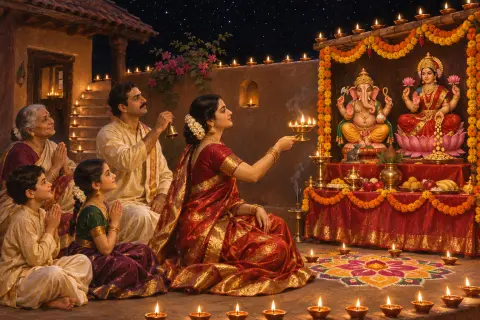
Lakshmi is the Hindu goddess of good fortune, wealth, beauty and well-being, and the wife of Vishnu. As Shri she is praised in the Shri Sukta, a hymn attached to the Rigveda. The Puranas tell how she rose from the Ocean of Milk when the gods and asuras churned it, chose Vishnu, and was born again beside him as Sita and Rukmini. She is worshipped in homes and shops across India, above all on Diwali night, and also on Dhanteras, Sharad Purnima (Kojagara), Varalakshmi Vratam and at the start of a new account book.
Also called: Shri (radiance, good fortune), Mahalakshmi, Padma and Kamala (the lotus one), Padmavati, Kamalatmika, Haripriya (beloved of Hari), Narayani, Vishnupriya, Indira, Kshirasagara-suta (daughter of the Ocean of Milk), Bhargavi (daughter of Bhrigu), Gajalakshmi (Lakshmi with elephants), Varalakshmi (giver of boons), Dhanalakshmi, Ambabai (at Kolhapur), Thayar (in Tamil temples)
Husband: Vishnu
Birth: she rises from the Ocean of Milk at the churning; the Vishnu Purana also gives her an earlier birth as the daughter of the sage Bhrigu and Khyati
Births with Vishnu's avatars: Padma or Kamala with Vamana, Dharani with Parashurama, Sita with Rama, Rukmini with Krishna
Sister: Alakshmi (Jyeshtha), the goddess of misfortune, born before her from the same ocean in later Puranas
Mount: an owl in eastern India; elephants attend her as Gajalakshmi
I call here Shri, who smiles, who is surrounded by gold, gentle and moist yet shining, content and giving contentment to others, who stands on a lotus and has the colour of a lotus.
Stories
The oldest hymn to Lakshmi is the Shri Sukta, preserved in the Khila (appendix) of the Rigveda, where Shri and Lakshmi are already one goddess of radiance, gold and plenty. The Shatapatha Brahmana tells of Shri as the splendour every god wants a share of. The Mahabharata lets her speak about where she chooses to live. The Vishnu Purana (Book 1, chapters 8 and 9) and the Bhagavata Purana (Book 8, chapter 8) tell the story most people know, of her rising from the churned ocean and choosing Vishnu, and from then on she is his constant companion. The stories below follow these texts.
Shri in the Veda
In the Shri Sukta the singer asks Agni, the fire, to bring Lakshmi to him: golden, wearing gold and silver garlands, shining like the moon, a goddess who will not leave. The hymn asks her to drive away Alakshmi, hunger, thirst and poverty, and to bring cattle, horses, grain and children. Its fifteen verses are still recited at almost every Lakshmi puja, and two of them open the Diwali and Varalakshmi pages.
The Shatapatha Brahmana (11.4.3) tells a short story about Shri. When Prajapati was creating the world, Shri came out of him, shining. The gods saw her beauty and wanted what she had. Agni took her food, Soma her royal power, Varuna her sovereignty, Indra her strength, and the other gods took her other gifts. Shri went to Prajapati, who told her to win them back by sacrifice, and she did.
Already here Shri is not only money. She is the bright fullness of a good life: food, power, beauty, health and honour, which flow to those who live well and leave those who do not.
Rising from the Ocean of Milk
Lakshmi rises from the churning of the Ocean of Milk, garland in hand.
The Vishnu Purana (Book 1, chapter 9) begins with a curse. The sage Durvasa gave Indra a garland, and Indra put it on his elephant's head; the elephant threw it on the ground. Durvasa cursed Indra that his fortune would leave him, and Shri left the three worlds. Without her, the gods grew weak and the asuras beat them.
On Vishnu's advice the gods made peace with the asuras and together they churned the Ocean of Milk, using Mount Mandara as the churning rod and the serpent Vasuki as the rope, with Vishnu as a tortoise holding up the mountain. Many treasures came out: the wish-granting cow, the Parijata tree, the moon, the physician Dhanvantari with the nectar (the Dhanteras page tells this).
Then Shri rose, the Purana says, shining, standing on an open lotus with a lotus in her hand. The sages sang the Shri Sukta, the rivers came to bathe her, and the elephants of the four directions poured water over her from golden pots. The ocean gave her a garland of unfading lotuses. She looked at all the gods and went to Vishnu, and rested on his chest. The Bhagavata Purana (Book 8, chapter 8) tells it a little differently: she walks among the gods with her garland, finds a fault in each, and chooses Vishnu, who has none.
Always Beside Vishnu
The Vishnu Purana (Book 1, chapter 8) says Lakshmi is never apart from Vishnu, the mother of the world who is as eternal as he is. It gives pairs to show it: if he is meaning, she is speech; if he is the lamp, she is its light; if he is the tree, she is the creeper that clings to it. The same chapter also tells of an earlier birth in which she was the daughter of the sage Bhrigu and his wife Khyati, which is why she is called Bhargavi.
Chapter 9 adds that she comes down with him in every avatar. When he was born as Vamana, she appeared from a lotus as Padma; with Parashurama she was Dharani; with Rama she was Sita; with Krishna she was Rukmini. In his other births too, the Purana says, she is always at his side.
That is why so many festivals worship the two together, and why South Indian Vaishnava teachers, especially in the Shri Vaishnava tradition of Ramanuja, see her as the one who leads devotees to him. The tradition takes its name from her, Shri.
Where Shri Chooses to Live
In the Anushasana Parva of the Mahabharata (chapter 11), Bhishma tells Yudhishthira of a conversation in which Rukmini, Krishna's wife, asks Shri which people she stays with. Shri answers that she lives with men who speak well, work hard, honour the gods, are grateful, keep their desires in check and think nobly, and with women who are truthful, gentle and good. She does not stay with those who neglect their work, who are ungrateful, harsh in speech or dishonest. She adds that she also lives in cow pens, among elephants and in lakes full of open lotuses.
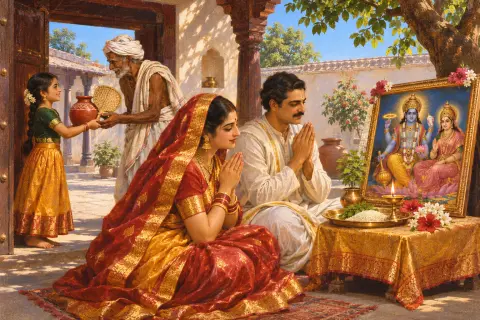
This is one of the ideas behind Diwali's cleaning. Houses are swept, broken things thrown out and lamps lit, so that Lakshmi will want to come in. Later Puranas give her an elder sister, Alakshmi or Jyeshtha, the goddess of quarrels and misfortune, who came out of the ocean first. On Diwali morning in parts of north and east India, women beat a winnowing fan to drive Alakshmi out before Lakshmi is worshipped (the Diwali page tells this).
The lesson is the same in both texts: good fortune is not a lottery. It stays where people live well, work honestly and treat each other kindly.
Lakshmi Through the Year
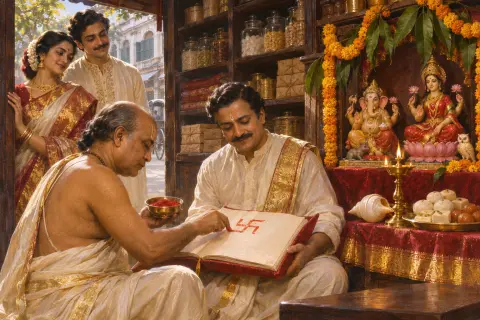
Diwali night, the new moon of Kartika, is her greatest festival. Families clean and light their homes and worship Lakshmi with Ganesha, and many traders open new account books. Two days earlier, on Dhanteras, people buy metal or new utensils to welcome her. In Bengal the new account book, the Haal Khata, is opened on Pohela Boishakh with Ganesh and Lakshmi puja.
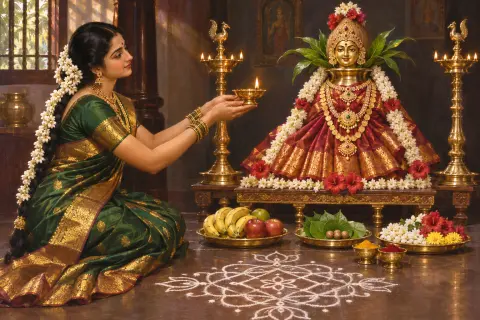
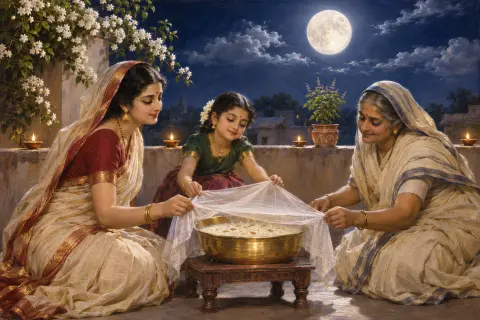
In Bengal, Odisha and Mithila her main puja is on Sharad Purnima, the full moon of Ashvin, as Kojagari Lakshmi. The vrat tradition says she goes from house to house that night asking, ko jagarti, who is awake, and blesses those who keep watch. In Karnataka, Andhra Pradesh and Tamil Nadu, married women keep Varalakshmi Vratam on the Friday before the full moon of Shravana, worshipping her in a kalasha dressed as the goddess.
Her best known temple is the Mahalakshmi temple at Kolhapur in Maharashtra, where she is called Ambabai, and pilgrims to Tirumala also visit her as Padmavati at Tiruchanur nearby. The group of eight Lakshmis, the Ashta Lakshmi (for wealth, grain, courage, children, victory, knowledge and so on), comes from later devotional tradition rather than the old Puranas.
How to recognise
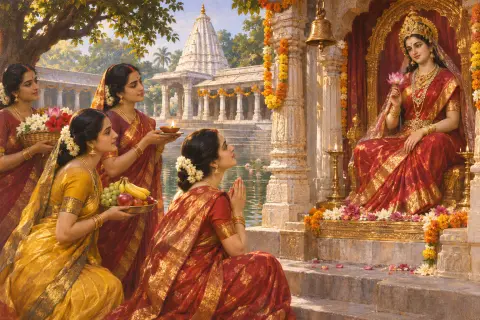
•She is golden or rosy in colour, young and calm, dressed in a red or pink silk sari with gold jewellery and a crown. She sits or stands on a fully open pink lotus, often in the middle of a lotus pond.
•She usually has four arms. The upper two hold lotuses; one lower hand is raised in blessing (abhaya) and the other is turned down in giving (varada), often with gold coins pouring from it. When she sits beside Vishnu she is shown with two arms.
•Two elephants standing on either side, pouring water over her from pots raised in their trunks, make the form called Gajalakshmi. It is one of the oldest Hindu images: it is carved on the Buddhist stupas at Bharhut and Sanchi, from about the second and first centuries BCE.
•The lotus is hers in nearly every text. It grows from mud but stays clean, and the Shri Sukta calls her lotus-born, lotus-coloured and standing on a lotus. Reading the lotus as purity in the middle of worldly life is a common later explanation.
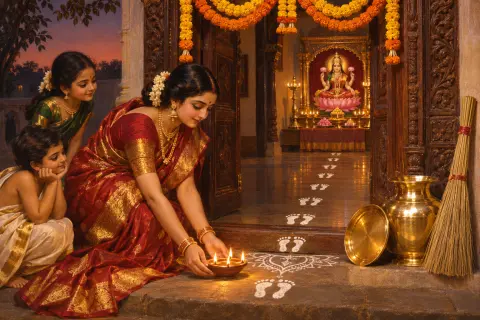
•In Bengal and eastern India her mount is a white owl. In Diwali pictures she often sits with Ganesha, and her small footprints are drawn in rice paste or rangoli leading into the house.
•In temples she often has her own shrine within Vishnu's, called Thayar in Tamil Nadu. With Vishnu, she sits at his feet on Shesha, or on his chest as the Shrivatsa mark, since the Puranas say she lives on his heart.
And I am the all-devouring Death, and the prosperity of those who are to be prosperous; among the feminine qualities (I am) fame, prosperity, speech, memory, intelligence, firmness and forgiveness.
Among feminine qualities, Krishna says, I am fame, shri, speech, memory, intelligence, steadiness and forgiveness. Shri here means good fortune and grace, which is also the goddess's oldest name; the Gita does not tell her story, but many commentators read her presence in the word.
Wherever is Krishna, the Lord of Yoga; wherever is Arjuna, the wielder of the bow; there are prosperity, victory, happiness and firm policy; such is my conviction.
The Gita's last verse says that wherever Krishna and Arjuna are, there will be shri, victory, prosperity and sound judgement. Shri again means good fortune, and devotees hear in it Lakshmi staying with Krishna. The verse itself does not name her as a goddess.