The Story
The story at the heart of Jitiya is old in writing. Jimutavahana, the prince who gave his own body to Garuda to save a young naga, is the hero of Harsha's Sanskrit play Nagananda from the seventh century, and his story is also told in Somadeva's Kathasaritsagara. The Jitiya vrat katha, which puja books attribute to the Bhavishya Purana, takes this story and adds a promise: mothers who fast on Ashvin Krishna Ashtami and worship Jimutavahana will see their children live. That is the meaning of the name Jivitputrika, the woman whose children live. Alongside it, women tell the folk tale of the eagle and the jackal, and many also remember Krishna bringing Uttara's child back to life in the Mahabharata.
The Prince Who Gave Himself
In the Nagananda, Jimutavahana is a prince of the Vidyadharas, a gentle young man who gave away his family's wish fulfilling tree so that it could end the poverty of the world. Jitiya tellings often call him a Gandharva king. He went to live on the Malaya mountain and married Malayavati.
One day, walking by the sea, he saw a great heap of white bones and heard an old woman weeping. Her son, the young naga Shankhachuda, was to be eaten by Garuda that day. The naga king Vasuki had agreed to send Garuda one naga every day to stop him from destroying them all, and today it was her son's turn.
Jimutavahana could not bear her grief. He took the red cloth marked for the victim, lay down on the stone where Garuda came to feed, and waited. Garuda swooped down, seized him and began to eat. But the prince did not cry out. He stayed calm, even glad. Garuda stopped, puzzled: who was this who did not fear death? Then Shankhachuda came running back, shouting that he was the one meant to die.
Garuda's Change of Heart
When Garuda understood that a prince had given his own body to save a stranger's son, he was filled with shame. Jimutavahana, badly wounded, asked him only one thing: stop killing the nagas, and be sorry for those already killed.
In the Nagananda, the goddess Gauri brings Jimutavahana back to life, and Garuda brings amrita, the nectar of immortality, and sprinkles it over the heap of bones, so that all the nagas he had eaten come back to life. Garuda promises never to hunt them again.
The Jitiya katha tells the ending as a boon. Pleased by the prince's selflessness, the gods (in some versions Garuda himself, in others Shiva and Parvati) promise that any mother who fasts on this Ashtami and worships Jimutavahana will never lose her children. That promise is why the vrat is kept.
The Eagle and the Jackal
No Jitiya puja is thought complete without the story of the cheel and the siyarin, the eagle and the jackal. In this folk tale, a female eagle lived in a tree near the river Narmada, and a female jackal lived in a hole below. They heard some women talking about the Jitiya vrat and decided to keep it too.
The eagle kept the fast faithfully. The jackal grew so hungry that, in the night, she secretly ate the flesh of a dead animal. The eagle saw it but kept her vow. In their next lives they were born as sisters. The eagle became Shilavati, and every one of her sons lived and grew. The jackal became Karpuravati, and her children died one after another.
Karpuravati's grief turned to jealousy, and she tried again and again to harm her sister's sons, but the power of the vrat kept them safe each time. In the end Shilavati told her of their past lives and the broken fast. Karpuravati then kept the vrat properly and was blessed with children. Names and details differ from village to village, but the lesson is the same: keep the vow with a whole heart.
Krishna and Uttara's Child
Many families also connect Jitiya with the Mahabharata. After the war, Ashwatthama turned a terrible weapon against the unborn heirs of the Pandavas, and Uttara's child was born dead.
The Mahabharata (Ashvamedhika Parva, chapter 69 in the Gita Press edition) tells how Krishna came to the grieving mother and said: Uttara, I do not speak falsely, this will come true, I will bring this child back to life in front of everyone. Calling on his own truthfulness, he revived the baby, who was named Parikshit.
Jitiya tradition sees in this the same promise as the vrat itself: a child given back to life. This is why some tellings link the name Jivitputrika to that moment.
Three Days in a Bihar Home
On Nahay Khay, the day before the fast, women bathe and eat a special meal. Across Bihar this means marua (finger millet) roti and noni saag, and in Mithila and many other homes, fish and rice as well. Late that night, before the Ashtami begins, many take a last meal, which in Mithila is called otghan.
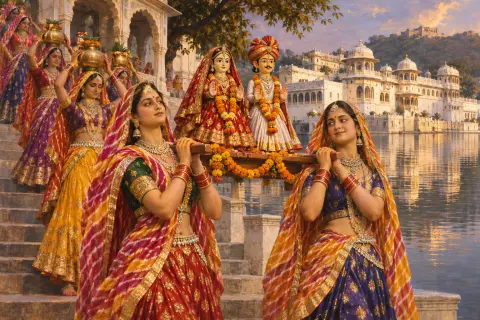
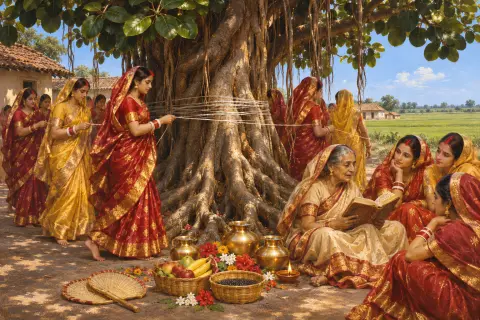
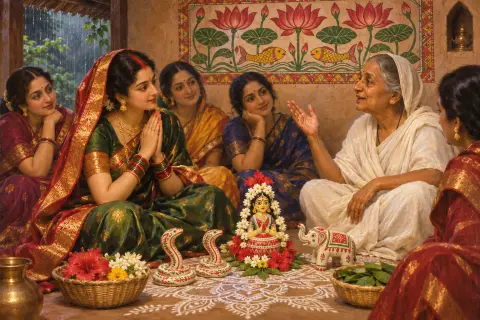
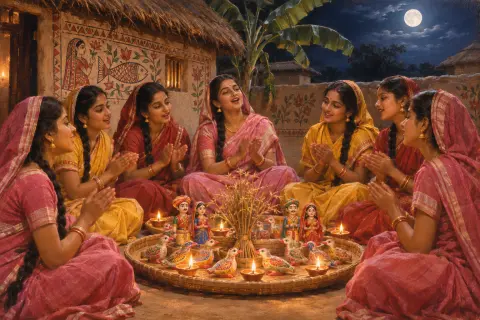
The fast day is the hardest: no food and no water from before dawn until the next morning. In the evening the women gather. In many courtyards they dig a small pond and set a branch of the pakar tree beside it. A figure of Jimutavahana made of kusha grass is worshipped with flowers, rice, incense and lamps, and small figures of the eagle and the jackal made of clay and cow dung are given a mark of sindoor. Then an elder reads the katha while the others listen.
On the third morning comes the paran, the breaking of the fast, often with rice, marua roti, noni saag and other vegetables, and in Mithila and parts of Bhojpur with fish. Many mothers wear a red or yellow jitiya thread around the neck, often with a small gold or silver pendant, as a sign of the vow for their children.
In Gita 5.25 Krishna speaks of the wise who are free of doubt and inner struggle and who delight in the welfare of all beings. Jimutavahana lived that verse: he gave himself for a stranger's son. Every Jitiya, mothers in Bihar keep a fast without water, not for themselves but for their children, and in remembering the prince they are reminded that real love reaches beyond one's own.