The Story
The story read at Varalakshmi puja comes from the vrata katha printed in household puja books, which tradition attributes to the Skanda Purana. No chapter of the Purana is usually cited for it, so it is best known as a living vrata tradition of the south. In it, Shiva tells Parvati of a vrata that brings every good thing to a family, and of Charumathi, a devoted wife to whom Lakshmi appeared in a dream and asked to be worshipped on this Friday. Charumathi kept the vrata with the women of her town, and all their homes were blessed. That is why women keep it on this day, and why they keep it together, inviting other married women to share in it.
Parvati asks for a vrata
In the vrata katha, Parvati asks Shiva to tell her of a vrata that a woman can keep for the good of her family, one that brings health, children, prosperity and a long married life. Shiva answers that there is such a vrata: the worship of Varalakshmi on the Friday before the full moon of Shravana.
To show what it can do, Shiva tells her the story of a woman called Charumathi. The details change a little from book to book and from family to family, but the heart of the story is the same everywhere.
Charumathi's dream
Charumathi lived in the town of Kundina. She was a devoted wife who looked after her husband and his parents with real care, rose early, kept the house clean and was kind to everyone. She did not ask for much for herself.
Lakshmi was pleased with her. One night the goddess appeared to Charumathi in a dream and told her to worship Varalakshmi on the Friday before the full moon of Shravana. If she did, the goddess said, she would be given whatever she wished for, and her family would want for nothing.
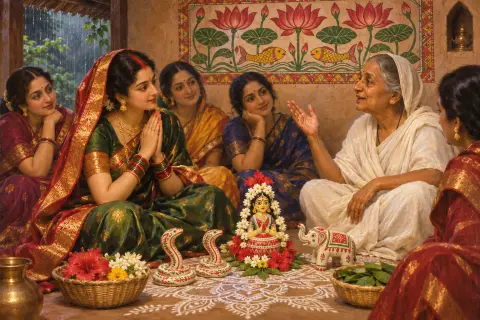
When Charumathi woke up, she did not keep the dream to herself. She told her family, and then the other women of the town, and invited them to keep the vrata with her.
The first Varalakshmi puja
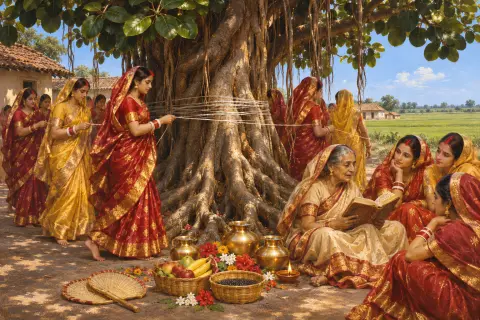
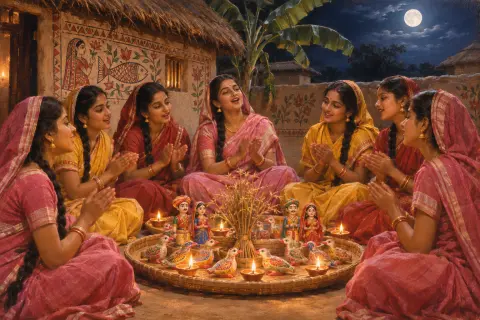
On the Friday, the women bathed early, set up a kalasha, and worshipped the goddess with flowers, turmeric, kumkum and sweets, as the dream had described. They tied a sacred thread on their right wrists and offered food to the goddess.
The vrata katha says that as they walked around the kalasha in worship, they found themselves wearing gold ornaments, round after round, and their homes filled with grain and wealth. Whether one reads that literally or as a picture of grace, the point is clear: Charumathi's blessing did not stay with her. Because she shared it, a whole town was blessed. That is why the vrata is still kept with other women, never quite alone.
Chitranemi and the curse
Some vrata books also tell a second story. Shiva and Parvati were playing dice, and a gana named Chitranemi was asked to judge. Parvati felt his ruling was unfair to her and, in her anger, cursed him with a skin disease. When Shiva asked her to soften the curse, she said Chitranemi would be healed when he saw women keeping the Varalakshmi vrata.
Years later Chitranemi came upon a group of celestial women worshipping Varalakshmi beside a lake. He joined them, kept the vrata as they did, and was healed. The story is told to show that the vrata is a blessing for anyone who keeps it with faith, and that even a curse can end in grace.
How the day is kept
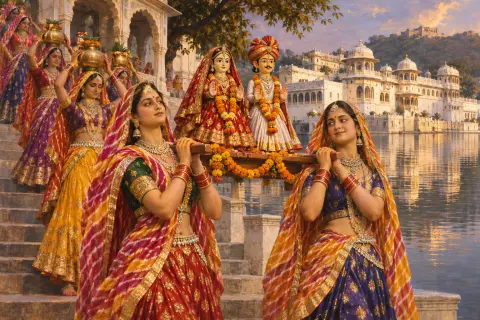
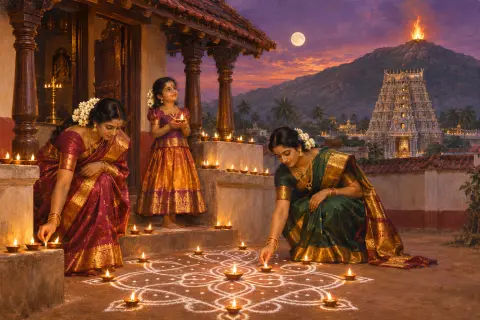
The day is Varalakshmi Vratam in Andhra Pradesh and Telangana, Varamahalakshmi Habba in Karnataka, and Varalakshmi Nombu in Tamil Nadu. Homes are cleaned, the doorway is drawn with rangoli, muggulu or kolam, and the women fast until the puja is over. The kalasha is filled with rice or water, coins, betel leaves and turmeric, topped with a coconut and mango leaves, and dressed with a sari, jewellery and a face of the goddess in silver or brass. In many Tamil homes the decorated kalasha is first set at the doorway and then brought inside with songs, as a guest is welcomed.
The puja is done in the morning or at an auspicious time of day. A yellow thread with knots and a flower in it, called the toram or nombu charadu, is worshipped and then tied on the right wrist. Families offer sweets and savouries such as payasam, kozhukattai and sundal, and read the story of Charumathi. In the evening, married women of the neighbourhood are invited for haldi kumkum and given thamboolam: betel leaves, turmeric, kumkum, bangles, fruit and a blouse piece. Many families keep the kalasha in place until the next day before taking it down.
In the Gita (10.41) Krishna says that whatever is glorious, prosperous or strong comes from a spark of his own splendour. The word he uses for prosperous is shrimat, from shri, the grace and prosperity that Lakshmi stands for. Charumathi is remembered not because she was rich but because she lived with that grace quietly, and then shared her blessing with every woman in town. Varalakshmi Vratam asks for prosperity, and it also shows where prosperity lives: in a cared-for home, a steady mind and an open door.